

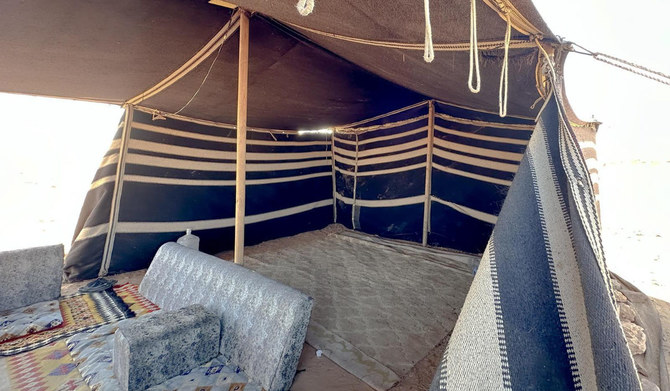
Bouyout Al-Shaar, a symbol of the desert that brings together families and friends in Saudi Arabia’s Jouf

1 / 2
The demand of Bedouin tents increases before winter more than any other period. (SPA)
2 / 2
The demand of Bedouin tents increases before winter more than any other period. (SPA)
Short Url
Updated 26 January 2024
Follow

Bouyout Al-Shaar, a symbol of the desert that brings together families and friends in Saudi Arabia’s Jouf

  • The material for Bouyout Al-Shaar and tents varies between camel hair, sheep’s wool, goat hair, fabrics and sadu. These components are used in Bouyout Al-Shaar to provide protection from cold, rain, sandstorms and the heat of the sun in the desert

RIYADH: The Bouyout Al-Shaar (or “house of hair” or Bedouin tent) is one of the symbols of the Badia desert during summer and winter. The tents emulate the deep-rootedness of a past during which our ancestors lived.

Nowadays, Bouyout Al-Shaar adorn the yards of many homes as a fragment of that heritage. Many households in Al-Jouf region are keen to have one as a way to spend time with family, friends and relatives, in addition to being a popular choice for many road-trip lovers and for holding social and family events.


The demand of Bedouin tents increases before winter more than any other period. (SPA)

Umm Najeh, who specializes in weaving and maintaining Bouyout Al-Shaar at the King Abdulaziz Women’s Association in Al-Jouf, said: “Demand has recently increased,” adding that “demand increases before winter more than any other period. The prices of tents vary according to the quality of the interior and exterior fabric as well as its furnishings, including mattresses, fire pits and other supplies.”

Long ago, the inhabitants of the desert in the Arabian Peninsula relied on Bouyout Al-Shaar, which is considered an authentic cultural feature in the Arab heritage. They were suitable for nomadic life as they are easy to carry and move.

The material for Bouyout Al-Shaar and tents varies between camel hair, sheep’s wool, goat hair, fabrics and sadu. These components are used in Bouyout Al-Shaar to provide protection from cold, rain, sandstorms and the heat of the sun in the desert.

Umm Najeh added: “The shapes of Bouyout Al-Shaar vary. Some are closed while others are open on one or more sides. They may be built in the shape of a tent or a square, with the roof raised with wood from tamarisk or ghada (white saxaul) trees. They are fixed to the ground with wooden or iron pegs.”

Bedouin women prepare Bouyout Al-Shaar from the raw materials available in their surroundings using a set of traditional tools, including the spindle, which is used to spin hair, and ropes used to tighten and secure Bouyout Al-Shaar.

The sizes and names of Bouyout Al-Shaar in the desert vary according to their size and the number of posts used to raise their roof. There are tents with one or two posts, while others take the shapes of triangles, squares, pentagons, hexagons, and so on, based on the number of posts inside it.

The interior of the Bouyout Al-Shaar is also divided into an open area for men and for welcoming guests, and another closed area designated for women.



Winter at Tantora Festival returns to AlUla, showcasing rich cultural heritage

The festival derives its name from the Tantora, an ancient sundial situated in the Old Town’s center. (SPA)
Updated 19 December 2025
Follow

Winter at Tantora Festival returns to AlUla, showcasing rich cultural heritage

  • Festival now established as a premier annual event

AlUla: The Winter at Tantora Festival launched on Thursday in AlUla. It runs until Jan. 10 and presents a cultural season which celebrates the region’s rich civilizational, cultural, and historic legacy.

The festival’s program includes a wide array of cultural, artistic, and traditional activities, reported the Saudi Press Agency. 

Attractions include Old Town Nights, Shorfat Tantora, When Shadow Tracks Us, and the Al-Manshiyah Carnival.

FASTFACT

In the past, AlUla’s inhabitants used this clock to measure time and coordinate their agricultural activities.

In addition, there are guided tours of street art through the Old Town, special events commemorating the Year of Handicrafts, culinary experiences, and artistic and musical performances.

The festival derives its name from the Tantora, an ancient sundial situated in the Old Town’s center. In the past, AlUla’s inhabitants used this clock to measure time and coordinate their agricultural activities. The modern festival honors this tradition by marking the onset of winter and the start of the planting season.

This year’s edition offers a range of experiences to celebrate heritage, genuine local culture, and traditional craftsmanship. 

As part of AlUla Moments, the Winter at Tantora Festival supports efforts to boost cultural and tourist engagement while enhancing the visitor experience.

The initiative reflects Saudi Vision 2030’s commitment to advancing cultural tourism and promoting the Kingdom’s historic landmarks.

The festival has established itself as one of AlUla’s premier annual events, consistently attracting both domestic and international audiences.