

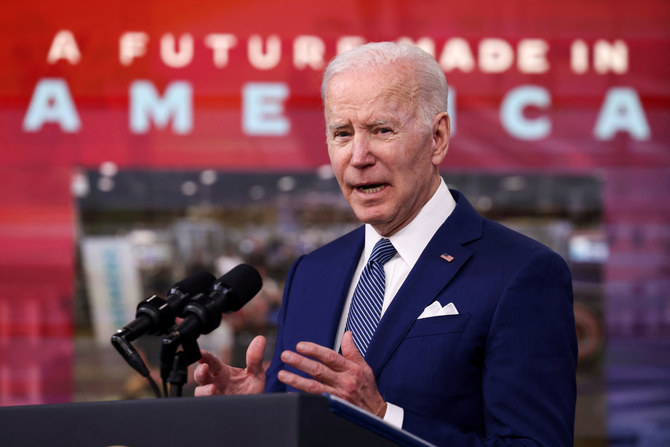
Biden wobbles under weight of multiple open fronts around the world

US President Joe Biden's likely Republican opponent, former president Donald Trump, has zeroed in on the global instability as an excuse to attack Biden as weak. (Reuters/File)
Short Url
Updated 25 January 2024
Follow

Biden wobbles under weight of multiple open fronts around the world

  • The US is not at war, but entanglement in multiple military fronts — plus the ongoing migrant strife along the US-Mexico border — is not an ideal environment for Biden as he ramps up his campaign for reelection in November

WASHINGTON: Long gone is the Joe Biden of February 2023, strolling confidently through the streets of Kyiv, basking in the role as champion of the Ukrainian cause in the fight against Vladimir Putin’s Russia.

Nearly one year after that triumphant appearance, the US president is instead facing the harsh realities of running for re-election while bogged down in one stagnant war and navigating the volatility of another, as the conflict in Gaza threatens at any moment to ignite the entire Middle East.
In fact, Israel’s war with Hamas has already boiled over into the Red Sea and Gulf of Aden as Yemen’s Tehran-backed Houthi rebels have attacked ships in the region and other pro-Iranian groups have targeted American troops in Iraq in Syria. Both have sparked retaliatory US strikes.
The United States is not at war, but entanglement in multiple military fronts — plus the ongoing migrant strife along the US-Mexico border — is not an ideal environment for Biden as he ramps up his campaign for reelection in November.
And even worse for the 81-year-old Democrat: his likely Republican opponent, former president Donald Trump, has zeroed in on this global instability as an excuse to attack Biden as weak.

For Democratic consultant Melissa DeRosa, “the feeling of instability caused by these conflicts, to say nothing of the border issues, will play a role in this election.”
“I do think it’s going to be a problem for Joe Biden,” she said, and “be something that Trump continues to play up” — especially the migration crisis, which she calls the president’s “Achilles’ heel” as record numbers of migrants have entered the United States in recent months.
Foreign policy has historically played only small roles in US presidential campaigns, and, barring major developments, those fundamentals are unlikely to change in 2024.
But Trump, well on his way to sewing up the Republican nomination, is spinning this anxiety around global uncertainty to his advantage — a message that lands well among his supporters.
“Foreign entities respect (Trump) more and fear him more than the present occupant of the White House,” New Hampshire Trump voter and 72-year-old architect Tony Ferrantello told AFP ahead of the state’s primary Tuesday.
Biden’s approval rating on foreign policy is underwater: 58 percent say they disapprove of his handling of international affairs, compared to 36 percent who approve, according to December-January poll average from the site RealClearPolitics.
It is an uncomfortable position for Biden, who presents himself as a foreign policy old hat, with eight years of dealing with world leaders as Barack Obama’s vice president and multiple terms as chair of the Senate Foreign Relations Committee.
Furthermore, Biden prides himself on having reinvigorated international alliances, including with NATO and in Asia, after having spent much of his 2020 campaign promising to bring America “back” to the world stage after the chaotic, isolationist Trump years.

But difficulties with the war in Ukraine loom large, as Biden has tried to position himself as leader of a vast multinational coalition supporting Kyiv after Russia’s 2022 invasion, all while avoiding direct confrontation between Washington and Moscow.
Now, two years on, he is dealing with fatigue from lawmakers and voters unsure about continuing to foot the bill for Ukraine’s defense without tangible returns on their investment.
In Congress, Republican opponents link these two issues together, offering their support for Ukraine aid in exchange for tougher immigration policies at the southern border.
Complicating matters further is Biden’s unwavering support for Israel’s war against Hamas, which has exposed him to intense criticism from his own supporters and others on the left.
Pro-Palestinian protesters interrupted Biden several times Tuesday during a speech on abortion rights, an issue the president is making central to his reelection campaign.
That tension could come back to bite him in November in key election swing states like Michigan, where there is a large Arab and Muslim population, and among young voters — both groups that are more likely to take issue with Biden’s handling of the war.
And that is all without even mentioning the potential of yet another front: in North Korea, as tensions between the North and staunch US ally South Korea have steadily worsened.
“North Korea exhibits a tendency to ramp up provocations during US election years,” warned Victor Cha and Andy Lim at the Center for Strategic and International Studies in Washington.


Immigration raids in Minnesota fuel grassroots Somali activism

Updated 5 sec ago
Follow

Immigration raids in Minnesota fuel grassroots Somali activism

  • “You would never fathom that people would just pluck you off the streets ... and say, ‘Prove to me that you’re a citizen,’” Mohamed said
  • Trump, who ‌has described Somalis as “garbage” who should be thrown out of the country, has said the operations are necessary to combat crime

MINNEAPOLIS: When immigration agents began aggressive operations in Minneapolis last month, Kowsar Mohamed started knocking on doors, fielding late-night calls and mobilizing other Somali Americans into an ad-hoc response team.
Many feared they were being singled out, a worry that revived memories of the state surveillance and arbitrary authority they thought they had left behind when they resettled in the United States.
More than 100 volunteers now patrol south Minneapolis, distribute “Know Your Rights” guides and escort frightened elders — part of a sweeping grassroots effort to counter what many describe as constitutionally suspect raids that are destabilizing Minnesota’s roughly 80,000-strong Somali community, one of the country’s largest refugee populations.
“You would never fathom that people would just pluck you off the streets ... and say, ‘Prove to me that you’re a citizen,’” Mohamed said, referring to reports of aggressive tactics by the agents. “It’s not that we never thought it was impossible. We just believed the Constitution was going to protect us from this level of interrogation.”

TRUMP’S 3,000-AGENT PUSH SPARKS VOTER-INTIMIDATION FEARS
The deployment of 3,000 federal agents — ordered by Republican President Donald Trump — has intensified accusations from Democrats and local leaders that he is targeting ‌a politically influential community ‌ahead of the 2026 midterm elections, deepening fears that the operations amount to intimidation aimed at suppressing ‌Somali ⁠voter turnout.
Trump, who ‌has described Somalis as “garbage” who should be thrown out of the country, has said the operations are necessary to combat crime, though many of those arrested have no criminal charges or convictions. He has also cited a fraud scandal around the theft of federal funds for social-welfare programs in Minnesota to justify sending agents into the state, many of them from US Immigration and Customs Enforcement.
Democrats and community leaders accuse the agents of harassing peaceful protesters, racial profiling and searching houses without warrants. Minneapolis has been on edge since the fatal shooting of 37-year-old Renee Good by an immigration agent on January 7.
“A lot of community members escaped war and this administration is triggering another war zone,” said Abdulahi Farah, co-chair of the Somali American Leadership Table, an advocacy group formed in response ⁠to hate crimes and political attacks on Somalis. He said Trump’s history of racist rhetoric against Black and other immigrants of color has emboldened far-right activists and had a destabilizing effect on ‌small businesses and citizens’ general sense of safety.
Department of Homeland Security spokesperson Tricia McLaughlin said in ‍a statement to Reuters that immigrants who are served administrative warrants or ‍I-205 removal orders “have had full due process and a final order of removal from an immigration judge.”

PUSHING BACK AGAINST IMMIGRATION RAIDS
In Cedar-Riverside, a ‍normally bustling Somali neighborhood lined with restaurants, boutique shops and convenience stores, business owners say activity is noticeably quieter since immigration agents arrived there last month.
“It’s been really slow,” said Rashid Jama, a grocery store manager in the neighborhood, also known as the West Bank. “A lot of our suppliers are Latino and they’re scared to come to work.”
The efforts of Mohamed, a third-year doctoral student at the University of Minnesota, are part of a broader wave of grassroots initiatives to push back by filming arrests, planning peaceful protests and accelerating voter outreach.
Some Somali Americans fear the raids are a bid to suppress voter turnout before midterm elections in November, according to over a dozen grassroots organizers, local officials and residents interviewed by ⁠Reuters.
“It’s signaling that if we get rid of them, if we scare them, they’re not going to come out to vote in the 2026 midterm election. We know that’s the target,” said Farah, whose group is partnering with other grassroots organizations to train people on priorities like opposing ICE raids as well as broader issues like affordability.
Mosques and neighboring community centers are now turning into political education hubs in Minnesota, local leaders said.
Civil rights advocates and scholars say the Minneapolis immigration operations echo past crackdowns in Black and Latino neighborhoods, fueling fears of political scapegoating, said political science professor Christina Greer at Fordham University.
Somali American voters have largely supported Democrats since refugees began resettling in the US in the 1990s, before becoming more politically active in the 2000s. US Representative Ilhan Omar is the community’s most high-profile member and a frequent target of racist attacks from Trump.
Asked about that and tactics of agents decried by residents, White House spokeswoman Abigail Jackson said in a statement to Reuters that immigrants “who fail to contribute to our economy, rip off Americans and refuse to assimilate into our society should not be here.”
Minnesota Republican Party Chairman Alex Plechash denied the raids were politically driven, calling the charge “categorically false” but said complaints about aggressive tactics ‌warrant review.
Some Somali community leaders say mobilizing voters will be a priority in the months ahead.
“The power we have is to vote,” said Abdullahi Kahiye, 37, who said he became a naturalized US citizen in 2024. “ICE and whoever is trying to terrorize the Somali community will not succeed.”