

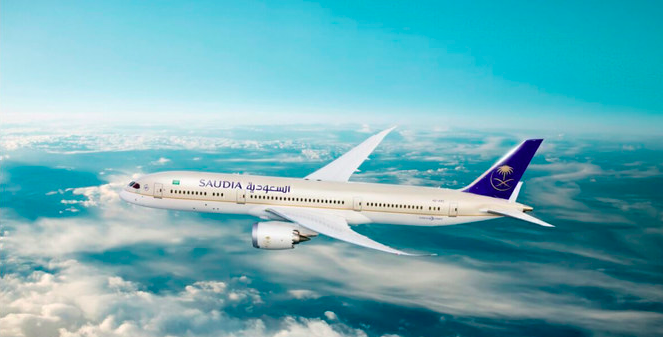
Saudia registers over 30m passengers in 2023, marking 21% growth

Saudia operated more than 176,300 flights in 2023. File
Short Url
Updated 23 January 2024
Follow

Saudia registers over 30m passengers in 2023, marking 21% growth

RIYADH: Saudi Arabia’s national flag carrier, Saudia, saw a 21 percent growth annual growth in passenger numbers in 2023 as it registered over 30 million travelers. 

The airline operated more than 176,300 flights, reflecting a 4 percent increase, with transit routes experiencing 77 percent growth compared to 2019, as detailed in a press release. 

The accomplishments were attributed to Saudia’s strategic enhancements to its operational model, emphasizing increased seat capacity and flight frequency as well as a focus on operational efficiency.

Captain Ibrahim Koshy, CEO of Saudia Group, stated: “Saudia’s growing performance metrics reflect the optimal execution of our year-round operational plan, particularly during peak seasons. These figures are a testament to our success in serving key sectors, including tourism, business, and pilgrimage.”

He added: “Looking ahead, we anticipate a substantial expansion of our fleet, propelling our performance and marking a new chapter for Saudia since its inception 80 years ago.”

In 2023, the airline achieved an on-time performance rate of 86.44 percent, securing a position among the top 10 globally.

Saudia transported over 16.7 million passengers through its international network in 2023, marking a 36 percent increase. 

The airline operated more than 79,400 international flights, showing a 19 percent rise from the previous year. 

Saudia also recorded a 26 percent increase in air travel hours, totaling 382,000 in 2023.

Domestically, the airline transported over 13.5 million passengers, a 7 percent increase from the previous year, with these journeys accounting for 55 percent of the total flights, totaling 96,900 and 163,000 hours.

In 2023, Saudia inaugurated operations at the Red Sea International Airport and launched several global stations, including in China, the UK, and South Africa, emphasizing its global reach across various continents.

Currently, Saudia operates flights to over 100 destinations across four continents, with a fleet of 142 aircraft. 

With strategic investments in King Abdulaziz International Airport in Jeddah, Saudia aims to establish a central hub for transit flights bridging the East and West. 

This aligns with the airline’s commitment to enhancing the travel experience by adopting the latest digital systems, artificial intelligence technologies, and an upgraded system infrastructure to elevate operational efficiency and punctuality.


What changed in Saudi stocks on 1st day of foreign entry 

Updated 59 min 33 sec ago
Follow

What changed in Saudi stocks on 1st day of foreign entry 

RIYADH: Saudi Arabia’s stock market saw foreign non-strategic investors reduce their ownership in nearly half of the companies listed on the main Tadawul All Share Index, or TASI, on the first day of implementing the decision to open the market to all categories of foreign investors, according to Tadawul data reflecting ownership positions as of Feb. 1  

According to the Financial Analysis Unit at Al-Eqtisadiah, foreign ownership declined in 120 companies, increased in 97 others, and remained unchanged in the rest, with no variation in the number of shares held by foreign investors. 

Foreign investors favor growth stocks 

Looking at the changes purely through valuation multiples — without factoring in operational or sectoral considerations — foreign investors appear to be reallocating ownership toward growth stocks at the expense of value stocks, with higher multiples used as an approximate indicator of growth. 

Ownership declines were concentrated in companies with lower valuation multiples, where the median price-to-earnings ratio stood at about 17.1 times and the median price-to-book ratio was around 2 times. 

Conversely, ownership rose in companies with higher multiples, with a median price-to-earnings ratio of 23.3 times and a median price-to-book ratio of 2.6 times. 

Mid- and small-cap firms see biggest changes 

Raoom, Entaj, and Obeikan Glass saw the largest declines in foreign ownership, dropping between 10 percent and 16 percent. In contrast, Tamkeen, SACO, and Abo Moati led gains, with foreign stakes rising 10 to 20 percent. 

In terms of overall foreign ownership, Al-Babtain, Rasan, and Etihad Etisalat topped the list at roughly 34 percent, 29 percent, and 24 percent, respectively.

Gradual foreign inflow and delayed impact 

The initial changes remain insufficient to reflect a major impact of the full foreign access decision, especially as the first day coincided with the weekend. Additionally, entry is expected to be gradual until financial institutions are fully ready to open accounts, particularly for individuals. 

Mohammed Al-Shammasi, CEO of Derayah Financial, has told Asharq that the firm received around 500 individual investor applications on the first day of full foreign access. 

Meanwhile, foreign institutions managing under $500 million can now invest directly in the market with easier access, joining more than 4,000 qualified foreign investors who already hold assets worth SR377 billion ($100.5 billion)