Pakistan’s economy fared best in past three decades under Nawaz Sharif — Bloomberg Economics report

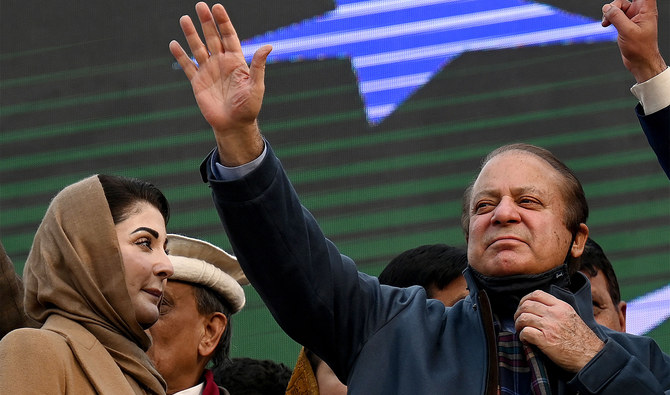
Pakistan's former Prime Minister and leader of Pakistan Muslim League Nawaz (PMLN) party Nawaz Sharif (R) with his daughter Maryam Nawaz (L) waves to supporters during an election campaign rally at Mansehra in Khyber Pakhtunkhwa province on January 22, 2024. (AFP)
Short Url
Updated 23 January 2024
Follow

Pakistan’s economy fared best in past three decades under Nawaz Sharif — Bloomberg Economics report

  • Bloomberg calculates misery index, an informal measure of state of economy generated by adding rates of inflation and unemployment
  • Results showed Sharif’s Pakistan Muslim League at 14.5%, Khan’s Pakistan Tehreek-e-Insaf at 16.1%, Pakistan Peoples Party at 17.2%

ISLAMABAD: Pakistan’s government under three-time former Prime Minister Nawaz Sharif’s party had the best performance in managing the South Asian nation’s economy over the past three decades compared with rivals, an analysis by Bloomberg Economics published this week said.

Using a misery index for Pakistan — an informal measure of the state of an economy generated by adding together its rates of inflation and unemployment — Bloomberg Economics found that Sharif’s Pakistan Muslim League (PML-N) scored better than Imran Khan’s Pakistan Tehreek-e-Insaf (PTI) and the Pakistan Peoples Party (PPP) of former foreign minister Bilawal Bhutto Zardari.

The past three decades saw the PML-N rule Pakistan four times under Sharif and his younger brother Shehbaz Sharif. The PPP under the Bhutto dynasty has held power three times, while Khan was in office for a four-year term ending in April 2022 when he was ousted from power in a parliamentary no-trust vote.

“Bloomberg Economics used an average of the index values over the respective years when each of the major political parties ruled the country since 1990. A higher value indicates more economic hardship for citizens,” the publication said, explaining its conclusions.

Bloomberg Economics Misery Index Results for Pakistan showed the Pakistan Muslim League scored 14.5 percent, Pakistan Tehreek-e-Insaf 16.1 percent and the Pakistan Peoples Party 17.2 percent.

Despite a higher misery index, Khan is still the most popular politician, with an approval rating of 57 percent, according to a recent Gallup opinion poll. Sharif’s ratings have jumped to 52 percent from 36 percent in the past six months.

“The public may be giving Sharif the benefit of the doubt,” Ankur Shukla of Bloomberg Economics wrote in the report, adding that “road ahead won’t be easy for any party that wins the election,” given inflation remains near record highs and unemployment is also elevated.

Inflation is close to 30 percent in Pakistan, the currency was Asia’s worst performer last year and foreign exchange reserves have slumped.

 The country is currently relying on a financial bailout from the International Monetary Fund, and under the fund’s conditions, the new government will need to implement policies that may be unpopular with voters, such as withdrawing subsidies and raising taxes. 

The IMF expects Pakistan’s economy to grow 2 percent in the current fiscal year after contracting in the previous year.


Pakistan’s OGDC ramps up unconventional gas plans

Updated 4 sec ago
Follow

Pakistan’s OGDC ramps up unconventional gas plans

  • Pakistan has long been viewed as having potential in tight and shale gas but commercial output has yet to be proved
  • OGDC says has tripled tight-gas study area to 4,500 square km after new seismic, reservoir analysis indicates potential

ISLAMABAD: Pakistan’s state-run Oil & Gas Development Company is planning a major expansion of unconventional gas developments from early next year, aiming to boost production and reduce reliance on imported liquefied natural gas.

Pakistan has long been viewed as having potential in both tight and shale gas, which are trapped in rock and can only be released with specialized drilling, but commercial output has yet to be proved.

Managing Director Ahmed Lak told Reuters that OGDC had tripled its tight-gas study area to 4,500 square kilometers (1,737 square miles) after new seismic and reservoir analysis indicated larger potential. Phase two of a technical evaluation will finish by end-January, followed by full development plans.

The renewed push comes after US President Donald Trump said Pakistan held “massive” oil reserves in July, a statement analysts said lacked credible geological evidence, but which prompted Islamabad to underscore that it is pursuing its own efforts to unlock unconventional resources.

“We started with 85 wells, but the footprint has expanded massively,” Lak said, adding that OGDC’s next five-year plan would look “drastically different.”

Early results point to a “significant” resource across parts of Sindh and Balochistan, where multiple reservoirs show tight-gas characteristics, he said.

SHALE PILOT RAMPS UP

OGDC is also fast-tracking its shale program, shifting from a single test well to a five- to six-well plan in 2026–27, with expected flows of 3–4 million standard cubic feet per day (mmcfd) per well.

If successful, the development could scale to hundreds or even more than 1,000 wells, Lak said.

He said shale alone could eventually add 600 mmcfd to 1 billion standard cubic feet per day of incremental supply, though partners would be needed if the pilot proves viable.

The company is open to partners “on a reciprocal basis,” potentially exchanging acreage abroad for participation in Pakistan, he said.

A 2015 US Energy Information Administration study estimated Pakistan had 9.1 billion barrels of technically recoverable shale oil, the largest such resource outside China and the United States.

A 2022 assessment found parts of the Indus Basin geologically comparable to North American shale plays, though analysts say commercial viability still hinges on better geomechanical data, expanded fracking capacity and water availability.

OGDC plans to begin drilling a deep-water offshore well in the Indus Basin, known as the Deepal prospect, in the fourth quarter of 2026, Lak said. In October, Turkiye’s TPAO with PPL and its consortium partners, including OGDC, were awarded a block for offshore exploration.

A combination of weak gas demand, rising solar uptake and a rigid LNG import schedule has created a surplus of gas that forced OGDC to curb output and pushed Pakistan to divert cargoes from Italy’s ENI and seek revised terms with Qatar.