

Former US soldier charged in Capitol riot was convicted of manslaughter for killing Iraqi man in 2004

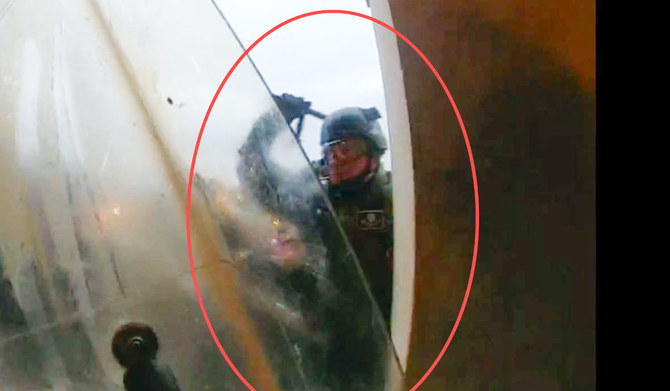
This image from police body-worn camera video, contained and annotated in the Justice Department's statement of facts, supporting the arrest warrant for Edward Richmond Jr., at the U.S. Capitol on Jan. 6, 2021, in Washington. (AP)
Short Url
Updated 23 January 2024
Follow

Former US soldier charged in Capitol riot was convicted of manslaughter for killing Iraqi man in 2004

  • Richmond was 20 when an Army court-martial panel convicted him of voluntary manslaughter and sentenced him to three years in prison for killing the handcuffed Iraqi civilian near Taal Al Jai in February 2004

WASHINGTON: A former US Army soldier who was convicted of manslaughter for fatally shooting a handcuffed civilian in Iraq was arrested Monday on charges that he attacked police officers with a baton during the US Capitol riot three years ago.
Edward Richmond Jr., 40, of Geismar, Louisiana, was wearing a helmet, shoulder pads, goggles and a Louisiana state flag patch on his chest when he assaulted police in a tunnel outside the Capitol on Jan. 6, 2021, according to an FBI agent’s affidavit.
Richmond was arrested in Baton Rouge, Louisiana, and is scheduled to make his initial court appearance Tuesday on charges including civil disorder and assaulting, resisting or impeding police with a dangerous weapon.
Richmond’s Louisiana-based attorney, John McLindon, said he hadn’t seen the charging documents and therefore couldn’t immediately comment on the case.
Richmond was 20 when an Army court-martial panel convicted him of voluntary manslaughter and sentenced him to three years in prison for killing the handcuffed Iraqi civilian near Taal Al Jai in February 2004. Richmond also received a dishonorable discharge from the Army.
Richmond initially was charged with unpremeditated murder, which carries a maximum sentence of life in prison. But the panel of five officers and five enlisted soldiers reduced the charge to voluntary manslaughter.
The Army said Richmond shot Muhamad Husain Kadir, a cow herder, in the back of the head from about six feet away after the man stumbled. Richmond testified that he didn’t know Kadir was handcuffed and believed the Iraqi man was going to harm a fellow soldier.
During the Jan. 6 riot, body camera footage captured Richmond repeatedly assaulting police officers with a black baton in a tunnel on the Capitol’s Lower West Terrace, the FBI said. Police struggled for hours to stop the mob of Donald Trump supporters from entering the Capitol through the same tunnel entrance.
A witness helped the FBI identify Richmond as somebody who had traveled to Washington, D.C., with several other people to serve as a “security team” for the witness for rallies planned for Jan. 6, according to the agent’s affidavit.
More than 1,200 people have been charged with Capitol riot-related crimes. About 900 have pleaded guilty or been convicted after trials. Over 750 have been sentenced, with nearly 500 receiving a term of imprisonment, according to data compiled by The Associated Press.


US allows oil majors to broadly operate in Venezuela, new energy investments

Updated 3 sec ago
Follow

US allows oil majors to broadly operate in Venezuela, new energy investments

  • Treasury Department issues general license allowing Chevron, BP, Eni, Shell and Repsol to operate oil and gas operations in Venezuela
  • Move is the most significant relaxation of sanctions on Venezuela since US forces captured and removed President Nicolas Maduro
WASHINGTON: The US ​eased sanctions on Venezuela’s energy sector on Friday, issuing two general licenses that allow global energy companies to operate oil and gas projects in the OPEC member and for other companies to negotiate contracts to bring in fresh investments. The move was the most significant relaxation of sanctions on Venezuela since US forces captured and removed President Nicolas Maduro last month.
The Treasury Department’s Office of Foreign Assets Control issued a general license allowing Chevron, BP, Eni, Shell and Repsol to operate oil and gas operations in Venezuela. Those companies still have offices in the country and stakes in projects, and are among the main partners of state-run ‌company PDVSA.
The authorization ‌for the oil majors’ operations requires payments for royalties and Venezuelan ​taxes ‌to ⁠go through ​the US-controlled ⁠Foreign Government Deposit Fund.
The other license allows companies around the world to enter contracts with PDVSA for new investments in Venezuelan oil and gas. The contracts are contingent on separate permits from OFAC.
The authorization does not allow transactions with companies in Russia, Iran, or China or entities owned or controlled by joint ventures with people in those countries.
The licenses “invite American and other aligned companies to play a constructive role in supporting economic recovery and responsible investment, ” the US State Department said in a release. Additional authorizations may be issued “as necessary,” it said.
A spokesperson for Chevron, ⁠the only US oil firm currently operating in Venezuela, said the company welcomed ‌the new licenses.
“The new General Licenses, coupled with recent changes ‌in Venezuela’s Hydrocarbons Law, are important steps toward enabling the further development ​of Venezuela’s resources for its people and for advancing ‌regional energy security,” the spokesperson said in a statement.
Eni said it is assessing the opportunities in ‌Venezuela that the authorization opens up.

Oil law reform

The US licenses follow a sweeping reform of Venezuela’s main oil law approved last month, which grants autonomy for foreign oil and gas producers to operate, export and cash sale proceeds under existing joint ventures with PDVSA or through a new production-sharing contract model.
The US has had sanctions on Venezuela since ‌2019 when President Donald Trump imposed them during his first administration. Trump is now seeking $100 billion in investments by energy companies in Venezuela’s oil and gas sector. ⁠US Energy Secretary Chris Wright ⁠said on Thursday, during his second day of a trip to Venezuela, that oil sales from the country since Maduro’s capture have hit $1 billion and would hit another $5 billion in months.
Wright said the US will control the proceeds from the sales until Venezuela stands up a “representative government.” Since last month, the Treasury issued several other general licenses to facilitate oil exports, storage, imports and sales from Venezuela. It also authorized the provision of US goods, technology, software or services for the exploration, development or production of oil and gas in Venezuela.
The Venezuelan government expropriated assets of Exxon Mobil and ConocoPhillips in 2007 under then-President Hugo Chavez. The Trump administration is trying to get those companies to invest in Venezuela as well. At a meeting at the White House with Trump last month, Exxon Mobil CEO Darren Woods said Venezuela was “uninvestable” at ​the moment.
Wright said on Thursday that Exxon, ​which no longer has an office in Venezuela, is in talks with the government there and gathering data about the oil sector. Exxon did not immediately comment.