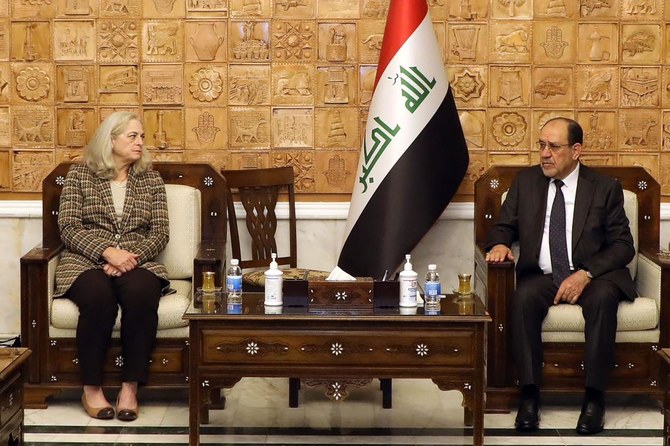
BAGHDAD: The US ambassador to Iraq met Sunday with former prime minister Nuri Al-Maliki, the Iraqi politician’s office said, a day after pro-Iran militants struck US forces in the country.
The meeting in Baghdad with Ambassador Alina Romanowski comes amid soaring regional tensions, the fallout from more than three months of war between US ally Israel and Hamas, supported by Tehran.
Ballistic missiles were launched Saturday at a base hosting US forces in western Iraq, in an attack claimed by “Islamic Resistance in Iraq,” a loose alliance of Iran-linked militants that oppose US support for Israel in the Gaza conflict.
Since mid-October, shortly after the Israel-Hamas war erupted, there have been dozens of attacks on US and coalition forces in Iraq and Syria, deployed there to fight Daesh extremists.
Maliki, an influential figure in Iraqi politics and one of the top leaders of a pro-Iranian bloc, discussed with Romanowski “the future of bilateral relations” with the United States and “the escalation in regional tensions,” a statement from his office said.
He stressed “the importance of strengthening the ties of friendship and cooperation” between Baghdad and Washington, the statement added.
Maliki also warned against “the expansion of the war” with “multiple crises the region faces” in the Palestinian territories, Lebanon, the Red Sea, Syria and Iraq.
He called for “swift action to reduce tensions and put an end to mutual attacks.”
Romanowski has not commented on the meeting. She regularly meets Iraqi officials and leaders across the political spectrum.
Maliki’s faction is part of the Coordination Framework, Iraq’s main pro-Iran coalition which has a majority in parliament.
The current Iraqi prime minister, Mohamed Shia Al-Sudani, was nominated by the Coordination Framework and relies on the support of Iran-aligned parties.
The Coordination Framework unites veteran politicians and former paramilitaries.
It includes opponents of Saddam Hussein’s regime who have taken the helm since the 2003 US-led invasion that toppled the former dictator, alongside the Hashed Al-Shaabi — a collection of mainly pro-Iranian former paramilitary units now integrated into the Iraqi armed forces.
One of the Hashed’s factions, Kataeb Hezbollah, expressed on Sunday their support for “Islamic Resistance in Iraq.”
A spokesman for the group, Abu Ali Al-Askari, said “the brothers of the resistance keep striking enemy strongholds,” calling in a statement to “continue the escalation of operations.”
The United States has about 2,500 soldiers in Iraq and nearly 900 in Syria.
Sudani has repeatedly said in recent weeks he would like to see foreign troops leave Iraq.


![]()

Ex-Iraq premier meets US envoy after missile strike
Short Url
https://arab.news/pygzc
Ex-Iraq premier meets US envoy after missile strike
- Maliki warned against “the expansion of the war” with “multiple crises the region faces” in the Palestinian territories, Lebanon, the Red Sea, Syria and Iraq


Latest updates


© 2026 SAUDI RESEARCH & PUBLISHING COMPANY, All Rights Reserved And subject to Terms of Use Agreement.