

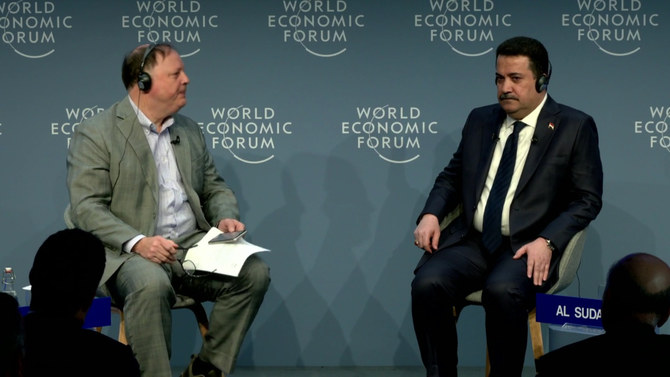


DAVOS: US forces and their international allies must leave Iraq, especially considering the heightened tensions in the Middle East, the country's Prime Minister Mohamed Shia Al-Sudani said on Thursday.
A US-led international anti-Daesh coalition has been operating in the country since 2014.
The end of the international coalition mission was a "necessity for the security and stability of Iraq,” he said during a panel at the World Economic Forum in Davos.
“It is also a necessity for preserving constructive bilateral relations between Iraq and the coalition countries,” he added.
Al-Sudani, whose administration is backed by Iran-aligned parties, has repeatedly called for the withdrawal of foreign troops from Iraq.
The US has about 2,500 soldiers in Iraq and nearly 900 in Syria supporting the anti-Daesh coalition, which since 2021 has said it has stopped all combat operations, which train and advise the local military.
He was speaking in Davos as US forces continued its strikes on pro-Iran groups in response to attacks since mid-October on forces from the US and its allies deployed in Iraq, with at least 130 attacks, including 53 in Iraq and 77 in Syria, recorded between October last year and Jan. 11, according to the Pentagon.
Most of the drone or rocket attacks targeting US or allied forces have been claimed by the Islamic Resistance in Iraq, a loose alliance of Iran-linked armed groups that oppose US support for Israel in the Gaza war.
A US drone strike in early January killed a military commander and another member of Harakat Al-Nujaba, a faction of Hashed Al-Shaabi, a collection of pro-Iran former paramilitary units now integrated into the Iraqi armed forces.
During his Davos panel, Al-Sudani said an immediate dialogue was needed to “reach an understanding and a timetable regarding the end of the mission of international advisers.”
Al-Sudani said the coalition was no longer needed.
“Today, according to the analysis of all specialists in Iraq and among our friends, Daesh does not represent a threat to the Iraqi state,” he said.
“The sooner we withdraw the coalition, it is a necessity for the stability, the security of Iraq,” he added.
Speaking about the crisis in Gaza, Al-Sudani refuted claims by US Secretary of State Antony Blinken’s about how the Israel-Hamas war offered a chance to get back on track for a two-state solution to the Israeli-Palestinian conflict.
Blinken, who attended the forum on Tuesday and Wednesday, said that doing so should involve broader efforts at improving Israel’s ties with Arab countries through normalization efforts, in a similar vein to the 2020 Abraham Accords.
“That is nothing new, what Blinken has said. Everybody has said the same thing,” he said. “What is being said by Blinken is refused by the Israeli government. Even the post-war scenario is refused from the Israelis.”
He continued: “The international community has failed,” the Iraqi leader added. “The International organizations have failed. The international institutions have failed in this unjustifiable, unacceptable death that is unraveling before us in Gaza.”
Iraq has set its sights on a three-year budget to move away from a dependence on oil revenue from 95% to 80%, Al-Sudani said.


