

Egypt, Spain foreign ministers discuss Gaza crisis in Brussels talks

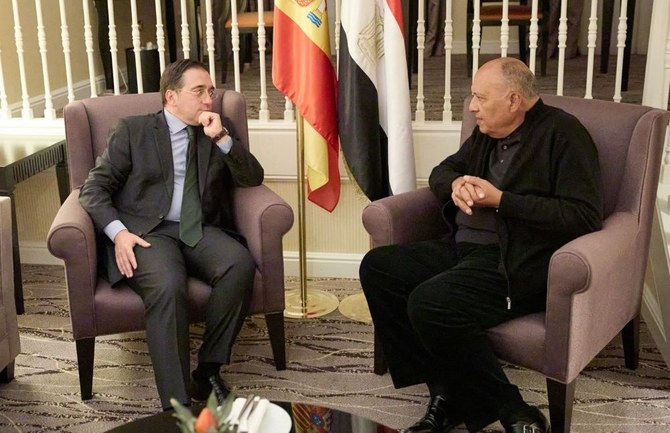
Jose Manuel Albares and Sameh Shoukry. (X / @MfaEgypt)
Short Url
Updated 22 January 2024
Follow

Egypt, Spain foreign ministers discuss Gaza crisis in Brussels talks

  • Shoukry leading his country’s delegation at the 10th EU-Egypt Association Council meeting in Brussels
  • Shoukry highlighted Spain’s historic role in supporting the Palestinian cause within the corridors of the EU

CAIRO: Egyptian Foreign Minister Sameh Shoukry discussed deteriorating humanitarian conditions in the Gaza Strip with his Spanish counterpart Jose Manuel Albares.

This came during Shoukry’s visit to Brussels, leading his country’s delegation at the 10th EU-Egypt Association Council meeting.

The two parties discussed in detail the deteriorating humanitarian conditions in the Gaza Strip, the importance of an immediate ceasefire, and the moves to fully implement the UN Security Council Resolution 2720 regarding facilitating, coordinating, and monitoring the process of bringing humanitarian aid into the enclave.

Shoukry highlighted Spain’s historic role in supporting the Palestinian cause within the corridors of the EU, noting the responsibility of the bloc and internationally active countries to intervene to put an end to Israeli human rights violations against Palestinian civilians in Gaza and the West Bank.

Shoukry stressed that an immediate ceasefire in the Gaza Strip would only be achieved through international pressure on Israel.

Albares praised the Egyptian efforts to find a solution to the crisis in Gaza, bring in humanitarian aid, and work to prevent the expansion of the conflict.

Shoukry and Albares also discussed ways to enhance cooperation between Egypt and Spain at the bilateral level and within the partnership framework between Egypt and the EU.

Egyptian Foreign Ministry spokesperson Ahmed Abu Zeid said that the two ministers expressed their enthusiasm to confirm their mutual desire to enhance various forms of cooperation and strengthen the friendly relations between the two countries.

They agreed on approaches to tackle existing regional and international challenges, showing consensus.

The two ministers agreed to continue consultation to coordinate moves to stop the war in Gaza, limit humanitarian repercussions for the Palestinian people, and revive the peace process on serious foundations that guarantee the establishment of an independent Palestinian state.

During his visit to Brussels, Shoukry held bilateral meetings with foreign ministers of EU countries and European commissioners concerned with policies such as the economy, energy, migration, climate, humanitarian affairs, and crisis management.

Shoukry held a bilateral meeting with Mariya Gabriel, deputy prime minister and minister of foreign affairs of Bulgaria, on the sidelines of the EU-Egypt Association Council meeting.

The two ministers discussed enhancing economic cooperation opportunities and increasing trade exchange between the two countries, especially in the sectors of industry, energy, and agriculture, as well as working to attract investments and benefit from joint manufacturing opportunities between the two countries in various fields.


Syrian government and SDF agree to de-escalate after Aleppo violence

Updated 23 December 2025
Follow

Syrian government and SDF agree to de-escalate after Aleppo violence

  • Turkiye views the US-backed SDF, which controls swathes of northeastern Syria, as a ⁠terrorist organization and has warned of military action if the group does not honor the agreement

DAMASCUS: Syrian government forces and the Kurdish-led Syrian Democratic Forces agreed to de-escalate on Monday evening in the northern city of Aleppo, after a wave of attacks that both sides blamed on each other left at least two civilians dead and several wounded.
Syria’s state news agency SANA, citing the defense ministry, said the army’s general command issued an order to stop targeting the SDF’s fire sources. The SDF said in a statement later that it had issued instructions to stop responding ‌to attacks ‌by Syrian government forces following de-escalation contacts.

HIGHLIGHTS

• SDF and Syrian government forces blame each other for Aleppo violence

• Turkiye threatens military action if SDF fails integration deadline

• Aleppo schools and offices closed on Tuesday following the violence

The Syrian health ministry ‌said ⁠two ​people ‌were killed and several were wounded in shelling by the SDF on residential neighborhoods in the city. The injuries included two children and two civil defense workers. The violence erupted hours after Turkish Foreign Minister Hakan Fidan said during a visit to Damascus that the SDF appeared to have no intention of honoring a commitment to integrate into the state’s armed forces by an agreed year-end deadline.
Turkiye views the US-backed SDF, which controls swathes of northeastern Syria, as a ⁠terrorist organization and has warned of military action if the group does not honor the agreement.
Integrating the SDF would ‌mend Syria’s deepest remaining fracture, but failing to do ‍so risks an armed clash that ‍could derail the country’s emergence from 14 years of war and potentially draw in Turkiye, ‍which has threatened an incursion against Kurdish fighters it views as terrorists.
Both sides have accused the other of stalling and acting in bad faith. The SDF is reluctant to give up autonomy it won as the main US ally during the war, which left it with control of Daesh prisons and rich oil resources.
SANA, citing the defense ministry, reported earlier that the SDF had launched a sudden attack on security forces ⁠and the army in the Sheikh Maqsoud and Ashrafiyah neighborhoods of Aleppo, resulting in injuries.
The SDF denied this and said the attack was carried out by factions affiliated with the Syrian government. It said those factions were using tanks and artillery against residential neighborhoods in the city.
The defense ministry denied the SDF’s statements, saying the army was responding to sources of fire from Kurdish forces. “We’re hearing the sounds of artillery and mortar shells, and there is a heavy army presence in most areas of Aleppo,” an eyewitness in Aleppo told Reuters earlier on Monday. Another eyewitness said the sound of strikes had been very strong and described the situation as “terrifying.”
Aleppo’s governor announced a temporary suspension of attendance in all public and private schools ‌and universities on Tuesday, as well as government offices within the city center.