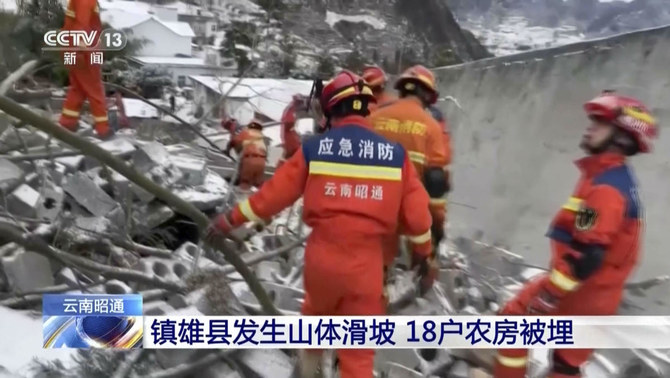
BEIJING: A landslide in southwestern China’s mountainous Yunnan province early on Monday buried 47 people, killing at least two, and forced the evacuation of 200 more amid freezing temperatures and falling snow.
The disaster struck just before 6 a.m. in the village of Liangshui in the northeastern part of Yunnan province. Rescue efforts were underway to find victims buried in 18 separate houses, the Zhenxiong county publicity department said.
Two bodies were pulled from the rubble, according to state broadcaster CCTV. The cause of the landslide wasn’t immediately known as survivors and rescuers struggled with snow and freezing temperatures that were forecast to persist for at least the next three days.
Luo Dongmei, 35, was sleeping when the landslide struck, but she survived and was relocated to a school building by local authorities.
“I was asleep, but my brother knocked on the door and woke me up. They said there was a landslide and the bed was shaking, so they rushed upstairs and woke us up,” Luo said.
Luo, her husband and their three children, along with many other residents, have been provided with food at the school but are still waiting for blankets and other protection from the cold weather, she said.
Luo said she’s been unable to contact her sister and aunt, who lived closer to the site of the landslide. “The only thing I can do is to wait,” she said.
Last week, rescuers evacuated tourists from a remote skiing area in northwestern China where dozens of avalanches triggered by heavy snow had trapped more than 1,000 people for a week. The avalanches blocked roads, stranding both tourists and residents in a village in Altay prefecture in the Xinjiang region, close to China’s border with Mongolia, Russia and Kazakhstan.
Landslides, often caused by rain or unsafe construction work, are not uncommon in China. At least 70 people were killed in landslides last year, including more than 50 at an open pit mine in China’s Inner Mongolia region.
In all, natural disasters in China left 691 people dead and missing and last year, causing direct economic losses of about 345 billion yuan ($48 billion, according to the National Commission for Disaster Reduction and the Ministry of Emergency Management. Meanwhile, the Ministry of Natural Resources enacted emergency response measures for geological disasters and sent a work team of experts to the site.
Minister of Emergency Management Wang Xiangxi has traveled to the landslide site to guide rescue operations, according to a statement from the ministry.
The landslide in Yunnan also came just over a month after China’s most powerful earthquake in years struck the northwest in a remote region between Gansu and Qinghai province. At least 149 people were killed in the magnitude 6.2 temblor that struck on Dec. 18, reducing homes to rubble and triggering heavy mudslides that inundated two villages in Qinghai province.
Nearly 1,000 people were injured and more than 14,000 homes were destroyed in what was China’s deadliest earthquake in nine years.


Landslide in mountainous southwestern China buries 47 people
https://arab.news/w7gp6
Landslide in mountainous southwestern China buries 47 people

- Rescue efforts were underway to find victims buried in 18 separate houses
- The cause of the landslide wasn’t immediately known as survivors and rescuers struggled with snow and freezing temperatures


India, Arab League target $500bn in trade by 2030
- It was the first such gathering of India–Arab FMs since the forum’s inauguration in 2016
- India and Arab states agree to link their startup ecosystems, cooperate in the space sector
NEW DELHI: India and the Arab League have committed to doubling bilateral trade to $500 billion by 2030, as their top diplomats met in New Delhi for the India–Arab Foreign Ministers’ Meeting.
The foreign ministers’ forum is the highest mechanism guiding India’s partnership with the Arab world. It was established in March 2002, with an agreement to institutionalize dialogue between India and the League of Arab States, a regional bloc of 22 Arab countries from the Middle East and North Africa.
The New Delhi meeting on Saturday was the first gathering in a decade, following the inaugural forum in Bahrain in 2016.
India’s Foreign Minister S. Jaishankar said in his opening remarks that the forum was taking place amid a transformation in the global order.
“Nowhere is this more apparent than in West Asia or the Middle East, where the landscape itself has undergone a dramatic change in the last year,” he said. “This obviously impacts all of us, and India as a proximate region. To a considerable degree, its implications are relevant for India’s relationship with Arab nations as well.”
Jaishankar and his UAE counterpart co-chaired the talks, which aimed at producing a cooperation agenda for 2026-28.
“It currently covers energy, environment, agriculture, tourism, human resource development, culture and education, amongst others,” Jaishankar said.
“India looks forward to more contemporary dimensions of cooperation being included, such as digital, space, start-ups, innovation, etc.”
According to the “executive program” released by India’s Ministry of External Affairs, the roadmap agreed by India and the League outlined their planned collaboration, which included the target “to double trade between India and LAS to US$500 billion by 2030, from the current trade of US$240 billion.”
Under the roadmap, they also agreed to link their startup ecosystems by facilitating market access, joint projects, and investment opportunities — especially health tech, fintech, agritech, and green technologies — and strengthen cooperation in space with the establishment of an India–Arab Space Cooperation Working Group, of which the first meeting is scheduled for next year.
Over the past few years, there has been a growing momentum in Indo-Arab relations focused on economic, business, trade and investment ties between the regions that have some of the world’s youngest demographics, resulting in a “commonality of circumstances, visions and goals,” according to Muddassir Quamar, associate professor at the School of International Studies, Jawaharlal Nehru University.
“The focus of the summit meeting was on capitalizing on the economic opportunities … including in the field of energy security, sustainability, renewables, food and water security, environmental security, trade, investments, entrepreneurship, start-ups, technological innovations, educational cooperation, cultural cooperation, youth engagement, etc.,” Quamar told Arab News.
“A number of critical decisions have been taken for furthering future cooperation in this regard. In terms of opportunities, there is immense potential.”


