

Pakistan’s election regulator releases list of contesting candidates for national polls

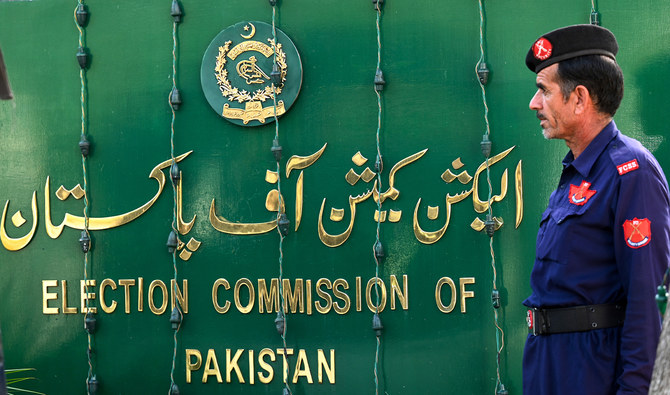
A security personnel stands guard at the headquarters of Election Commission of Pakistan in Islamabad on September 21, 2023. (AFP/File)
Short Url
Updated 22 January 2024
Follow

Pakistan’s election regulator releases list of contesting candidates for national polls

  • National polls in economically troubled Pakistan are scheduled to be held on Feb. 8
  • Preparation for the polls have been marred by pre-poll rigging allegations, security threats

ISLAMABAD: Pakistan’s election regulator issued the list of contesting candidates for hundreds of national and provincial assembly constituencies on Sunday, with only two weeks left before the South Asian country heads to the polls. 

The Election Commission of Pakistan (ECP) had said last month that the last date for candidates to withdraw their nominations would be Jan.12 and that electoral symbols would be allotted to candidates the next day, Jan. 13. 

However, the election regulator did not issue the final list of election candidates a week after Jan. 13. The ECP’s spokesperson, Syed Nadeem Haider, told local media last week that cases relating to the allocation of electoral symbols were being heard in court, which were leading to a delay in the watchdog issuing the final list of candidates and their electoral symbols. 

The election oversight body uploaded the final list of contesting candidates on the social media platform X on Sunday. 

Among the most eagerly watched constituencies on Feb. 8 when Pakistan heads to the polls is of NA-130 in the eastern city of Lahore, where former three-time prime minister and Pakistan Muslim League-Nawaz chief Nawaz Sharif squares off against the Pakistan Tehreek-e-Insaf’s (PTI) former provincial health minister, Dr. Yasmin Rashid. 

Sharif is also contesting from NA-15 in the northwestern city of Mansehra, where he is set to face tough challenges from the PTI’s Gustasif Khan, who will now contest as an independent, and the Jamiat Ulama-e-Pakistan Fazl’s (JUI-F) Mufti Kifayatullah.

Former Pakistan president Asif Ali Zardari will contest from NA-207 constituency in Shaheed Benazirabad, previously Nawabshah in the southern Sindh province, where he will go up against the PTI’s Sardar Sher Mohammad Rind Baloch.

Zardari’s son and Pakistan’s former foreign minister Bilawal Bhutto-Zardari will be contesting from three constituencies, two from Sindh and one from Lahore. In Lahore, Bhutto-Zardari will face the PML-N’s Ataullah Tarar and the PTI’s Chaudhry Shabbir Gujjar from NA-127. 

Today, Monday, marks the deadline for Pakistan’s election staff to submit applications for postal ballots for the Feb. 8 polls, Pakistani state media reported last week. 

“The Election Commission has started the process of providing postal ballot papers to eligible individuals for the general elections for both national and provincial assemblies,” Radio Pakistan said in a report on Sunday. 

Pakistan is currently being run by a caretaker government under interim Prime Minister Anwaar-ul-Haq Kakar that is meant to oversee the election on Feb. 8. Polls in the South Asian country were originally expected to be held in November but were delayed after the ECP had to redraw hundreds of constituencies across the country based on the results of the latest population census. 

Preparations for the national polls have been marred by allegations of pre-poll rigging, mainly by former prime minister Imran Khan’s PTI, and security challenges, especially in Pakistan’s western provinces bordering Afghanistan. 


Pakistan says repaid over $13.06 billion domestic debt early in last 14 months

Updated 29 January 2026
Follow

Pakistan says repaid over $13.06 billion domestic debt early in last 14 months

  • Finance adviser says repayment shows “decisive shift” toward fiscal discipline, responsible economic management
  • Says Pakistan’s total public debt has declined from over $286.6 billion in June 2025 to $284.7 billion in November 2025

KARACHI: Pakistan has repaid Rs3,650 billion [$13.06 billion] in domestic debt before time during the last 14 months, Adviser to the Finance Minister Khurram Schehzad said on Thursday, adding that the achievement reflected a shift in the country’s approach toward fiscal discipline. 

Schehzad said Pakistan has been repaying its debt before maturity, owed to the market as well as the State Bank of Pakistan (SBP), since December 2024. He said the government had repaid the central bank Rs300 billion [$1.08 billion] in its latest repayment on Thursday. 

“This landmark achievement reflects a decisive shift toward fiscal discipline, credibility, and responsible economic management,” Schehzad wrote on social media platform X. 

Giving a breakdown of what he said was Pakistan’s “early debt retirement journey,” the finance official said Pakistan retired Rs1,000 billion [$3.576 billion] in December 2024, Rs500 billion [$1.78 billion] in June 2025, Rs1,160 billion [$4.150 billion] in August 2025, Rs200 billion [$715 million] in October 2025, Rs494 billion [$1.76 billion] in December 2025 and $1.08 billion in January 2026. 

He said with the latest debt repaid today, the July to January period of fiscal year 2026 alone recorded Rs2,150 billion [$7.69 billion] in early retirement, which was 44 percent higher than the debt retired in FY25.

He said of the total early repayments, the government has repaid 65 percent of the central bank’s debt, 30 percent of the treasury bills debt and five percent of the Pakistan Investment Bonds (PIBs) debt. 

The official said Pakistan’s total public debt has declined from over Rs 80.5 trillion [$286.6 billion] in June 2025 to Rs80 trillion [$284.7 billion] in November 2025. 

“Crucially, Pakistan’s debt-to-GDP ratio, around 74 percent in FY22, has declined to around 70 percent, reflecting a broader strengthening of fiscal fundamentals alongside disciplined debt management,” Schehzad wrote. 

Pakistan’s government has said the country’s fragile economy is on an upward trajectory. The South Asian country has been trying to navigate a tricky path to economic recovery under a $7 billion loan from the International Monetary Fund.