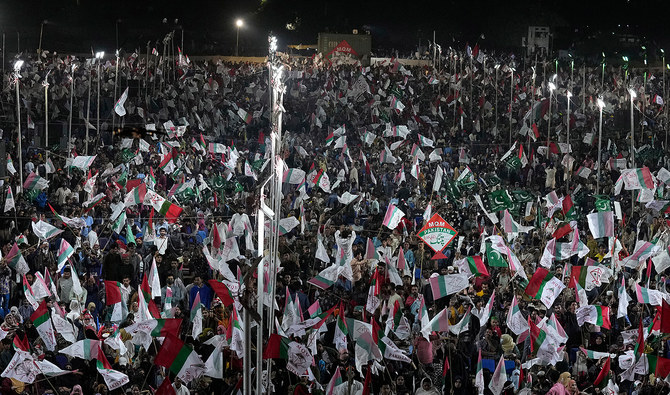
KARACHI: The Muttahida Quami Movement-Pakistan (MQM-P), one of the major stakeholders in Pakistan’s largest city of Karachi, on Sunday held a power show at the city’s iconic Bagh-e-Jinnah venue, where its leaders said the party would gain a thumping majority in urban centers of the southern Sindh province in Feb. 8 national elections.
The MQM-P is an offshoot of the Muttahida Quami Movement (MQM), which has historically held sway in Sindh’s urban areas, particularly Karachi, where it claimed to represent the Muhajir community, which comprises Urdu-speaking Muslims who migrated from India to Pakistan after the partition of the Indian subcontinent in 1947.
The Bagh-e-Jinnah park, located adjacent to the mausoleum of Pakistan’s founder Muhammad Ali Jinnah, is a venue that has often been used by parties as a symbol of political might that can help gauge public support.
Sunday’s public gathering, the maiden election rally held by the MQM-P since the recent unification of its various factions, was addressed by party leaders who previously led their own separate groups.
“The MQM-P will once again win with a huge majority in Karachi and other parts of Sindh,” MQM-P chief Khalid Maqbool Siddiqui said, while addressing the attendees.
Mustafa Kamal, who merged his Pak Sarzameen Party (PSP) faction into the MQM-P last year, criticized the Pakistan People’s Party (PPP), which has been ruling in Sindh since 2008, for trying to turn the masses against the MQM-P by provoking them for a boycott of elections as urged by the party’s estranged, London-based founder Altaf Hussain.
“The people have given their decision that the sureties of the opponents will be seized in the election,” Kamal said, adding the PPP was attempting to cover up its poor performance by relaying the boycott announcement from London.
Founded by Hussain in 1984, the Muttahida Quami Movement first split into two factions, the MQM-Haqeeqi and the MQM. In 2016, Kamal, a former Karachi mayor, announced the formation of the PSP.
But Hussain continued to wield power over the largest faction, the MQM, and enjoy the loyalty of hundreds of thousands of workers and supporters until 2016, when his anti-Pakistan speech at a party meeting forced majority of his loyalists to part ways with the MQM and form a new faction, the MQM-P.
Over the subsequent years, the MQM-P further split into two factions owing to internal rifts. Last year, these factions, except of the Hussain-led MQM and the MQM-Haqeeqi, reunited under the leadership of Siddiqui.
With national elections just weeks away, the MQM-P is struggling to reclaim its lost political ground in the face of the election boycott call by its London-based founder and amid growing popularity of former premier Imran Khan’s Pakistan Tehreek-e-Insaf (PTI) party, which secured 14 out of 21 parliamentary seats in Karachi in the 2018 general elections.
Recent victories by the Jamaat-e-Islami (JI) religious party and the PPP in the local government elections in Karachi have further put the MQM-P on the defensive, grappling to woo voters ahead of the national polls.


![]()

With Bagh-e-Jinnah rally, Karachi’s key political party aims to win big in elections in southern Pakistan
Short Url
https://arab.news/wu2n8
With Bagh-e-Jinnah rally, Karachi’s key political party aims to win big in elections in southern Pakistan
- This was the first election rally held by the MQM-P since the merger of its various factions last year
- The party is struggling to regain its lost political ground amid a boycott call by its estranged founder


Latest updates





Recommended



© 2026 SAUDI RESEARCH & PUBLISHING COMPANY, All Rights Reserved And subject to Terms of Use Agreement.