

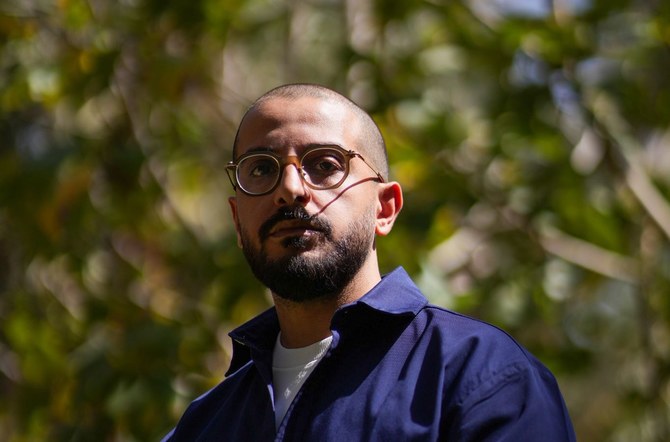

DUBAI: It’s been three years since Ayman Zedani quit his job to become a full-time artist. Three years since he left the curatorial team at Sharjah Art Foundation, took a leap of faith, and concentrated on building an investigative practice that considers both the past and the future of the Arabian Peninsula.
Sometimes the Saudi artist still has to pinch himself. Not because it’s all so far removed from his days studying biomedical science in Australia, but because he’s free to move wherever his art takes him. “Technically, since I don’t really have a full-time job anymore, I just move where the work is,” he says with a laugh. “I mean, honestly, I’m still thinking ‘How is this possible?’ I keep telling people: ‘The moment I feel hungry, I’ll just go back to work.’ For now, things are working fine and I can sense that it would be really hard for me to go back to a normal working setup, especially creatively speaking.”
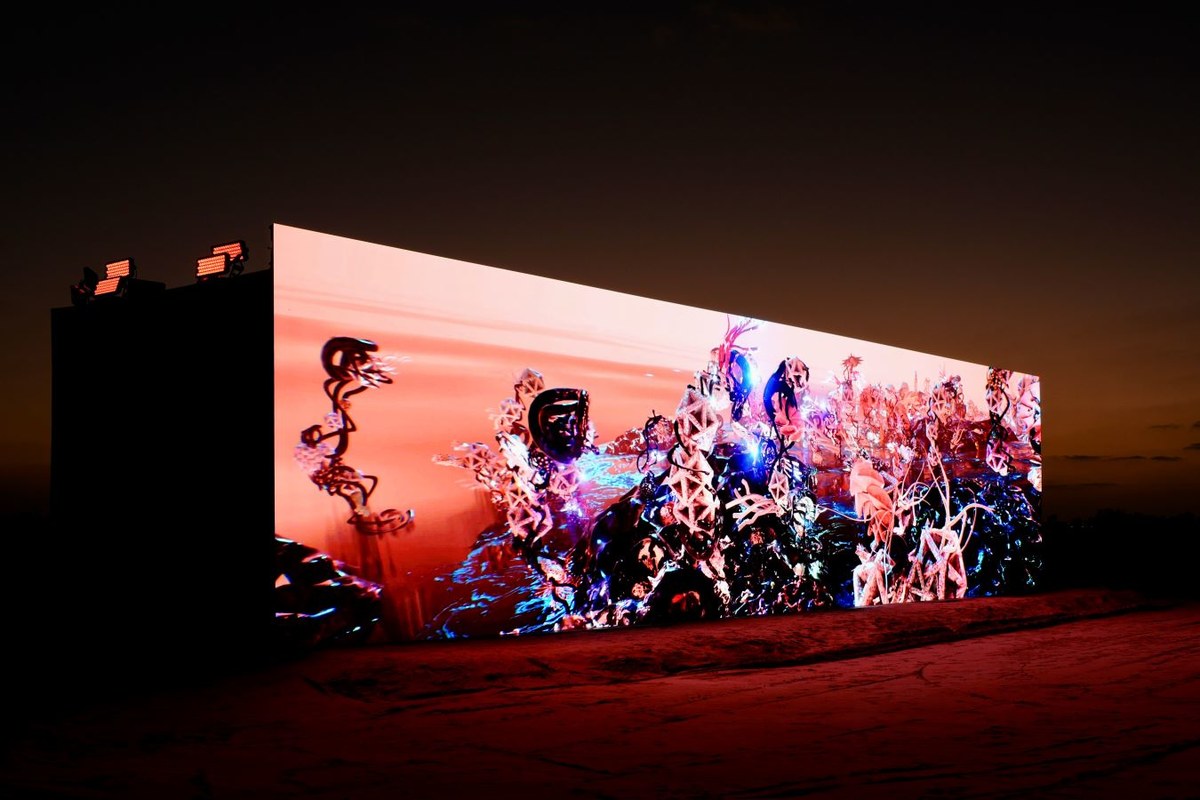
Ayman Zedani’s ‘Terrapolis’ installation. (Supplied)
Primarily splitting his time between Riyadh and Sharjah, Zedani, who won the inaugural Ithra Art Prize in 2018 and held his first solo show at Jeddah’s Athr Gallery in 2019, has been quietly and diligently experimenting with speculative fiction, sci-fi, and cultural genealogy for more than a decade.
“For me, writing is what starts all my projects,” he explains. “I kind of work backwards. I usually write the stories and the narrative and then start to create the visuals to respond to the text. It’s an interesting approach. Because I didn’t really learn how to make movies in the ‘proper way’, I have my own way of making video works. And I try to borrow a lot from the way the Bedu tell stories, because people of the desert had their own way of telling narratives that is not necessarily similar to the three-act narrative, which I found really fascinating.”
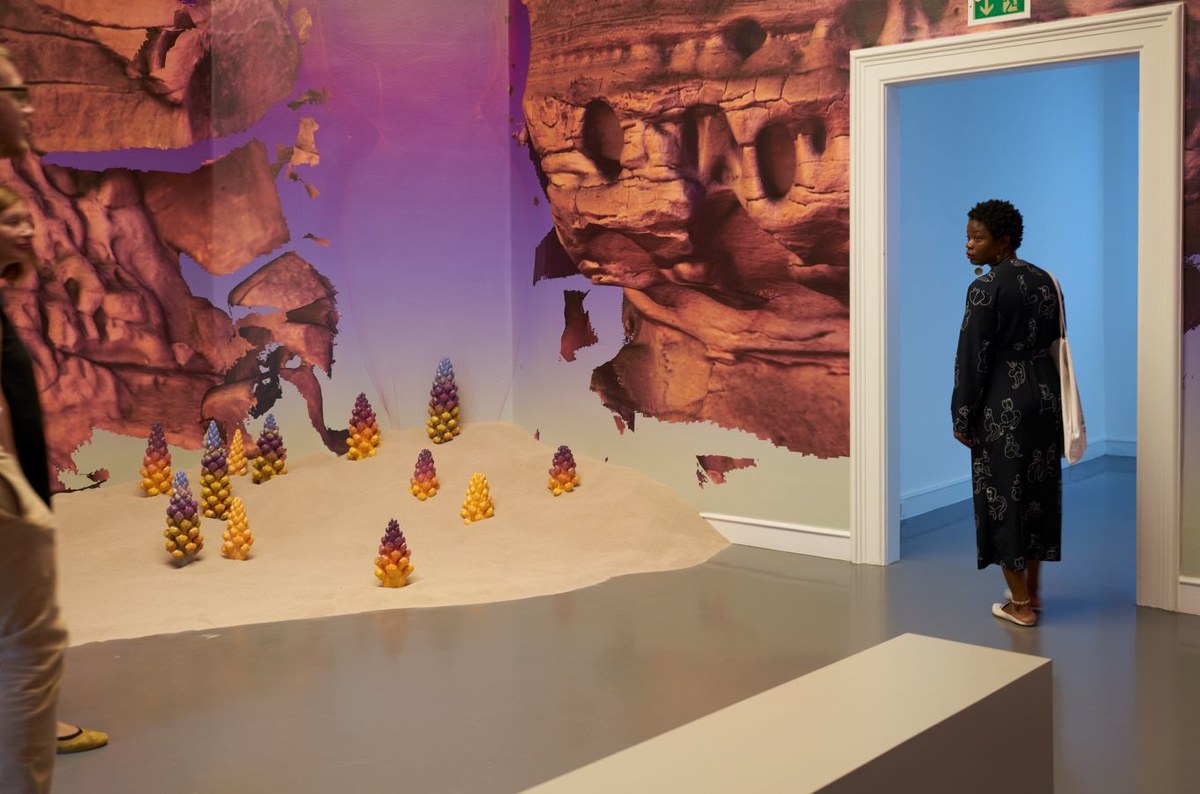
Ayman Zedani’s ‘The Keepers.’ (Supplied)
One of his works is currently on display as part of Manar Abu Dhabi, a city-wide exhibition of light art sculptures and installations that runs until Jan. 30. The show, spread across the archipelagos and mangroves of the UAE capital, features more than 35 site-specific works by local and international artists including light sculptures, immersive artworks, and projections.
Zedani’s exhibited work falls under the latter. Originally commissioned for Expo 2020, “Terrapolis” incorporates the names of the 5,000 people who built Expo 2020’s Sustainability Pavilion. Rather than represent each person literally, Zedani fed their names into an algorithm, turning every individual into an “organic looking flower.” Inspired by the flora of the Arabian Peninsula, the video projection allowed Zedani to study the interplay between humans and the desert, prompting a reflection on the environment around us.
“We created this fictional island in the middle of this digital world and in it are these 5,000 plants — each one representing a person, including the leaders of the expo team,” says Zedani, who grew up between the cities of Khamis Mushait and Abha. “You can’t really tell who’s who because you’re just seeing these organic beings, which is nice because it kind of neutralizes everybody and it doesn’t separate who worked on the actual building and who just sent emails. It was kind of interesting for me to do it in that way, but I needed to create something adjacent to that that would give people a sense of what they’re looking at.”
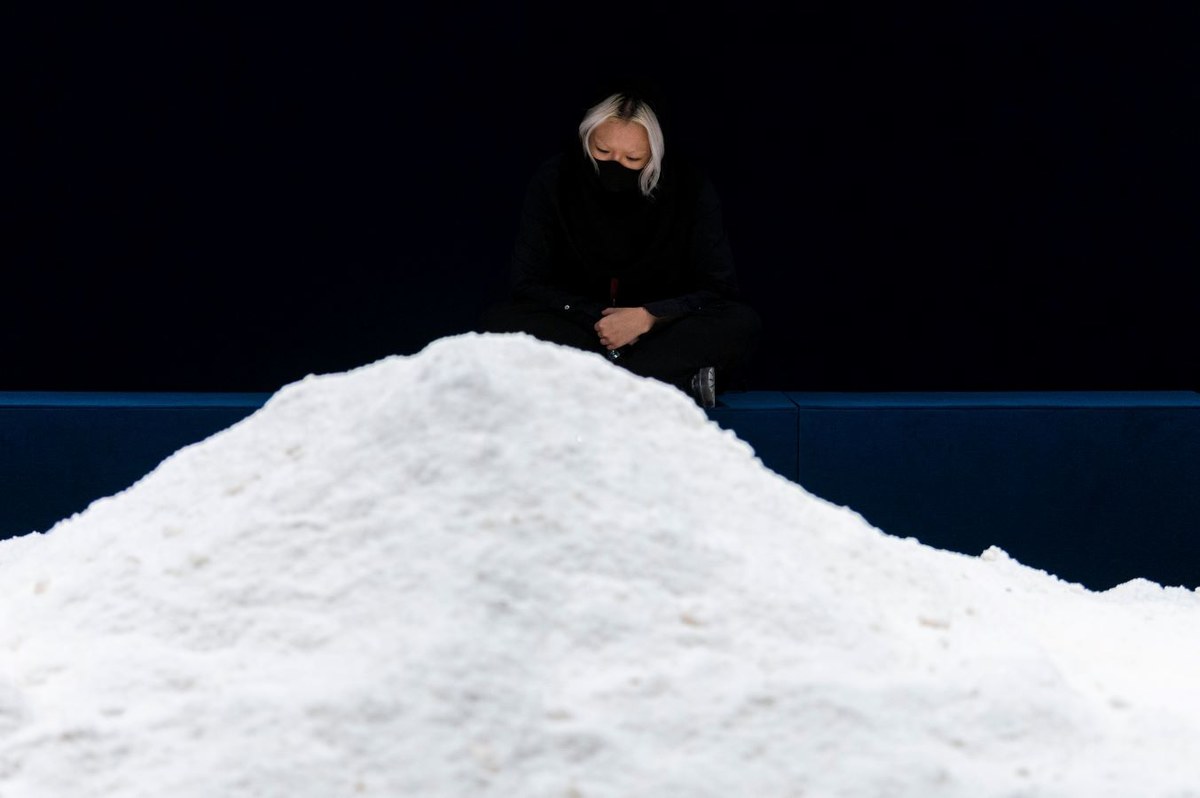
Ayman Zedani’s ‘Between Desert Seas.’ (Supplied)
That “something” was an accompanying app, which allows anyone to enter their name and become a flower too. Originally a two-channel video projection, for Manar Abu Dhabi “Terrapolis” has become a single horizontal channel.
“I just wanted to give it another life in a place that is so prominent, and also to revive the work,” says Zedani. “Because I don’t really think that child had enough attention from its inception. So this is kind of like a redo.”
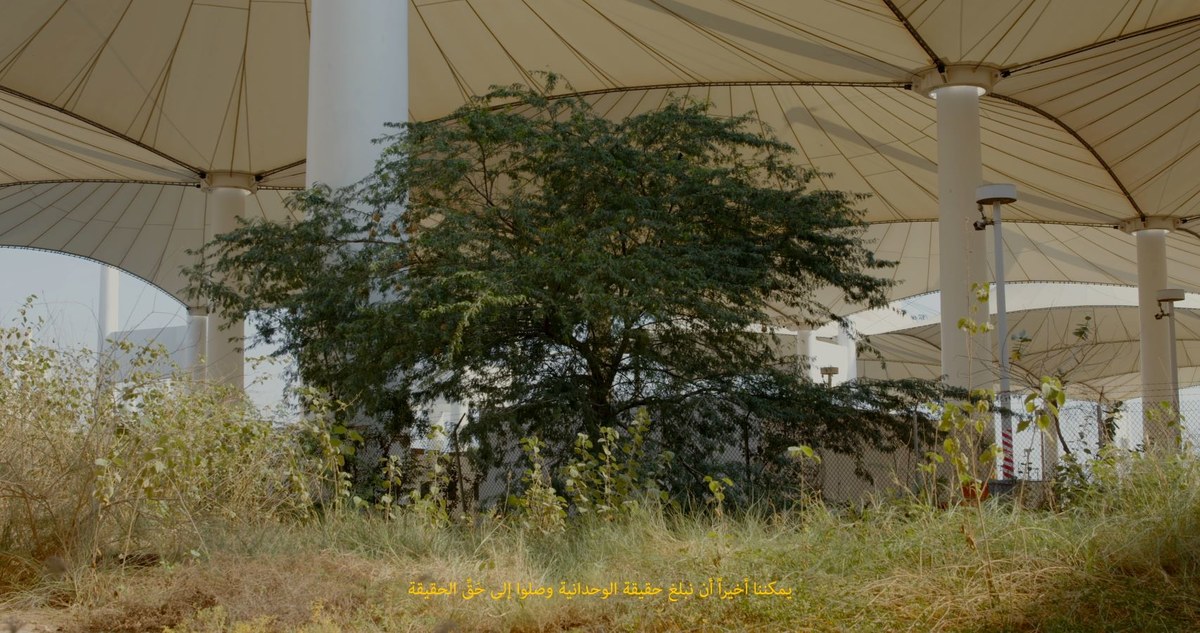
A still from Zedani's ‘The Heavens is for All.’ (Supplied)
The natural world is of huge importance to Zedani. So too is history. His research-based practice seeks to challenge humanity’s comprehension of the past, as well as its acceptance of the future. This he achieves through a combination of videos, installations, and immersive environments. Last year, for example, Zedani participated in the AlUla Artist Residency program, contributing to its “Palimpsest of Time” exhibition and researching the region’s ancient civilizations. Civilizations that were responsible for the creation of desert kites (monumental wild game drives or hunting traps) and mustatils (funerary structures), both of which are liberally scattered across Saudi Arabia.
“My research was to try to understand the different civilizations that have lived in AlUla and Khaybar and to try to link them together through a shared heritage,” explains Zedani. “Because there is a lot of missing history in a lot of these different places, especially the ones in Khaybar, with these ancient structures that you can only see from the sky. For me, it’s such a fascinating thing to find these structures that span maybe a quarter of the peninsula and we don’t really have a record of who actually lived there. We don’t know who they are.”
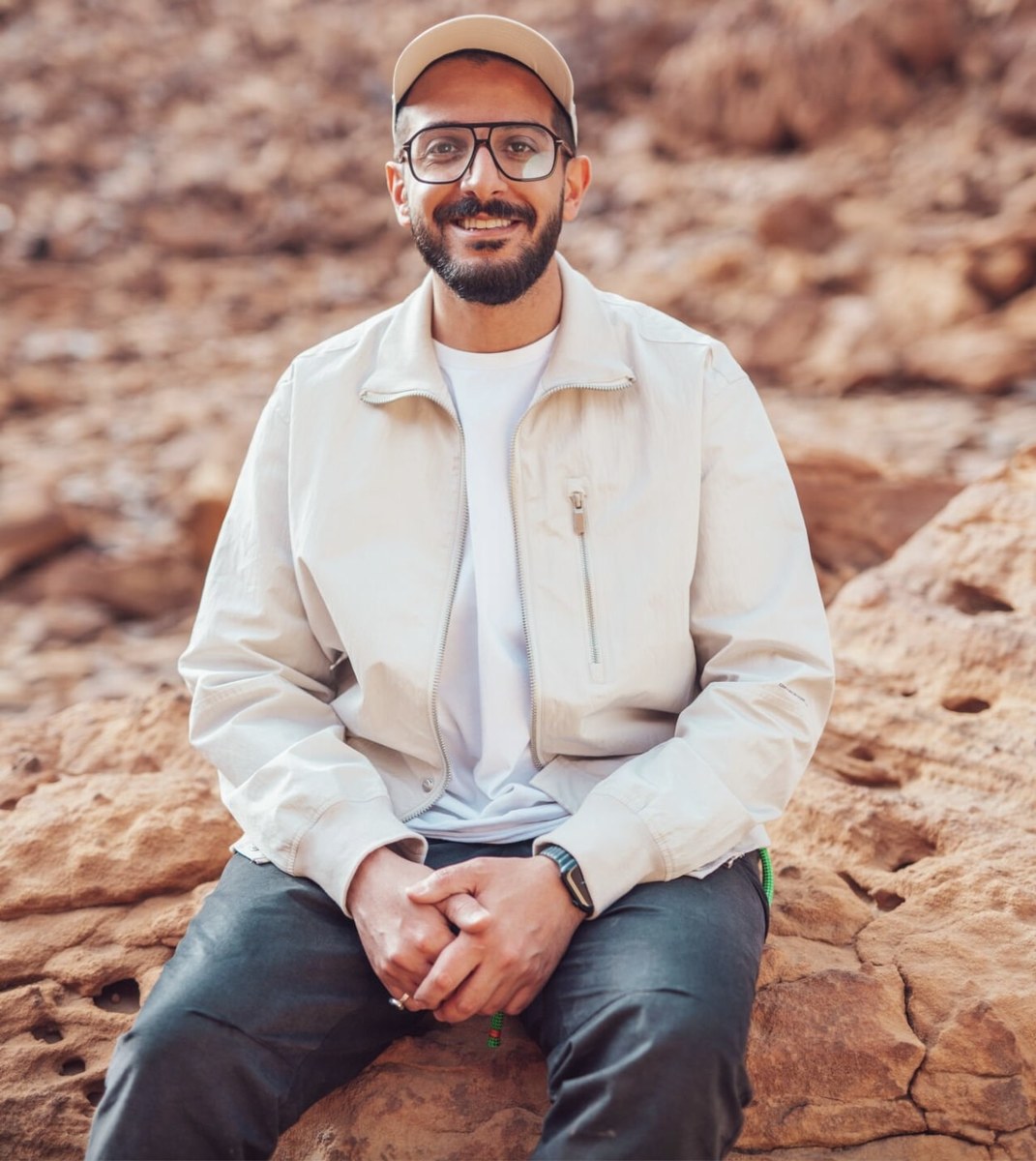
Ayman Zedani’s research-based practice seeks to challenge humanity’s comprehension of the past, as well as its acceptance of the future. (Supplied)
Using speculative fiction to “fill the missing gaps between these different civilizations”, Zedani sought to create a “narrative that makes the whole place make sense.” That narrative was, or is, sci-fi in nature.
“AlUla’s a place where science fiction happens. It kind of collapses all time narratives. It’s a place where everything could actually happen all at once. I’m really interested in how the temporal dimension dissolves in the middle of the desert. Another thing about AlUla is it doesn’t share secrets easily,” he says. “You need to spend a lot of time in the desert in order for it to allow you to experience some of its secrets, which is a beautiful thing.”
For “The Valley of the Desert Keepers,” a soundscape installation exhibited as part of the 2022 edition of Desert X AlUla, Zedani explored parasitic plants of the Arabian desert. In “The Desert Keepers,” a multi-channel video installation that explored the different ways in which desert plants have evolved to survive in their environment, the work’s narrative element offered a poetic perspective from the plants themselves.
“I crave these sorts of environments, and I create these narratives to try to make people contemplate things in relation to our influence on the planet, our relationship with everything around us, and the livability of the future — especially from a Gulf perspective. My characters, or non-human protagonists, are all based on actual things; their stories are fictional, but they’re also based on the actual map of the peninsula.”
Only in retrospect has Zedani come to understand his work, boiling it down to a single sentence that he says describes all of his projects: “To the ancestors, human and non-human.”
“I think my practice, or my work, is an attempt to try to re-establish the relationship between us as a species and everything around us,” he says. “This is a personal thing as well. What I do is try to re-story our relationship with the world around us, with the ground, with the plants, with the more-than-human world.”


