

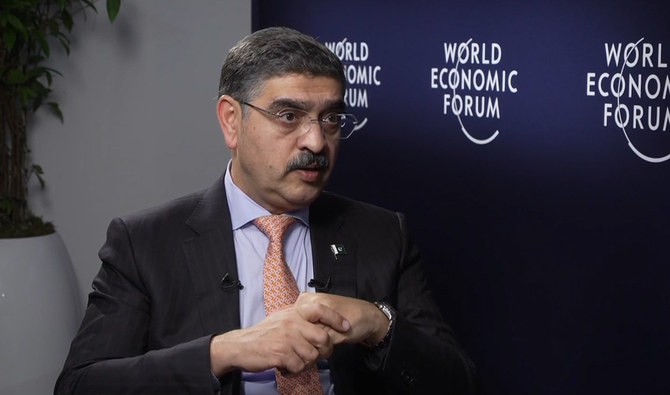

ISLAMABAD: Pakistani Caretaker Prime Minister Anwaar-ul-Haq Kakar on Wednesday called on the United States to “constructively” engage with the South Asian nation in an interview on the sidelines of the World Economic Forum.
Ties between Islamabad and Washington, once close allies, have just started to warm after some years of frosty relations, mostly due to concerns about Pakistan’s alleged support of the Taliban in Afghanistan. Pakistan denies this support.
Relations strained further under the government of former prime minister Imran Khan, who ruled from 2018-22 and antagonized Washington throughout his tenure, welcoming the Taliban takeover of Afghanistan in 2021 and later accusing Washington of being behind attempts to oust him. Washington has dismissed the accusation.
The government of PM Shehbaz Sharif that took over after Khan and whose term ended last year tried to mend ties but analysts widely believe the United States will not seek a significant broadening of ties with Islamabad in the near future but remain mostly focused on security cooperation, especially on counterterrorism and Afghanistan.
“Pakistan is a country of consequence, not a country of concern so we need that Pakistan should be constructively engaged,” Kakar said in an interview to CNBC when asked about Pakistan’s message to the Joe Biden administration ahead of polls on Feb. 8.
“It’s a mid-sized power and its actual potential and role needs to be appreciated and that constructive engagement, be it in the region or a global scale, is a requirement and need of the hour.”
Islamabad has long called for a broadening of ties with Washington beyond just security concerns and hopes to boost bilateral trade in goods and services, which the Pakistani embassy says totals about $12 billion currently.
Pakistan also hopes to attract more US investment, with a particular focus on IT and pharmaceuticals, after a long lull during which China became the dominant investor. Pakistani officials say the country is well-placed to help diversify US supply chains that were dependent on China before COVID-19, but have started to shift toward other regional suppliers and could serve as a gateway to Central Asia.
“The United States has been one of the largest sources of foreign direct investment in Pakistan and remains Pakistan’s largest export market,” the US State Department profile on Pak-US ties says.
“Trade and investment relations between the United States and Pakistan continue to grow, and the US government supports this relationship by organizing business to business trade delegations, providing technical assistance, and promoting business opportunities for US companies to develop US-Pakistan commercial partnerships.”
On the economic front, the US has long been Pakistan’s largest export market, importing more than $5 billion in Pakistani goods in 2021, far surpassing any other country. The United States has also been a leading investor in Pakistan for the past 20 years.
“In the most recent fiscal year, US direct investment in Pakistan increased by 50 percent – it is now the highest it has been in over a decade,” the State Department said.
“Major US investments are concentrated in consumer goods, chemicals, energy, agriculture, business process out-sourcing, transportation, and communications.”
However, the US has often emphasized areas in Pakistan’s business climate that need to be strengthened, including regulation, intellectual property protection, and taxation.


