Israel army reports killing top militant in West Bank strike

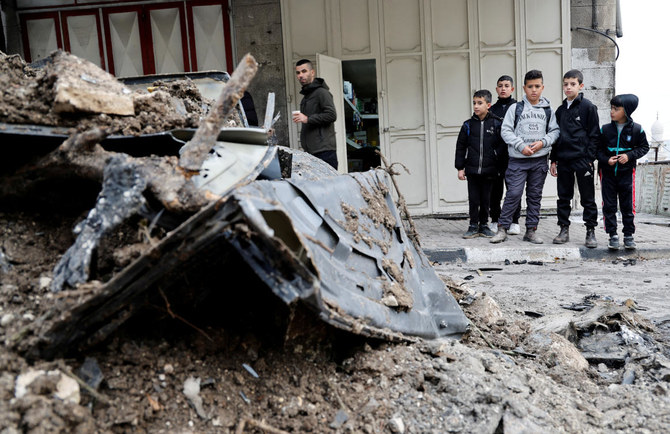
A Palestinian man and children inspect the site of an Israeli strike on a car in Nablus, in the Israeli-occupied West Bank. (Reuters)
Short Url
Updated 17 January 2024
Follow

Israel army reports killing top militant in West Bank strike

  • Ahmed Abdullah Abu Shalal had been responsible for a “number of terrorist attacks” over the past year, including one in annexed east Jerusalem

JERUSALEM: The Israeli army said it killed a top Palestinian militant in an air strike in the occupied West Bank early Wednesday, averting a “terrorist attack” he was planning.
Ahmed Abdullah Abu Shalal had been responsible for a “number of terrorist attacks” over the past year, including one in annexed east Jerusalem, the army said.
He was “eliminated in a precision air strike,” it said in a statement that had a video link showing the strike on a vehicle.
The Palestinian health ministry in Ramallah said the body of an “unidentified martyr killed by the occupation (Israel) in a bombing of a vehicle” had been received by a hospital in Nablus.
The army said Abu Shalal was killed following intelligence “of his cell’s intentions of carrying out an imminent terrorist attack.”
The army did not offer details, but said he was responsible for carrying out a shooting in the Shimon HaTzadik neighborhood of east Jerusalem in April last year in which two residents were wounded.
Abu Shalal was also responsible for a bomb attack on Israeli troops in October in which one soldier was wounded. The army did not specify where the soldiers were targeted.
“Under Abdullah’s leadership, the terrorist infrastructure in the Balata (refugee) camp in Nablus has received funding and guidance from Iranian sources,” the army claimed.
Since the start of the Israel-Hamas war in Gaza on October 7, the West Bank has experienced a level of violence not seen since the second Palestinian uprising or intifada between 2000 and 2005.
Israeli army raids and attacks by settlers have killed around 350 people in the territory, according to an AFP tally based on sources from both sides.


Chaos erupts in Somalia’s parliament over proposed constitutional amendments

Updated 10 sec ago
Follow

Chaos erupts in Somalia’s parliament over proposed constitutional amendments

  • Somalia has been under a provisional constitution since 2012
  • A constitutional crisis in 2021 led to armed confrontations in Mogadishu

MOGADISHU: Scuffles and shouting broke out Wednesday during a joint session of Somalia’s parliament after the speaker attempted to advance proposed constitutional amendments that opposition lawmakers said would extend parliament’s mandate, forcing the session’s suspension.
Somalia has been under a provisional constitution since 2012, and repeated efforts to finalize it have exposed deep divisions over governance and power-sharing between the federal government and regional states.
A similar attempt to extend political mandates under former president Mohamed Abdullahi Mohamed triggered a constitutional crisis in 2021 and led to armed confrontations in Mogadishu, pushing the country to the brink of wider unrest.
Wednesday’s disorder erupted when the parliament speaker announced an unexpected agenda to amend five chapters of the provisional constitution and moved to distribute written copies to lawmakers at the start of the session.
Opposition lawmakers said the proposed amendments would allow for a two-year extension of parliament’s term, which expires in April. The presidential term expires in May.
Videos shared on social media showed Internal Security Minister Abdullahi Sheikh Ismail, a member of the Upper House who supported the agenda, engaging in a physical confrontation with Hassan Yare, an opposition lawmaker. It was not immediately clear how the scuffle began.
Abdirahman Abdishakur Warsameh, an opposition lawmaker, accused Speaker Adan Madobe of attempting to rush through the amendments without following proper procedure.
Lawmakers opposed to the move tore up agenda papers, shouted slogans and blew whistles, bringing proceedings to a halt. Madobe adjourned the session, warning that disciplinary measures would be taken against those responsible for the disruptions.
The speaker did not immediately respond to requests for comment, and it was unclear when deliberations on the proposed amendments might resume.