LONDON: UK leader Rishi Sunak battled Tuesday to quell growing dissent over his controversial plan to send migrants to Rwanda, testing his authority with a general election on the horizon.
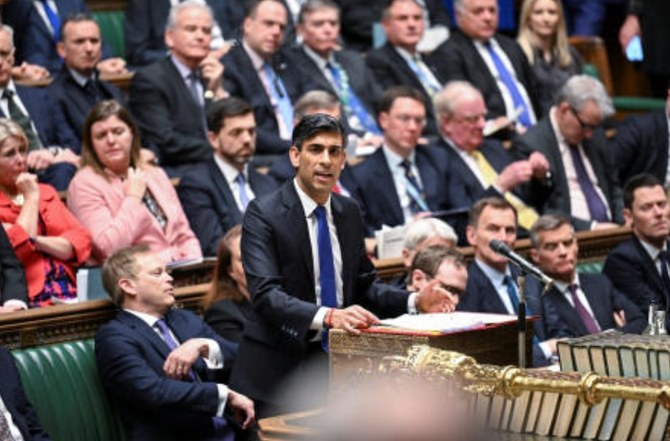
Parliament launched two days of debate about the scheme — a central part of Sunak’s pledge to stop asylum seekers crossing from France to Britain in small boats.
The Conservative prime minister has staked his political future on slashing record levels of regular and irregular migration, with his Safety of Rwanda (Asylum and Immigration) Bill key to that pledge.
But the proposal has reopened divisions in his ruling Tory party between right-wingers and centrists, leaving Sunak between a rock and a hard place as he fights to turn it into law.
The plan is his answer to a unanimous UK Supreme Court ruling in November that deporting asylum seekers to Rwanda is illegal under international law.
If passed, it would compel judges to treat Rwanda as a safe third country and proposes giving UK ministers powers to disregard sections of international and British human rights legislation.
The United Nations High Commissioner for Refugees (UNHCR) reiterated this week that the bill and a recently signed treaty with Kigali designating Rwanda “safe” were “not compatible” with international refugee law.
More than 60 MPs have publicly backed amendments to make the bill even tougher though, including by disapplying international law and restricting asylum seekers’ rights to appeal against deportation.
They include two Tory deputy chairmen, testing Sunak’s leadership mettle amid calls for the pair to be dismissed, in infighting not seen since the wranglings over Brexit.
Ex-prime minister Boris Johnson, who introduced the Rwanda scheme when he was in office, has also backed the amendments, although he is no longer an MP and cannot vote.
If Sunak bows to the rebels’ demands, then the bill would almost certainly be scuppered by moderates, who oppose violating international law and say the legislation already pushes the limits.
In a bid to appease MPs who fear that individual appeals against deportation to Rwanda could clog the courts, Sunak’s government announced Tuesday that it would hire new judges to fast-track cases.
Justice Secretary Alex Chalk said the changes would create 5,000 additional sitting days to hear appeals.
A spokesman for Sunak said the move showed that the government was “taking every conceivable step to ensure” that flights to Kigali could take off.
But several right-wing MPs told the House of Commons debate that Sunak’s bill does not go far enough.
Former immigration minister Robert Jenrick, who quit in protest at the bill in December, said the amendments “represent the last opportunity for us to get this policy right.”
The amendments are unlikely to be passed but will provide clues as to whether Sunak is in danger of losing a main vote on his bill expected on Wednesday night.
His spokesman told reporters that discussions with lawmakers were “still ongoing.”
Party rebels had threatened to kill the Rwanda legislation during the first vote on the issue last month but Sunak faced them down and won a knife-edge parliamentary vote.
The rebels may ultimately decide it is better to back their leader, rather then side with the main opposition Labour party, which calls the plan a “gimmick.”
The prime minister says the law is essential to deter migrants from considering traveling to the UK via unauthorized routes.
Around 30,000 asylum seekers crossed the English Channel on rudimentary vessels last year. Five died trying to make the journey this past weekend.
Sunak has yet to announce the date of the UK’s general election but has said it will be held this year.
Some opinion polls put Labour more than 20 points ahead of the Tories, suggesting the ruling party is heading for a landslide defeat.


![]()

UK’s Sunak battles to push through Rwanda migrant law
Short Url
https://arab.news/4t9qn
UK’s Sunak battles to push through Rwanda migrant law
- Parliament launched two days of debate about the scheme — a central part of Sunak’s pledge to stop asylum seekers crossing from France to Britain in small boats
- The Conservative prime minister has staked his political future on slashing record levels of regular and irregular migration


Latest updates




© 2026 SAUDI RESEARCH & PUBLISHING COMPANY, All Rights Reserved And subject to Terms of Use Agreement.