GAZA: Health officials in Hamas-ruled Gaza said Saturday that Israeli strikes killed at least 60 people in the besieged territory, 99 days into the war.
Fears of the conflict widening intensified after US and British forces struck pro-Hamas Houthi rebels in Yemen following attacks on Red Sea shipping, with the US military announcing a fresh air strike on Saturday, a day after the initial barrage.
Witnesses in the Gaza Strip reported early-morning Israeli bombardment. An AFP correspondent said intense shelling and air strikes hit the south of Gaza overnight.
Nimma Al-Akhras, 80, described the strike that destroyed her home.
“It was very powerful,” she said. “We started to scream and I couldn’t move but someone pulled me out and put me on a cart.”
The Israeli army said its forces had struck dozens of rocket launchers that were “ready to be used” in central Gaza, and eliminated four “terrorists” in air strikes on Khan Yunis, Gaza’s main southern city.
The military also reported that its engineers had destroyed a Hamas “command center” and weapons found there, after a raid in central Gaza.
Health ministry spokesman Ashraf Al-Qudra reported “more than 60 martyrs” in Israeli air strikes and artillery fire overnight, with dozens more wounded.
Israel’s relentless bombardment of Gaza since Hamas’s October 7 attack has killed at least 23,843 people, mostly women and children, according to the latest ministry toll.
The war, in which Israel has vowed to destroy Hamas, began when the militants launched their unprecedented attack that resulted in about 1,140 deaths in Israel, mostly civilians, according to an AFP tally based on official figures.
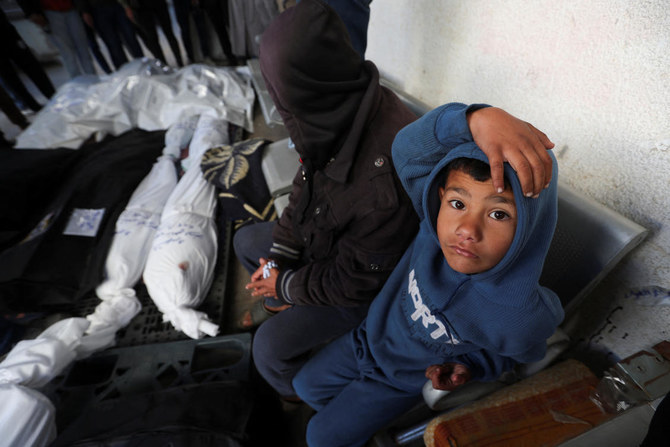
At Rafah’s Al-Najjar hospital, mourners gathered and prayed around the bodies of slain relatives. One man stroked the body of a child, wrapped up like a white parcel. He kissed it, then placed it gently among others.
Another man, Bassem Araf, held up a photo of another child.
“She died hungry with bread in her hand. We tried to remove the bread from her hand but it was held tight,” Araf said. “This is the resistance they are targeting in Gaza, just children.”
An AFP reporter in Rafah said telecommunications had been partially restored, a day after Gaza’s main operator Paltel reported the latest outage. Paltel did not immediately confirm the service restoration.
Winter rains have exacerbated the dire humanitarian situation in Gaza, where the UN estimates 1.9 million — nearly 85 percent of the population — have been displaced.
Many have sought shelter in Rafah and other southern areas where the health ministry says there isn’t the infrastructure to support them.
“The infrastructure, services and health care in Rafah are fragile and cannot bear the needs of 1.3 million citizens and displaced people,” its spokesman said.
The United Nations humanitarian office, OCHA, told AFP that Israel was blocking aid convoys into northern Gaza.
“They have been very systematic in not allowing us to support hospitals,” OCHA’s head for the Palestinian territories, Andrea De Domenico, said on Friday decrying “a level of inhumanity... beyond comprehension.”
The health ministry spokesman accused Israel of “deliberately targeting hospitals... to put them out of service,” warning of “devastating repercussions.”
Hospitals, protected under international humanitarian law, have repeatedly been hit by Israeli strikes in Gaza since the war erupted.
The Israeli military accuses Hamas of operating command centers in tunnels under hospitals, a charge denied by the Islamist group.
Fewer than half of Gaza’s hospitals are functioning and those only partly, the World Health Organization says.
In Israel, concern grew for hostages held in Gaza as they approach their 100th day in captivity.
Palestinian militants on October 7 seized about 250 hostages, 132 of whom Israel says remain in Gaza, including at least 25 believed to have been killed.
The office of Israeli Prime Minister Benjamin Netanyahu — under domestic pressure to get the hostages home — said on Friday a deal had been negotiated with Qatar to get medicine to the captives.
“It’s not enough. I want him home, in hospital, in a good health care, not in Hamas health care,” Ella Ben Ami, daughter of hostage Ohad Ben Ami, 55, said in Tel Aviv.
Bombing and deprivation didn’t stop Gaza couple Afnan Jibril and Mustafa Shamlakh, displaced by the war, from getting married in Rafah.
“We are all living through the same tragedy. However, we must continue to live, and life should go on,” said Ayman Shamlakh, the groom’s uncle.
In the Israeli-occupied West Bank, where violence has surged during the Israel-Hamas war, Israeli troops killed three militants after they attacked a Jewish settlement, the army said.
It said there had been a “terrorist infiltration” in the Adora settlement, about 20 kilometers (12 miles) west of Hebron, and soldiers had come under fire.
Palestinian news agency Wafa identified the three killed as a 19-year-old and two 16-year-olds.
The International Court of Justice this week heard arguments in a case launched by South Africa — and welcomed by Gazans — accusing Israel of breaching the UN Genocide Convention in the Gaza war. The case seeks a halt to Israel’s military campaign.
Israel stressed to the court that its response was in self-defense and not aimed at Palestinian residents.
The court is likely to make an initial ruling within weeks.


On 99th day of war, Gaza ministry says dozens killed in Israel strikes
https://arab.news/99x9a
On 99th day of war, Gaza ministry says dozens killed in Israel strikes

- Fears of the conflict widening have grown after US and British forces struck pro-Hamas Houthi rebels in Yemen
- UN aid chief calls anew for Gaza ceasefire, urges UN action to end war


Iran temporarily closes airspace to most flights
WASHINGTON: Iran temporarily closed its airspace to all flights except international ones to and from Iran with official permission at 5:15 p.m. ET on Wednesday, according to a notice posted on the Federal Aviation Administration’s website. The prohibition is set to last for more than two hours until 7:30 p.m. ET, or 0030 GMT, but could be extended, the notice said. The United States was withdrawing some personnel from bases in the Middle East, a US official said on Wednesday, after a senior Iranian official said Tehran had warned neighbors it would hit American bases if Washington strikes. Missile and drone barrages in a growing number of conflict zones represent a high risk to airline traffic. India’s largest airline, IndiGo said some of its international flights would be impacted by Iran’s sudden airspace closure. A flight by Russia’s Aeroflot bound for Tehran returned to Moscow after the closure, according to tracking data from Flightradar24. Earlier on Wednesday, Germany issued a new directive cautioning the country’s airlines from entering Iranian airspace, shortly after Lufthansa rejigged its flight operations across the Middle East amid escalating tensions in the region.
The United States already prohibits all US commercial flights from overflying Iran and there are no direct flights between the countries. Airline operators like flydubai and Turkish Airlines have canceled multiple flights to Iran in the past week. “Several airlines have already reduced or suspended services, and most carriers are avoiding Iranian airspace,” said Safe Airspace, a website run by OPSGROUP, a membership-based organization that shares flight risk information. “The situation may signal further security or military activity, including the risk of missile launches or heightened air defense, increasing the risk of misidentification of civil traffic.” Lufthansa said on Wednesday that it would bypass Iranian and Iraqi airspace until further notice while it would only operate day flights to Tel Aviv and Amman from Wednesday until Monday next week so that crew would not have to stay overnight. Some flights could also be canceled as a result of these actions, it added in a statement. Italian carrier ITA Airways, in which Lufthansa Group is now a major shareholder, said that it would similarly suspend night flights to Tel Aviv until Tuesday next week.


