KARACHI: Saima Victor, a 40-year-old mother of two, has been working as a beautician in the bustling Pakistani port city of Karachi for more than two decades. While she earned Rs40,000 ($142) a month, her 10-hour job at a salon and the commute to work left her with little time and energy to spend time with her family.
In June 2022, Victor began using Singapore-based home services, Helpp, to find clients and has since found a new path to financial independence and work-life balance. She is now one of 35 beauticians currently registered with the app in Karachi, largest city and commercial hub of Pakistan, where time and money are often precious commodities.
Once confined to the constraints of a conventional beautician job, Victor says she is now a thriving beautician and has seen her income double through Helpp, which offers on-demand salon, laundry, paint and air conditioning services in Pakistan’s Karachi and Lahore cities.
“Prior to registering with Helpp, I was working at a saloon from 11 in the morning to 9 in the evening, unable to properly take care of children. The rise of technology has largely eased financial burden,” Victor told Arab News, packing her bags before leaving to serve a customer.
“At the saloon where I worked previously, my salary was fixed at Rs40,000 per month, but since I joined the startup, the income has more than doubled to above Rs80,000.”
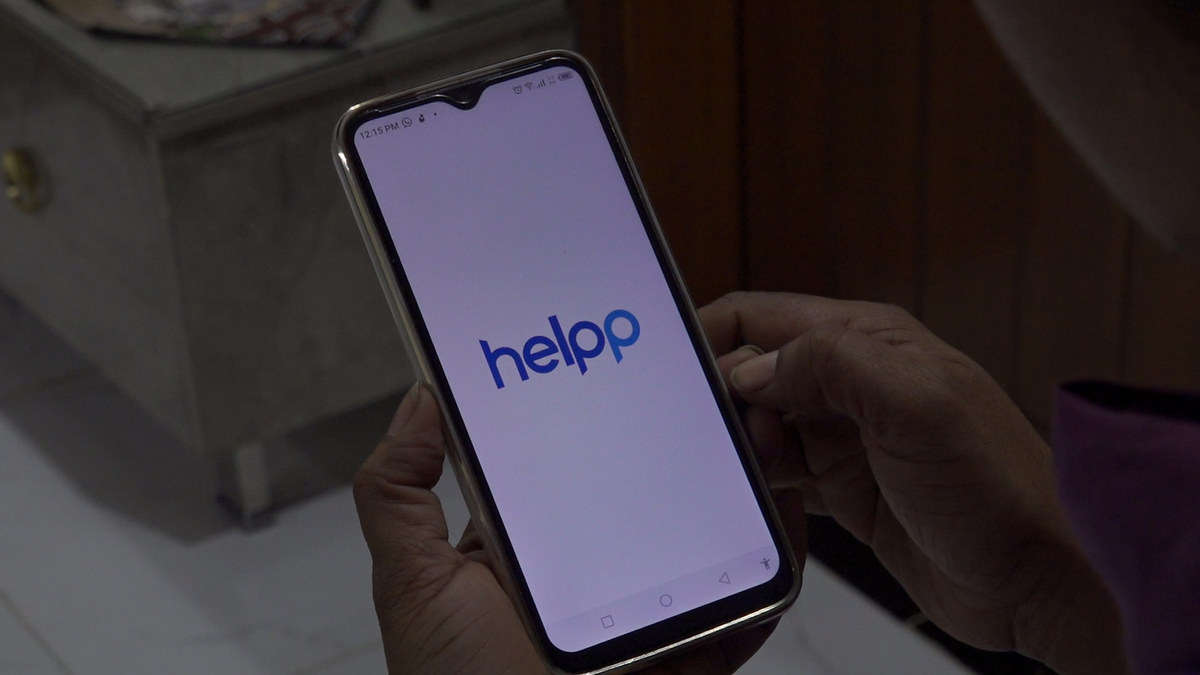
The picture taken on January 11, 2024, shows Saima Victor, a 40-year-old beautician, using Helpp app to find clients in Karachi, Pakistan. (AN photo)
Victor gets booking orders directly from clients on her mobile phone, while her husband, Joseph Victor, takes her to customers in different areas of the city.
Breaking away from conventional norms of the Pakistani society, Joseph quit working as a daily wager at an auto workshop and took on the role of a driver to ensure that his spouse navigated her work commitments seamlessly.
He says he is happy with “what we earn together while saving her from big hassle of commute by a woman in the city.”
This dynamic shift has granted Victor and her husband the means to carve a niche in the industry, while offering a modest yet empowering income.
Naveeza Kamran, another 26-year-old beautician who joined the app in 2022, says it had helped increase her income from Rs20,000 ($71) to more than Rs50,000 ($177).
“My husband works at a furniture market where he sometimes gets work and sometimes he does not,” she said, adding that through Helpp, she could share the burden of their household expenses.
In the face of economic challenges and rising costs of living in Pakistan, online platforms across various sectors are emerging as a crucial lifeline for households, providing an effective means to navigate the dire economic situation.
The technology is not only alleviating financial woes and time constraints of beauticians like Victor and Kamran, but it is also rescuing customers from waiting for long at salons, traffic jams, and transportation costs.
Sadia Bilal, a 26-year-old teacher who booked a slot with Victor, believed economical services within one’s comfort zone were the best option to avail through technology.
“I had to go to an event and it was most convenient for me to avail services online by using the technology, instead of going out and facing huge traffic and paying high prices,” Bilal told Arab News.
“I am getting the services at economical rates and that too within my comfort zone, sitting at my home.”
Helpp officials say women have increased their income manifolds by using their app.
“If we see the offline model of salon services, these beauticians are earning around Rs10,000 to Rs25,000 per month and working abnormal hours from 12 to 15 hours daily, leaving their kids behind,” said Asra Anwar-ul-Haq, category head at Helpp.
“What we are providing them is flexible working hours. We have elevated their income by 5x as compared to the offline market.”
About the idea behind the salon category, Haq said their startup, Helpp Technology, saw ‘salon-at-home’ opportunity in the market after the COVID-19 pandemic, because a lot of people had started pursuing such kind of salon services.
Haq said her platform was aiming to empower around 100,000 women in Pakistan within the next five years.
“Basically, our vision, of Helpp, overall is to impact around 100,000 women in the coming years,” she said, adding the goal was to make them financially independent.
Kamran, who recently bought a washing machine for herself as well as gifted a motorbike to her husband to ride to work, said she had stopped dreaming about the things she wanted because she could now afford them.
“I no more dream about things,” Kamran told Arab News. “Now I can afford things since I am able to use technology that has enabled me to augment my income.”