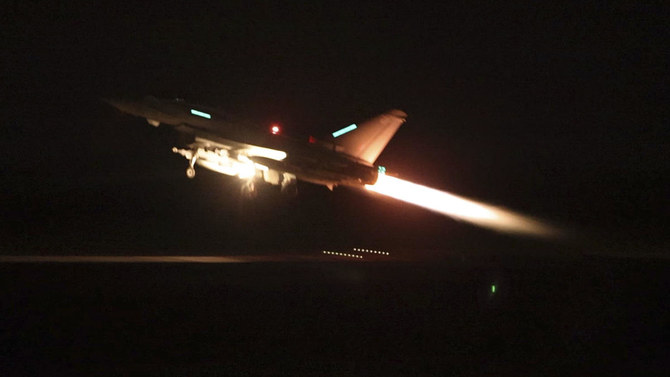
TEHRAN: Iran on Friday lambasted strikes in Yemen by US and British forces, saying that the attacks against Tehran-backed Houthi rebels were “arbitrary” and a “violation” of international law.
The overnight strikes followed weeks of missile and drone attacks by Houthi forces on vessels in the Red Sea, claiming to act in solidarity with Palestinians in the war-ravaged Gaza Strip.
Iranian foreign ministry spokesman Nasser Kanani said in a statement that Tehran “strongly condemned the military attacks of the United States and the United Kingdom this morning on several Yemeni cities.”
He said the strikes were “an arbitrary action, a clear violation of the sovereignty and territorial integrity of Yemen, and a violation of international laws and regulations.”
The United States and its allies said in a joint statement following the air strikes on Houthi targets that their goal “remains to de-escalate tensions and restore stability in the Red Sea.”
The attacks by the Houthis have disrupted traffic through the vital maritime route, with some companies suspending passage through the area.
Kanani warned that the attacks “will have no result other than fueling insecurity and instability in the region” as well as “diverting the world’s attention from the crimes” in Gaza, where Israel has been fighting the Palestinian territory’s Hamas rulers.
The Iranian spokesman urged the international community to take action “to prevent the spread of war.”
The Israel-Hamas war erupted on October 7 with attacks by Palestinian militants on southern Israel, resulting in about 1,140 deaths, mostly civilians, according to an AFP tally based on Israeli figures.
Iran, which supports Hamas financially and militarily, has hailed the attack but denied any involvement.
Israel has responded with a relentless military campaign that has killed more than 23,000 people in the besieged Gaza Strip, the majority of them women and children, according to the health ministry in the Hamas-ruled territory.
The Islamic republic has repeatedly warned of a widening conflict. Foreign Minister Hossein Amir-Abdollahian in November said the intensity of the war had rendered its expansion “inevitable.”
The Houthi rebels — part of the regional Tehran-aligned “axis of resistance” against Israel and its allies — seized Yemen’s capital Sanaa in 2014 and now control large swathes of the country.
Washington had said Iran was “deeply involved” in the Houthis’ maritime attacks, a claim Tehran has denied.
President Ebrahim Raisi has said Iran sees it as “its duty to support the resistance groups” but insisted that they “are independent in their opinion, decision and action.”


![]()

Iran condemns ‘arbitrary’ US, UK strikes on Yemen rebels
Short Url
https://arab.news/ng2s3
Iran condemns ‘arbitrary’ US, UK strikes on Yemen rebels
- The Iranian spokesman urged the international community to take action “to prevent the spread of war.”


Latest updates






© 2026 SAUDI RESEARCH & PUBLISHING COMPANY, All Rights Reserved And subject to Terms of Use Agreement.