

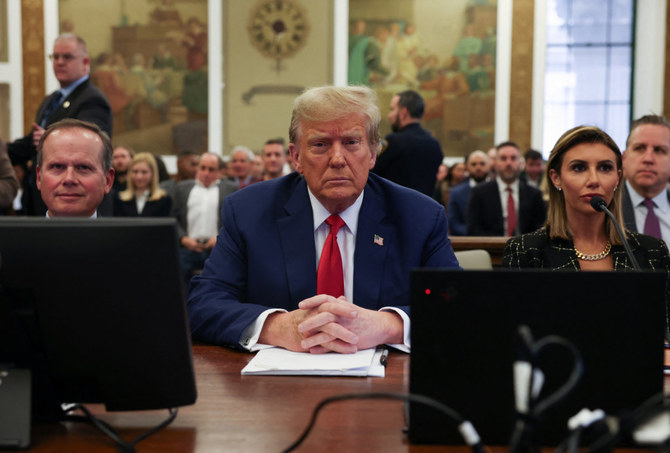


NEW YORK: Barred from giving a formal closing argument, Donald Trump wrested an opportunity to speak in court at the conclusion of his New York civil fraud trial Thursday, unleashing a barrage of attacks in a six-minute diatribe before being cut off by the judge.
Trump spoke as the judge was trying to find out if the former president would follow rules requiring him to keep his remarks focused on matters related to the trial. Asked whether he would comply with the guidelines, Trump defied the judge and simply launched into his speech.
“I am an innocent man,” Trump protested. “I’m being persecuted by someone running for office and I think you have to go outside the bounds.”
Judge Arthur Engoron — who earlier denied Trump’s extraordinary request to give his own closing statement — let him continue almost uninterrupted for what amounted to a brief personal summation, then cut him off for a scheduled lunch break.
Trump’s in-court remarks, which were not televised, ensured a tumultuous final day for a trial over allegations that he habitually exaggerated his wealth on financial statements he provided to banks, insurance companies and others.
New York Attorney General Letitia James, a Democrat, sued Trump in 2022 under a state law that gives her broad power to investigate allegations of persistent fraud in business dealings. She wants the judge to impose $370 million in penalties and forbid Trump from doing business in New York.
Adding to the day’s tension, the exchanges took place hours after authorities responded to a bomb threat at the judge’s house in New York City’s suburbs. The scare didn’t delay the start of court proceedings.

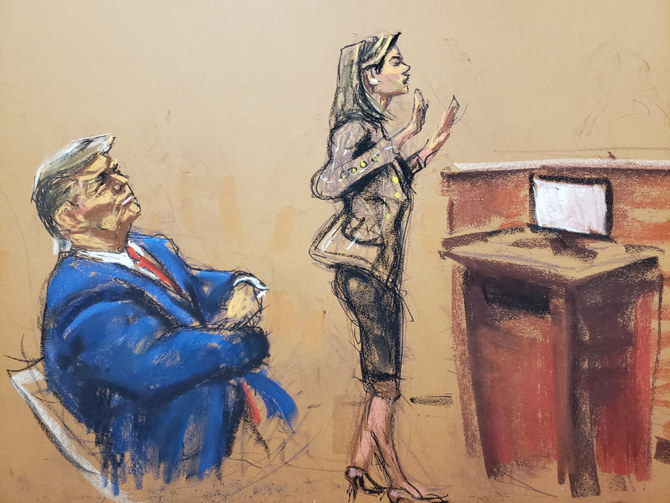
Lawyer Alina Habba gives closing arguments with former US president Donald Trump watching in the Trump Organization civil fraud trial at New York State Supreme Court in the Manhattan borough of New York City on January 11, 2024 in this courtroom sketch. (REUTERS/Jane Rosenberg)
Trump, the leading contender for the Republican presidential nomination, has disparaged Engoron throughout the trial, accusing him in a social media post Wednesday night of working closely with James.
On Wednesday, Engoron had rejected an unusual plan by Trump to deliver his own closing remarks in the courtroom, in addition to summations from his legal team. The sticking point was that Trump’s lawyers would not agree to the judge’s demand that he stick to “relevant” matters and not try to introduce new evidence or make a campaign speech.
After two of Trump’s lawyers had delivered traditional closing arguments Thursday, one of them, Christopher Kise, asked the judge again whether Trump could speak. Engoron asked Trump whether he would abide by the guidelines.
Trump then launched into his remarks.
“This is a fraud on me. What’s happened here, sir, is a fraud on me,” Trump said. He later accused the judge of not listening to him. “I know this is boring to you.”
“Control your client,” Engoron warned Kise.
Engoron then told Trump he had a minute left, let him speak a little more, and then adjourned.
In the afternoon, a lawyer for New York state said in his closing remarks that Trump and his “cash poor” company couldn’t have completed various development projects without loans and cash flow from interest savings enabled by spurious financial statements.
“Fraud was central to the operation of the Trump Organization’s business,” said the attorney, Kevin Wallace. He said that Trump and the other defendants intentionally put false information in the company’s financial statements.
Engoron, who is deciding the case because state law doesn’t allow for juries in this type of lawsuit, ended the court day by saying he hoped to have a final decision in the case by Jan. 31.
“Not a promise, not a guarantee, but I’m reasonably confident,” he said, adding, “You’ll be hearing from me,” as he left the bench.
Trump skipped the afternoon court session in favor of a news conference that served as counter programming to the state’s closing argument. He peppered his remarks at a lower Manhattan office building he owns — and could lose control of as a result of the trial — with barbs about President Joe Biden and a writer who accused him of rape, E. Jean Carroll.
James told reporters after exiting court, “This case has never been about politics or personal vendetta or about name calling. This case is about the facts and the law. And Mr. Donald Trump violated the law.”
“I trust that justice will be done,” she said.
The day began with police on Long Island checking out the threat at Engoron’s Long Island home. At 5:30 a.m. Nassau County police said they responded to a “swatting incident” at the house in Great Neck. Nothing amiss was found at the location, officials said.
Taking the bench a few minutes late, Engoron made no mention of the incident.
The false report came days after a fake emergency call reporting a shooting at the home of the judge in Trump’s Washington, D.C. criminal case. The incidents are among a recent spate of similar false reports at the homes of public officials.
Engoron decided some of the key issues before testimony began. In a pretrial ruling, he found that Trump had committed years of fraud by lying about his riches on financial statements with tricks like claiming his Trump Tower penthouse was nearly three times its actual size.
The trial involves six undecided claims, including allegations of conspiracy, insurance fraud and falsifying business records. Trump’s company and two of his sons, Eric Trump and Donald Trump Jr., are also defendants. Eric Trump was also in court for closing arguments.
During his argument, Kise contended Trump did nothing wrong and didn’t mislead anyone about his wealth. He said his client “should get a medal” for his business acumen instead of punishment he deemed the “corporate death penalty.”
“This entire case is a manufactured claim to pursue a political agenda,” Kise said.
Since the trial began Oct. 2, Trump has gone to court nine times to observe, testify and complain to TV cameras about the case.
He clashed with Engoron and state lawyers during 3½ hours on the witness stand in November and remains under a limited gag order after making a disparaging and false social media post about the judge’s law clerk.
Thursday’s arguments were part of a busy legal and political stretch for Trump.
On Tuesday, he was in court in Washington, D.C., to watch appeals court arguments over whether he is immune from prosecution on charges that he plotted to overturn the 2020 election — one of four criminal cases against him. Trump has pleaded not guilty. On Monday, the presidential primary season kicks off with the Iowa caucus.
State lawyers say that by making himself seem richer, Trump qualified for better loan terms from banks, saving him at least $168 million.
Kise acknowledged that some holdings may have been listed “higher by immaterial” amounts, but he added” “there’s plenty of assets that were undervalued by substantial sums.”
Last month, in a ruling denying a defense bid for an early verdict, the judge signaled he’s inclined to find Trump and his co-defendants liable on at least some claims.
“Valuations, as elucidated ad nauseum in this trial, can be based on different criteria analyzed in different ways,” Engoron wrote in the Dec. 18 ruling. “But a lie is still a lie.”


