

Syria extends aid deliveries via Turkiye for six months

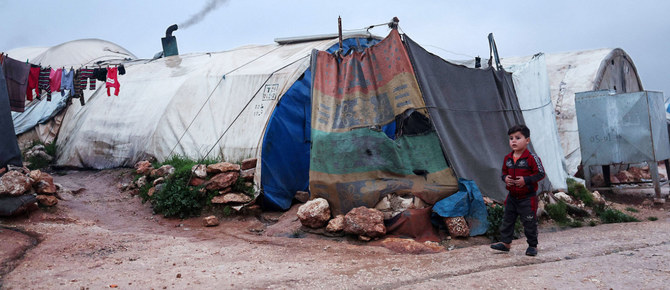
A boy walks in front of tents at a camp for displaced Syrians near the town of Maarrat Misrin in the Idlib governorate. (AFP)
Short Url
Updated 13 January 2024
Follow

Syria extends aid deliveries via Turkiye for six months

  • The permission granted by the Assad regime for aid deliveries through the  Bab Al-Hawa crossing expires on Jan. 13
  • Syria granted another permission for aid deliveries from the Bab Al-Salam and Al Ra’ee crossings, but that will also expire on Feb. 13

BEIRUT: The Syrian regime has extended its approval for humanitarian aid to be delivered to opppsition-held parts of the country’s northwest through a border crossing with Turkiye for another six months.
The UN has been using the Bab Al-Hawa crossing from Turkiye to deliver aid to millions in northwest Syria since 2014 with authorization from the UN Security Council.
That expired in mid-2023 after the 15-member body failed to reach an agreement to extend it, and the Syrian regime then said the UN could continue using the Bab Al-Hawa crossing for another six months.

BACKGROUND

The UN has been using the Bab Al-Hawa crossing from Turkiye to deliver aid to millions in northwest Syria since 2014 with authorization from the UN Security Council.

In a diplomatic note seen by Reuters and dated Thursday, Syria’s mission to the UN said Damascus would “extend its permission granted to the United Nations to use Bab Al-Hawa crossing to deliver humanitarian assistance to the North-West of Syria for an additional period of six months until July 13, 2024.”
Damascus has also allowed the UN to send aid through two other Turkish crossings after an earthquake killed more than 50,000 people in Turkiye and Syria last year.
That authorization is set to expire on Feb. 13.
Turkiye has been seeking renewals to both sets of authorizations as interest levels and funding priorities have hampered the aid response.
Millions of people in the northwest rely on aid deliveries through Turkiye to access food, medicine, and other basic needs.
After nearly 13 years of conflict, many across the country are living in their most dire economic conditions yet, with nine out of 10 Syrians living under the poverty line.


Algeria parliament to vote on law declaring French colonization ‘state crime’

Updated 58 min 10 sec ago
Follow

Algeria parliament to vote on law declaring French colonization ‘state crime’

  • The vote comes as the two countries are embroiled in a major diplomatic crisis

ALGERIA: Algeria’s parliament is set to vote on Wednesday on a law declaring France’s colonization of the country a “state crime,” and demanding an apology and reparations.
The vote comes as the two countries are embroiled in a major diplomatic crisis, and analysts say that while Algeria’s move is largely symbolic, it could still be politically significant.
The bill states that France holds “legal responsibility for its colonial past in Algeria and the tragedies it caused,” according to a draft seen by AFP.
The proposed law “is a sovereign act,” parliament speaker Brahim Boughali was quoted by the APS state news agency as saying.
It represents “a clear message, both internally and externally, that Algeria’s national memory is neither erasable nor negotiable,” he added.
France’s colonization of Algeria from 1830 until 1962 remains a sore spot in relations between the two countries.
French rule over Algeria was marked by mass killings and large-scale deportations, all the way to the bloody war of independence from 1954-1962.
Algeria says the war killed 1.5 million people, while French historians put the death toll lower at 500,000 in total, 400,000 of them Algerian.
French President Emmanuel Macron has previously acknowledged the colonization of Algeria as a “crime against humanity,” but has stopped short of offering an apology.
Asked last week about the vote, French foreign ministry spokesman Pascal Confavreux said he would not comment on “political debates taking place in foreign countries.”
Hosni Kitouni, a researcher in colonial history at the University of Exeter in the UK, said that “legally, this law has no international scope and therefore is not binding for France.”
But “its political and symbolic significance is important: it marks a rupture in the relationship with France in terms of memory,” he said.