

In major development, second Pakistani Supreme Court judge resigns in as many days

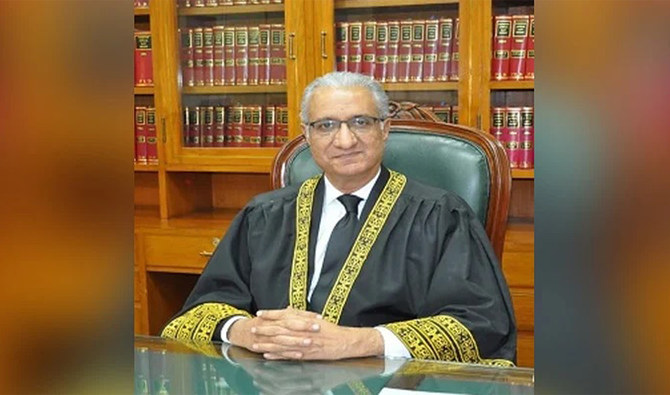
The undated photo shows Pakistani Supreme Court judge, Justice Ijaz Ul Ahsan. (Supreme Court of Pakistan)
Short Url
Updated 11 January 2024
Follow

In major development, second Pakistani Supreme Court judge resigns in as many days

  • Justice Ijaz Ul Ahsan was in line to become Pakistan’s next chief justice in October this year
  • Legal experts term development “unfavorable omen” for Pakistani judiciary’s credibility 

ISLAMABAD: In a significant development on Thursday, another Pakistani Supreme Court judge resigned from his post, making him the second judge to do so in as many days in what legal experts said was a sign of “serious rifts” in the country’s judiciary. 

Justice Ahsan, the third-most senior judge of the Supreme Court, was poised to assume the coveted post of chief justice after the country’s incumbent top judge, Chief Justice Qazi Faiz Isa, retires in October this year. 

His resignation comes a day after Justice Muhammad Mazahar Ali Akbar Naqvi also hung up his robes. Justice Naqvi was facing allegations of misconduct and was being investigated by the Supreme Judicial Council (SJC). On Tuesday, the Supreme Court dismissed his plea to halt SJC’s proceedings against him. 

“I no longer wish to continue as a judge of the Supreme Court of Pakistan,” Justice Ahsan wrote in his resignation letter addressed to the president, a copy of which was seen by Arab News. 

“Therefore, I, Justice Ijaz Ul Ahsan, resign as a Judge of the Supreme Court of Pakistan in terms of Article 206 (1) of the Constitution with immediate effect.”

Justice Ahsan, who was part of the five-member SJC, had declined to join other members of the council on November 22, 2023 in issuing a fresh show-cause notice to Justice Naqvi.

He also objected to the SJC’s proceedings this week against Justice Naqvi and did not participate in the council’s hearing held today, Thursday.

Legal experts termed Ahsan’s resignation as an unfavorable omen for the judiciary’s credibility.

“These developments are not a good omen and would impact the judiciary very severely,” ex-attorney general of Pakistan, Anwar Mansoor Khan, told Arab News.

Khan said the resignations showed that Pakistan’s judicial system had been compromised.

“The manner in which they [judges] have resigned shows such serious rifts between the judges [exist], which is not an appropriate thing to do because judges are there to give justice to people,” he added.

Legal expert Barrister Afzaal Hussain termed Justice Ahsan’s resignation a “big development.” 

“Justice Ijaz Ul Ahsan was supposed to become the chief justice in the next few months, so his resignation is significant,” Hussain told Arab News.

Usama Khawar, another legal expert, said both judges had been on the wrong side of the military establishment for some time. 

“Both of them had given some judgments,” he said. “Now, whether they have any connection with them or not, there is a perception that they were considered pro-PTI,” Khawar added, referring to former prime minister Imran Khan’s Pakistan Tehreek-e-Insaf (PTI) party. 

“For judicial credibility, It is very important that people know the real reasons for their resignations, as justice must not only be done, it should also be seen to be done,” he added.


Pakistan says repaid over $13.06 billion domestic debt early in last 14 months

Updated 29 January 2026
Follow

Pakistan says repaid over $13.06 billion domestic debt early in last 14 months

  • Finance adviser says repayment shows “decisive shift” toward fiscal discipline, responsible economic management
  • Says Pakistan’s total public debt has declined from over $286.6 billion in June 2025 to $284.7 billion in November 2025

KARACHI: Pakistan has repaid Rs3,650 billion [$13.06 billion] in domestic debt before time during the last 14 months, Adviser to the Finance Minister Khurram Schehzad said on Thursday, adding that the achievement reflected a shift in the country’s approach toward fiscal discipline. 

Schehzad said Pakistan has been repaying its debt before maturity, owed to the market as well as the State Bank of Pakistan (SBP), since December 2024. He said the government had repaid the central bank Rs300 billion [$1.08 billion] in its latest repayment on Thursday. 

“This landmark achievement reflects a decisive shift toward fiscal discipline, credibility, and responsible economic management,” Schehzad wrote on social media platform X. 

Giving a breakdown of what he said was Pakistan’s “early debt retirement journey,” the finance official said Pakistan retired Rs1,000 billion [$3.576 billion] in December 2024, Rs500 billion [$1.78 billion] in June 2025, Rs1,160 billion [$4.150 billion] in August 2025, Rs200 billion [$715 million] in October 2025, Rs494 billion [$1.76 billion] in December 2025 and $1.08 billion in January 2026. 

He said with the latest debt repaid today, the July to January period of fiscal year 2026 alone recorded Rs2,150 billion [$7.69 billion] in early retirement, which was 44 percent higher than the debt retired in FY25.

He said of the total early repayments, the government has repaid 65 percent of the central bank’s debt, 30 percent of the treasury bills debt and five percent of the Pakistan Investment Bonds (PIBs) debt. 

The official said Pakistan’s total public debt has declined from over Rs 80.5 trillion [$286.6 billion] in June 2025 to Rs80 trillion [$284.7 billion] in November 2025. 

“Crucially, Pakistan’s debt-to-GDP ratio, around 74 percent in FY22, has declined to around 70 percent, reflecting a broader strengthening of fiscal fundamentals alongside disciplined debt management,” Schehzad wrote. 

Pakistan’s government has said the country’s fragile economy is on an upward trajectory. The South Asian country has been trying to navigate a tricky path to economic recovery under a $7 billion loan from the International Monetary Fund.