KARACHI: After Karachi’s Zahid Nihari made it to TasteAtlas’ list of ‘Most Iconic Food Places in the World’ last week, its owner says it was a “proud moment” for the family that began the business in the southern Pakistani port city more than four decades ago and is now known worldwide for its rich taste and quality.
TasteAtlas is a world atlas of traditional dishes, local ingredients and authentic restaurants. Last week, it issued a list of top 150 restaurants in the world to try in 2024 and Zahid Nihari secured the 89th spot on the list. Out of 23,751 traditional eateries in TasteAtlas’ database, these restaurants were chosen for their “longevity, reliability, and iconic status,” according to the TasteAtlas official website.
Abubaker Bilal, one of the owners of Zahid Nihari, says his late grandfather, Baksh Ilahi, had launched the iconic nihari, a slow-cooked beef stew, in 1980 by opening a shop in Karachi’s Saddar area. In 2006, Bilal’s family opened its second branch on the city’s famous Tariq Road.
The nihari outlet, which was named after Ilahi’s son Zahid, has continued to attract a large number of customers since its inception, according to Bilal.
“Pakistan made a mark in the top 100 [restaurants] globally through us so it’s a proud moment for us,” 34-year-old Bilal, who runs the Tariq Road branch of the restaurant, told Arab News on Saturday. “People have loved Zahid Nihari since the beginning.”
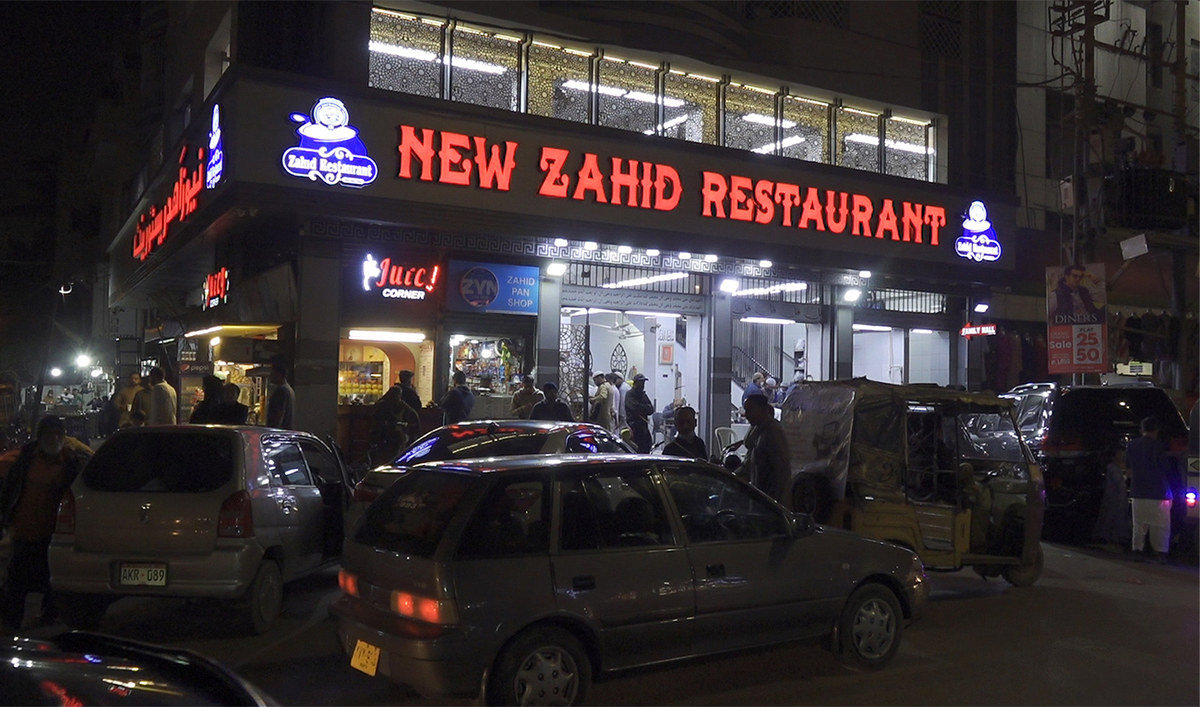
Cars drive past Zahid Nihari restaurant in Karachi, Pakistan, on January 6, 2024. (AN photo)
The slow-cooked beef stew is “renowned for its rich flavor and tender meat, served in a basic, no-frills environment,” according to TasteAtlas, which describes Zahid Nihari as a “landmark in Karachi for traditional Pakistani cuisine.”
“Indeed, Zahid Nihari is at the number 89,” the TasteAtlas Editorial confirmed to Arab News on Friday, in an email exchange about their list of ‘Most Iconic Food Places in the World.’
On Saturday, Arab News visited the Tariq Road branch of the eatery and it was fully occupied, with many families waiting for their turn.
“We like beef nihari, maghaz (brain) nihari and their special nihari that has both. I am having their nihari ever since I came to Karachi,” Nadeem Bhatti, who works at a private firm, told Arab News on Saturday.
Bhatti, who moved to Karachi from Multan in 1997, said he visited the restaurant with family once a month for a relaxing time after their shopping spree.
“Within the domain of nihari, Zahid Nihari has managed to make people happy,” he said. “Zahid Nihari is the best.”
Many of the customers are regular visitors, especially during winters.
“We have been having nihari from here since I was born. Before marriage, my father used to bring us. After marriage, I come here with my husband who is also fond of it. We have come from quite afar,” Rabya Masood, a schoolteacher, told Arab News.
“We visit more frequently in winters because it is an even better experience then. Definitely [Zahid Nihari deserves a spot in top 100 restaurants]. It’s a very proud moment for us.”
Masood said the restaurant served nihari in “good quantity” at a reasonable price, besides taking customer demands into consideration.
The turnout is “huge” on weekends, particularly on Sundays, when the business starts early in the morning, according to Bilal. The restaurant stands out among other nihari outlets in the city because it doesn’t compromise on quality.
“We have special nihari on Sunday and people come to have it from far flung areas,” he said. “We get whole spices and grind them under our supervision. Then we use it very efficiently to make nihari.”
Another customer, Nurain Sheikh, came to the restaurant with his father, friends and his cousins, who were visiting from outside Karachi.
“It’s a tradition to have Zahid Nihari every Friday [after prayers]. We have it in office every Friday while we visit twice or thrice a month with family,” Sheikh told Arab News.
Sheikh said the taste, quality and aroma of Zahid Nihari was the “best” and to him it deserved the “number one” spot on the list.
“Their meat quality and the bong (beef shank) nihari [sets them apart]. I have tried everything. I am a foodie. I eat out every single day but this is the best place,” he added.