

Somalia signs law ‘nullifying’ Ethiopia-Somaliland port pact

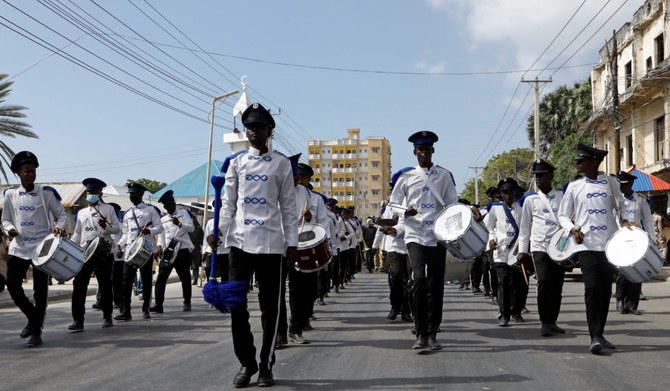
Police band members take part in a march against the Ethiopia-Somaliland port deal in Mogadishu, Somalia. The port agreement has raised tensions in the Horn of Africa. (Reuters)
Short Url
Updated 07 January 2024
Follow

Somalia signs law ‘nullifying’ Ethiopia-Somaliland port pact

  • Passage of the bill ‘is an illustration of our commitment to safeguard our unity’

NAIROBI: Somalia’s president has signed a law “nullifying” a contentious agreement between Ethiopia and Somaliland in a largely symbolic gesture of his government’s displeasure over the deal to grant port access.

President Hassan Sheikh Mohamud said the law voided the “illegal” pact, giving landlocked Ethiopia long-sought access to the Red Sea through Somaliland, a separatist northwestern region where Somalia exercises little real authority.
The passage of the bill on Saturday evening “is an illustration of our commitment to safeguard our unity, sovereignty & territorial integrity as per international law,” the president wrote on X, formerly Twitter.

BACKGROUND

The central government in Mogadishu called the surprise pact signed on Monday an act of ‘aggression’ and a violation of its sovereignty and appealed for international support.

The central government in Mogadishu has vowed to strenuously oppose by any legal means the port agreement between regional power Ethiopia and Somaliland, whose 1991 claim of independence from Somalia is not recognized internationally.
Somalia called the surprise pact signed on Monday an act of “aggression” and a violation of its sovereignty and appealed for international support.
It staunchly opposes Somaliland’s claim to independence but has little say over the affairs of the de facto state, which has its government, security forces, currency, and a long coastline on one of the world’s busiest shipping routes.
Somaliland’s leadership has said Ethiopia would “formally recognize the Republic of Somaliland” under the deal, but this has not been confirmed by the government in Addis Ababa.
The agreement has raised tensions in the Horn of Africa, and the African Union, US, EU, and the Arab League have called for calm and for Somalia’s sovereignty to be respected.
The memorandum of understanding gives Ethiopia access to commercial maritime services and a military base, with Somaliland leasing 20 km of coastline for 50 years.
Ethiopia, the second most populous country in Africa and one of the biggest landlocked nations in the world was cut off from the coast after Eritrea seceded and declared independence in 1993 following a three-decade war.
Addis Ababa had maintained access to a port in Eritrea until the two countries went to war in 1998-2000, and since then Ethiopia funnels most of its trade through Djibouti.


‘Stay out of our politics,’ Australia’s former PM tells Netenyahu

Former Australian Prime Minister Malcolm Turnbull talks to the UK’s Channel 4 News. (Screenshot)
Updated 7 sec ago
Follow

‘Stay out of our politics,’ Australia’s former PM tells Netenyahu

  • Turnbull slams Israeli prime minister in Channel 4 interview
  • Netanyahu’s attempts to link Bondi massacre to Palestine policy ‘unhelpful’

LONDON: Australia’s former prime minister Malcolm Turnbull has told Benjamin Netanyahu to “stay out of our politics” after the Israeli leader linked the recognition of Palestine to the Bondi Beach mass shooting.
Fifteen people were killed when a father and son opened fire on people celebrating the Jewish festival of Hanukkah on Sunday evening.
Netanyahu said Australia's decision to recognize Palestinian statehood earlier this year had poured “oil on the fire of antisemitism” in the weeks leading up to the attack.
When asked about the comments on Channel 4 News in the UK, Turnbull said: “I would respectfully say to Bibi Netanyahu, please stay out of our politics.
“If you've got that kind of commentary to make, you are not helping … and it’s not right.”
Turnbull backed the current Australian Prime Minister Anthony Albanese’s government for recogizing Palestinian statehood in August along with many other Western nations as international pressure grew over the war in Gaza.
In a speech after the Bondi attack, Netanyahu said: “A few months ago I wrote to the Australian prime minister that your policy is pouring oil on the fire of antisemitism.”
He added: “Antisemitism is a cancer that spreads when leaders are silent.”
Turnbull said the vast majority of countries in the world recognize Palestine as a state and support a two-state solution to the conflict.
He said Australia is a very successful multicultural society that can not allow foreign conflicts to be imported.
“We need to ensure that that wars in the Middle East or wars in any other part of the world are not fought out here,” he said. “Trying to link them, which is what Netanyahu has done, is not helpful and that's exactly the reverse of what we want to achieve.”
Albanese also rejected Netanyahu’s comments when asked about whether there was a link between his approach to Palestine and the Bondi attack.
“Overwhelmingly, most of the world recognizes a two-state solution as being the way forward in the Middle East,” he told broadcasters. “This is a moment of national unity where we need to come together … We need to wrap our arms around members of the Jewish community who are going through an extraordinarily difficult period.”
Albanese visited in hospital the man hailed a s hero for disarming one of the attackers.
Ahmed Al-Ahmed, a shopkeeper who moved to Australia from Syria in 2007, is recovering after tackling the gunman.