

Arab League backs Somalia in rejecting Ethiopia-Somaliland deal

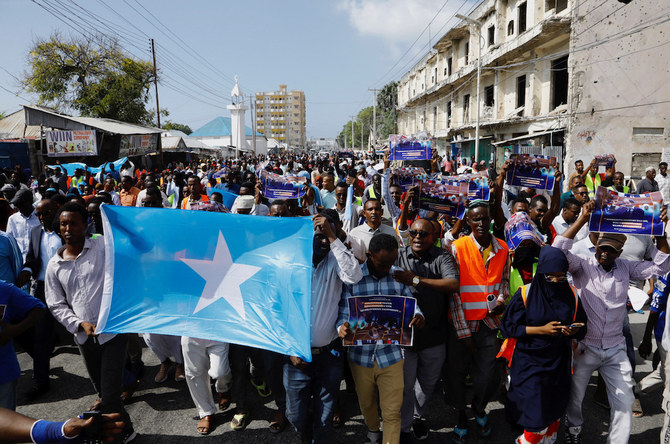
Somali people march against the Ethiopia-Somaliland port deal at the Yarisow stadium in Mogadishu, Somalia January 3, 2024. (Reuters)
Short Url
Updated 04 January 2024
Follow

Arab League backs Somalia in rejecting Ethiopia-Somaliland deal

  • Ethiopia signed agreement granting naval and commercial access to ports along Somaliland’s coast
  • Deal came in exchange for recognition of breakaway region’s independence

CAIRO: The League of Arab States and the Arab Parliament have voiced support for the Somali government in condemning a controversial deal between Ethiopia and Somaliland.

Ethiopia this week signed an agreement granting it naval and commercial access to ports along Somaliland’s coast in exchange for recognition of the breakaway region’s independence.

The Arab League said that the memorandum of understanding violated Somalia’s sovereignty and territorial integrity.

Somalia vowed on Tuesday to defend its territory by any legal means and recalled its ambassador to Ethiopia after Addis Ababa agreed the deal with Somaliland.

The agreement, signed by Ethiopian Prime Minister Abiy Ahmed and Somaliland leader Muse Bihi Abdi, will give Ethiopia access to the Red Sea port of Berbera.

Jamal Rushdi, spokesman for the secretary-general of the Arab League, condemned any deal that violates the sovereignty of the Somali state or attempts to take advantage of Somalia’s fragile internal situation.

He said that the Arab League supports the decision of the Somali Cabinet, which rejected the memorandum of understanding signed on Jan. 1, between Ethiopia and Somaliland as “null and void and unacceptable.”

Rushdi said the deal violates Somalia’s sovereignty, territorial integrity, and international law.

The Arab League also warned that the agreement could increase the spread of extremist ideas at a time when the Somali state was making considerable efforts to confront the issue.

Meanwhile, the Arab Parliament called on Ethiopia to “adhere to the rules and principles of good neighborliness, respect for countries’ sovereignty, and not interfere in their internal affairs to achieve regional security and stability.”

The Arab Parliament voiced its support for Somalia in any legal action to maintain its stability and national sovereignty.


UN warns of abuse of Palestinians returning to Gaza through Rafah crossing

Updated 7 sec ago
Follow

UN warns of abuse of Palestinians returning to Gaza through Rafah crossing

  • Human Rights Office describes pattern of ill-treatment, abuse and humiliation of returnees by Israeli forces, and by armed Palestinians allegedly backed by Israeli military
  • Meanwhile, reports continue of airstrikes, gunfire and shelling across Gaza, and Israeli forces demolish a UN-run school

NEW YORK CITY: The Rafah crossing on the border between Gaza and Egypt opened for a fourth consecutive day on Thursday, allowing a limited number of people to pass through.
However, the UN voiced concerns about reported mistreatment of Palestinians returning to the war-ravaged enclave.
The UN’s Office for the Coordination of Humanitarian Affairs also said reports continue across civilian areas in Gaza of airstrikes, gunfire and shelling, resulting in casualties and damage to infrastructure.
And Israeli forces on Wednesday demolished Jabalya Preparatory Boys’ School in northern Gaza, OCHA said. Run by the UN Relief and Works Agency for Palestine Refugees, it was the last remaining school in a compound of six. Its destruction means the entire educational complex has been razed to the ground.
A limited flow of people were allowed to use the Rafah crossing, Gaza’s main physical connection to the outside world, for four days in a row since it reopened on Monday, OCHA said. Only 98 returnees were received by UN teams inside Gaza between Monday and Thursday, it added, and the crossing remains closed on Fridays.
The UN Human Rights Office warned of what it described as a pattern of ill-treatment, abuse and humiliation of returnees by Israeli forces, and by armed Palestinians allegedly backed by the Israeli military.
According to accounts collected by the UN’s Human Rights Office, armed Palestinians handcuffed and blindfolded returnees, threatened and intimidated them, conducted searches and stole personal belongings and money. Returnees also reported violence, degrading interrogations and invasive body searches upon arrival at Israeli checkpoints.
The accounts point to conduct that violates the rights of Palestinians to personal security and dignity, and freedom from torture and other ill-treatment, the Human Rights Office said.
Meanwhile, the UN said it attempted to coordinate 11 humanitarian missions with the Israeli authorities on Wednesday and Thursday. Six were fully facilitated, but four faced lengthy delays at holding points along designated routes. Two of those missions were only partially completed, the other two eventually went ahead despite the delays.
A mission to monitor humanitarian cargo at the Kissufim crossing, east of Khan Younis, was denied on Wednesday after the crossing was closed.
The purposes of the missions included the collection of water, sanitation supplies, fuel and other items, medical evacuations through the Rafah crossing, and the transportation of returnees to Nasser Hospital in Khan Younis, OCHA said.