

Exiled opposition leader condemns ‘sham’ Bangladesh election

1 / 3
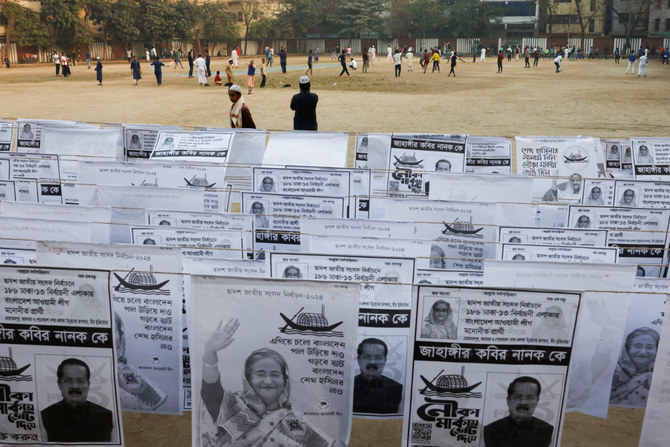
People play as election campaign posters of a candidate from Bangladesh's Awami League, with the picture of Prime Minister Sheikh Hasina hang in a park in Dhaka on January 3, 2024' ahead of the general election of Bangladesh. (Reuters)
2 / 3
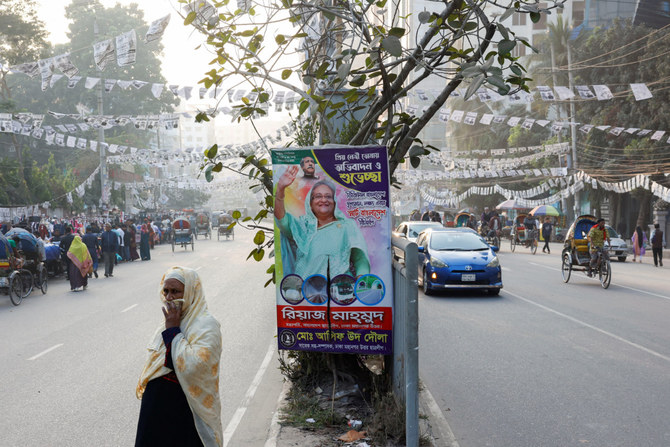
A woman looks is shown in front of a poster of Bangladesh Prime Minister Sheikh Hasina at a suburb in Dhaka on January 3, 2024. (Reuters)
3 / 3
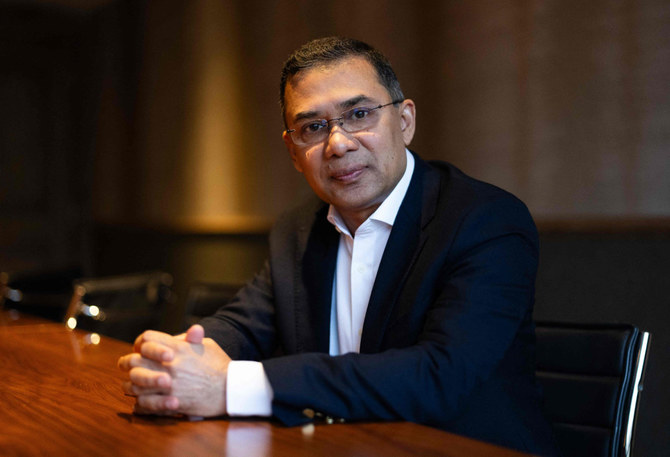
Acting chairman of Bangladesh Nationalist Party Tarique Rahman, poses for a portrait in a hotel in south-west London on December 30, 2023.(AFP)
Short Url
Updated 04 January 2024
Follow

Exiled opposition leader condemns ‘sham’ Bangladesh election

  • Tarique Rahman it useless to have his party participate in a vote with a “predetermined” outcome
  • He accused the ruling Awami League of fielding dummy candidates to give the election a patina of legitimacy

LONDON: Bangladesh’s election on Sunday will be a “sham” designed to cement Prime Minister Sheikh Hasina’s rule, exiled opposition leader Tarique Rahman has told AFP in an exclusive interview defending his party’s boycott.

Rahman is heir to one of the country’s two main political dynasties — the other led by Hasina — and has helmed its largest opposition party since the 2018 jailing of his mother, two-time premier Khaleda Zia.
Six years ago he was convicted in absentia of masterminding a deadly grenade attack on a campaign rally for Hasina — a charge he insists is fabricated — and sentenced to life imprisonment.
His party staged a months-long protest campaign last year demanding the prime minister’s resignation that saw at least 11 people killed and thousands of its supporters arrested.
In his first interview with a major international media outlet for several years, Rahman, 56, said it would be inappropriate to have his party participate in a vote with a “predetermined” outcome.
“Bangladesh is approaching another sham election,” he told AFP by email from London, where he has lived since 2008.
“Participating in an election under Hasina, against the aspirations of the Bangladeshi people, would undermine the sacrifices of those who fought, shed blood and gave their lives for democracy.”
Rahman said the odds against his Bangladesh Nationalist Party (BNP) and dozens of other parties which joined the boycott had been overwhelmingly stacked against them by the ruling Awami League.
He accused it of fielding “dummy” opposition candidates aligned with the ruling party to give the election a patina of legitimacy.
This would create “an impression of competition even though all results are predetermined,” he said.
He also claimed the party was attempting to drive up turnout by threatening to withhold government benefits from those who did not vote for Awami League candidates.
The United States, which sanctioned Bangladeshi security forces in 2021 over allegations of rights abuses, and other countries have also voiced their concerns about the conduct of this week’s vote.
Hasina, in power since 2009, has repeatedly vowed that the election would be credible, after observers said previous polls won by her party in 2014 and 2018 were marred by irregularities.
“Go to the polling stations and cast votes in the morning to show the world that we know how to hold the election in a free and fair manner,” she told a Saturday campaign rally.

Rahman and Hasina’s families have between them ruled the world’s eighth-most populous nation for all but 12 years since 1971.
Rahman’s father, a former army chief, took the reins of the country after the assassination of Hasina’s father, serving as president until his own assassination in 1981.
His mother Zia once teamed up with Hasina to restore democracy after a period of military rule, before the two became bitter adversaries as they competed for political power from the 1990s onward.
Rahman has kept a low profile in London since leaving his country shortly before Hasina took power.
He is rarely seen in public outside of weddings for prominent members of the Bangladeshi diaspora or events marking national holidays.
But with Zia jailed for corruption in 2018 and now confined to a Dhaka hospital in deteriorating health, Rahman has led the South Asian country’s largest opposition party in her stead, speaking daily with cadres through video and phone conferences.
Last year the BNP mounted huge rallies, industrial strikes and road blockades that brought the capital to a standstill.
The campaign demanded Hasina resign and appoint a neutral caretaker government to oversee the election, an earlier convention in Bangladeshi politics that her government had abolished.
One rally in October ended in bloodshed and the BNP said around 25,000 opposition activists had been arrested in the ensuing crackdown. The government puts the figure at 11,000.
Hasina has accused Rahman of orchestrating violence that accompanied the protest campaign and raised the prospect of banning the BNP after the vote.
“We will not allow him to give orders from London to harm and kill people,” she said on Saturday.

Rahman denied accusations that his party was responsible for a spate of arson attacks during the protests, which he described as a pretext for the government’s crackdown.
But his own political career has long been under a cloud.
A leaked US embassy cable from 2008 calls him a “notorious and widely feared... symbol of kleptocratic government” who had “flagrantly” demanded bribes in return for procurement decisions and political appointments.
He was frequently accused of corruption during his mother’s last premiership and was convicted of graft while in exile. He maintains his innocence.
Rahman was also convicted while abroad of organizing a 2004 grenade attack on a political rally that injured Hasina and killed at least 20 others.
He insists the verdict was politically motivated and accused Hasina of rewarding the police officer who led the probe against him with a parliamentary nomination for this week’s election.
“I am being targeted in a brutal and blatant manner,” he said.
“Even after fifteen years of power, this regime has failed to produce (any) single genuine evidence.”


UK’s Starmer calls Trump’s remarks on allies in Afghanistan ‘frankly appalling’

Updated 5 sec ago
Follow

UK’s Starmer calls Trump’s remarks on allies in Afghanistan ‘frankly appalling’

  • Britain lost 457 service personnel killed in Afghanistan, its deadliest overseas war since the 1950s

LONDON: British Prime Minister Keir Starmer called ​US President Donald Trump’s comments about European troops staying off the front lines in Afghanistan insulting and appalling, joining a chorus of criticism from other European officials and veterans.
“I consider President Trump’s remarks to be insulting and frankly appalling, and I’m not surprised they’ve caused such hurt for the loved ones of those who were killed or injured,” Starmer told reporters.
When asked whether he would demand an apology from the US leader, Starmer said: “If I had misspoken in that way or said those words, I would certainly apologize.”
Britain lost 457 service personnel killed in Afghanistan, its deadliest overseas war since the 1950s. For several of the war’s most intense years it led the allied campaign in Helmand, Afghanistan’s biggest and most violent province, ‌while also fighting as ‌the main US battlefield ally in Iraq.
Starmer’s remarks were notably strong coming ‌from ⁠a ​leader who has ‌tended to avoid direct criticism of Trump in public.
Trump told Fox Business Network’s “Mornings with Maria” on Thursday the United States had “never needed” the transatlantic alliance and accused allies of staying “a little off the front lines” in Afghanistan.
His remarks added to already strained relations with European allies after he used the World Economic Forum in the Swiss ski resort of Davos to again signal his interest in acquiring Greenland.
Dutch Foreign Minister David van Weel condemned Trump’s remarks on Afghanistan, calling them untrue and disrespectful.
Britain’s Prince Harry, who served in Afghanistan, also weighed in. “Those sacrifices deserve to be spoken about truthfully and with respect,” he said in a statement.

’WE PAID IN ⁠BLOOD FOR THIS ALLIANCE’
“We expect an apology for this statement,” Roman Polko, a retired Polish general and former special forces commander who also served in Afghanistan and ‌Iraq, told Reuters in an interview.
Trump has “crossed a red line,” he added. “We ‍paid with blood for this alliance. We truly sacrificed our ‍own lives.”
Britain’s veterans minister, Alistair Carns, whose own military service included five tours including alongside American troops in Afghanistan, called ‍Trump’s claims “utterly ridiculous.”
“We shed blood, sweat and tears together. Not everybody came home,” he said in a video posted on X.
Richard Moore, the former head of Britain’s MI6 intelligence service, said he, like many MI6 officers, had operated in dangerous environments with “brave and highly esteemed” CIA counterparts and had been proud to do so with Britain’s closest ally.
Under NATO’s founding treaty, members are bound by a collective-defense clause, Article ​5, which treats an attack on one member as an attack on all.
It has been invoked only once — after the September 11, 2001 attacks on New York and Washington, when allies pledged to support ⁠the United States. For most of the war in Afghanistan, the US-led force there was under NATO command.

POLISH SACRIFICE ‘MUST NOT BE DIMINISHED’
Some politicians noted that Trump had avoided the draft for the Vietnam War, citing bone spurs in his feet.
“Trump avoided military service 5 times,” Ed Davey, leader of Britain’s centrist Liberal Democrats, wrote on X. “How dare he question their sacrifice.”
Poland’s sacrifice “will never be forgotten and must not be diminished,” Defense Minister Wladyslaw Kosiniak-Kamysz said.
Trump’s comments were “ignorant,” said Rasmus Jarlov, an opposition Conservative Party member of Denmark’s parliament. In addition to the British deaths, more than 150 Canadians were killed in Afghanistan, along with 90 French service personnel and scores from Germany, Italy and other countries. Denmark — now under heavy pressure from Trump to transfer its semi-autonomous region of Greenland to the US — lost 44 troops, one of NATO’s highest per-capita death rates.
The United States lost about 2,460 troops in Afghanistan, according to the US Department of Defense, a figure on par per capita with those of Britain and Denmark. (Reporting by Sam ‌Tabahriti and Elizabeth Evans in London, Stine Jacobsen in Copenhagen and Terje Solsvik in Oslo, Malgorzata Wojtunik in Gdansk, additional reporting by Andrew MacAskill, Muvija M and James Davey in London and Bart Meijer in Amsterdam; Writing by Sam Tabahriti; editing by Gareth Jones, Andrew Heavens, Ros ‌Russell and Diane Craft)