Iran arrests four over bootleg alcohol deaths

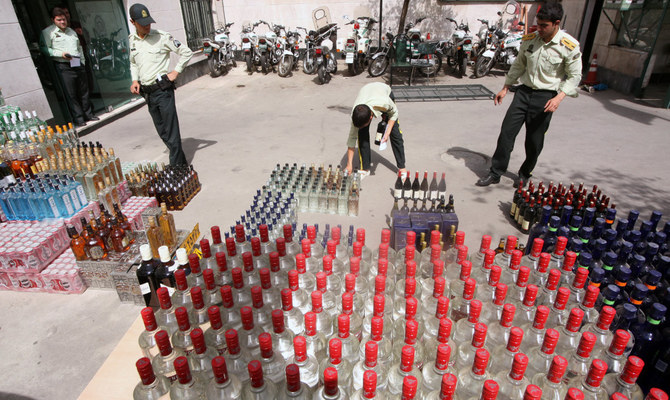
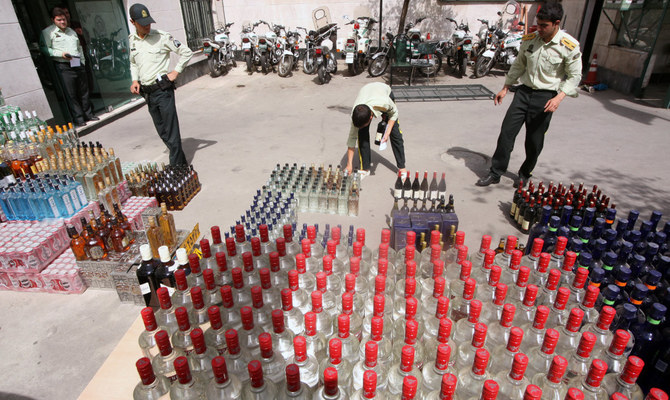
Iranian police prepare to destroy confiscated bottles of alcohol in Tehran. The possession, production and consumption of alcohol is strictly forbidden in the Islamic Republic. (AFP/File)
Short Url
Updated 04 January 2024
Follow

Iran arrests four over bootleg alcohol deaths

  • The sale and consumption of alcohol has been banned in Iran since the 1979 Islamic revolution, leading to a huge illicit trade in bootleg products, some of them adulterated with poisonous methanol

TEHRAN: Iranian authorities have arrested four people on suspicion of selling contaminated bootleg alcohol that killed at least three people, Iranian media reported Wednesday.

The sale and consumption of alcohol has been banned in Iran since the 1979 Islamic revolution, leading to a huge illicit trade in bootleg products, some of them adulterated with poisonous methanol.

“Three people have died of alcohol poisoning due to the consumption of counterfeit beverages,” said Saber Jafari, prosecutor for the city of Maku in the northwestern province of West Azerbaijan.

“Twenty people with symptoms of alcohol poisoning have been transferred to the city’s Fajr Hospital,” Jafari told the Fars news agency.

He said four people had been arrested and an investigation was underway.

Iran sentenced four people to death in September for selling contaminated bootleg alcohol that killed 17 people in June.

In the year to March, 644 people died after consuming “counterfeit alcoholic beverages,” Iran’s forensics institute said, a 30 percent increase on the previous 12-month period.

At the height of the COVID pandemic in 2020, at least 210 Iranians died after drinking bootleg alcohol, falsely believing it to be a remedy for the virus.

Only members of Iran’s Christian, Jewish and Zoroastrian minorities are exempt from the alcohol ban. Foreigners are required to respect it.


Hamas calls for sanctions against Israel over new West Bank moves

Updated 6 sec ago
Follow

Hamas calls for sanctions against Israel over new West Bank moves

  • Israel has approved a series of initiatives this month backed by far-right ministers
  • Hamas hailed the condemnation as “a step in the right direction in confronting the occupation’s expansionist plans

GAZA CITY, Palestinian Territories: Hamas on Tuesday called for sanctions against Israel, welcoming a joint condemnation by nearly 20 countries of new Israeli measures aimed at tightening control over the occupied West Bank.
Israel has approved a series of initiatives this month backed by far-right ministers, including launching a process to register land in the West Bank as “state property” and allowing Israelis to purchase land there directly.
Late on Monday, 18 countries including regional heavyweights Saudi Arabia, Egypt, and European powers France and Spain, slammed Israel over the recent moves.
They “are part of a clear trajectory that aims to change the reality on the ground and to advance unacceptable de facto annexation,” the countries said.
“Such actions are a deliberate and direct attack on the viability of the Palestinian state and the implementation of the two-state solution.”
Hamas hailed the condemnation as “a step in the right direction in confronting the occupation’s expansionist plans, which flagrantly violate international law and relevant UN resolutions.”
The group in a statement urged the countries involved “to impose deterrent sanctions and exert pressure on the fascist occupation government to halt its policies aimed at entrenching annexation, colonial settlement and forced displacement.”
It said the Israeli measures were part of ongoing “aggression” against Palestinians in the West Bank and Gaza.
In addition to roughly three million Palestinians, more than 500,000 Israelis live in settlements and outposts in the West Bank, which are considered illegal under international law.
Israel’s current government has accelerated settlement expansion, approving a record 54 settlements in 2025, according to activists.
The West Bank, which Israel has occupied since 1967, is envisioned as the core of a future Palestinian state, but many on Israel’s religious right view it as part of Israel’s historic homeland.