Speaker of Jordan’s lower house holds talks with Kuwaiti and UN envoys

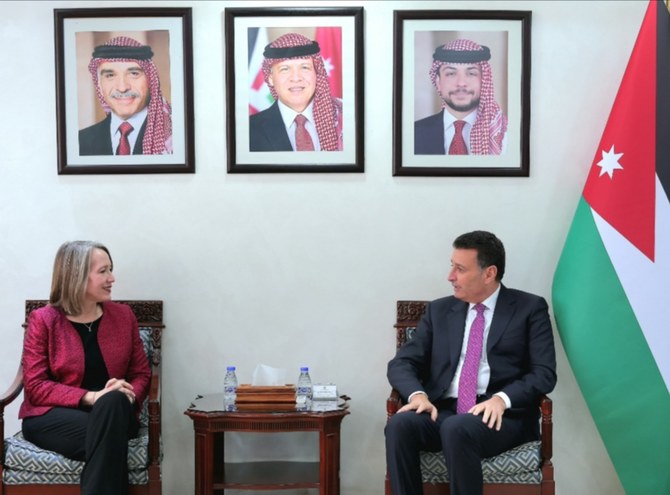
Ahmed Safadi, the speaker of Jordan's House of Representatives, and the UN’s resident coordinator in Jordan, Sheri Ritsema-Anderson. (Amman)
Short Url
Updated 04 January 2024
Follow

Speaker of Jordan’s lower house holds talks with Kuwaiti and UN envoys

  • Speaker also stressed that Jordan will continue to be a defender of justice and Palestinian rights

AMMAN: Ahmed Safadi, the speaker of the House of Representatives, the lower house of the Jordanian parliament, on Wednesday met the Kuwaiti ambassador to Jordan, Hamad Rashid Al-Marri, to discuss relations between the nations’ parliaments.

Safadi offered his condolences to Kuwait and its people for the death in December of the country’s emir, Sheikh Nawaf Al-Ahmad Al-Sabah.

He and Al-Marri emphasized the need for cooperative communication and consultation to best serve the common interests of their countries and strengthen ties under the leaderships of Jordan’s King Abdullah and Kuwait’s new emir, Sheikh Meshaal Al-Ahmad Al-Sabah.

Safadi said that through their policies, the two countries aim to serve the interests of Arab countries and the issues that affect them, the most important of which is the Palestinian cause, and stressed that Jordan will continue to be a defender of justice and Palestinian rights.

He added that Jordanians are unanimous in their support for Hashemite custodianship of Islamic and Christian holy sites in Jerusalem.

Safadi also had a separate meeting with the UN’s resident coordinator in Jordan, Sheri Ritsema-Anderson, during which they stressed the need to uphold human rights and the principles and concepts of international law without discrimination.

The two officials emphasized the importance of international support for King Abdullah’s efforts to end the war in Gaza. Safadi said the king and Queen Rania have repeatedly highlighted blatant double standards and the selective nature of efforts to implement international and human rights laws.

He also noted what he described as Western bias toward the deceptive narrative of the Israeli occupation that depicts the aggressor as the victim.

“All know, deep down, that the occupation’s acts are pure brutality,” he said, adding that the targeting of civilians, women and children, hospitals, schools, mosques and churches are war crimes and must be stopped.

He emphasized Jordan’s “unequivocal” rejection of any attempt to forcibly displace Palestinians from their homeland, adding that this would be a violation of international law with disastrous consequences for the region.

Ritsema-Anderson said the war on Gaza has shown that not all people are guaranteed universal human rights on an equal footing.

She added that the UN is committed to supporting Jordan’s efforts to achieve its humanitarian and development priorities and its strategic goals, especially with regard to the economy, education and food security.

Jordan, she said, is a “model” of stability, which everyone must support as a fundamental pillar of regional security.


Turkiye to forge on with tight economic policy, some fine-tuning, VP Yilmaz says

Updated 2 sec ago
Follow

Turkiye to forge on with tight economic policy, some fine-tuning, VP Yilmaz says

ISTANBUL: Turkiye is committed to carrying on its tight economic policies ​in order to cool inflation, and though it may fine-tune the program it will not change course, Vice President Cevdet Yilmaz said in comments embargoed to Friday.
“There is no plan to pause our program,” Yilmaz said at a briefing with reporters in Istanbul on Thursday. “All programs are dynamic, and adjustments can always be made.”
Yilmaz, who plays a key role overseeing economic policy at the presidency, said any such adjustments would aim to support production, investment and ‌exports while moderating consumption.
Turkiye ‌has pursued tight monetary and fiscal policies ‌for more ⁠than ​two years ‌in order to reduce price pressure, leading to high financing and borrowing costs that have weighed on businesses and households. Inflation has eased slowly but steadily over the last year but remains elevated at 31 percent annually.
Last month, Is Bank CEO Hakan Aran warned that focusing solely on one target — inflation — could create side effects, suggesting a “pause and restart” might be healthy once the program achieves certain targets.
Yılmaz said the ⁠government expects improvements in inflation in the first quarter, which should reflect to market expectations for year-end ‌inflation around 23 percent. The government projects inflation to dip ‍as far as 16 percent by year end, ‍within a 13-19 percent range, and falling to 9 percent in 2027. The central ‍bank forecasts inflation between 13-19 percent by end-2026.
Yilmaz noted inflation fell by nearly 45 points despite pressure from elevated food prices, hit by agricultural frost and drought.
The agricultural sector is expected to support growth and help ease price rises this year, which could ​help achieve official inflation targets, he said.
Yilmaz said the government wants to avoid a rapid drop in inflation that could hurt economic ⁠growth, jobs and social stability.
Turkiye’s economic program was established in 2023 after years of unorthodox easy money that aimed to stoke growth but that sent inflation soaring and the lira plunging. The program aims to dislodge high inflation expectations while boosting production and exports, in order to address long-standing current account deficits.
The central bank, having raised interest rates as high as 50 percent in 2024, eased policy through most of last year, bringing the key rate down to 38 percent.
Asked whether lower rates could trigger an exit from the lira currency, Yilmaz said: “What matters is real interest rates. Lowering rates as inflation falls does not affect real rates, so we do ‌not expect such an impact.”
He added that the government will strengthen mechanisms that selectively support companies while improving overall financial conditions.