

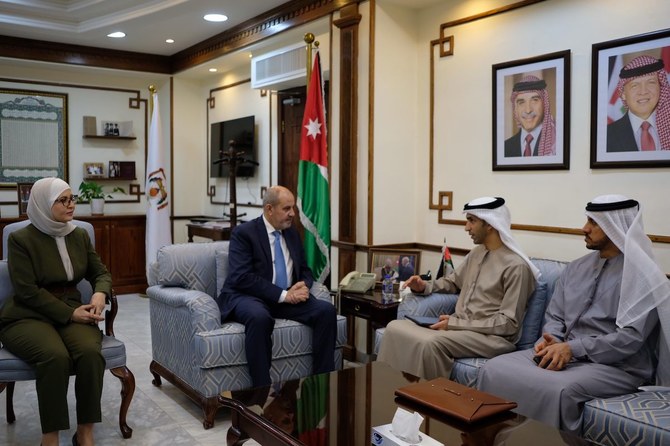
UAE foreign trade minister and Jordanian PM discuss trade and investment cooperation

UAE Foreign Trade Minister Thani Al-Zeyoudi and Jordanian PM Bisher Khasawneh in Amman. (Petra)
Short Url
Updated 03 January 2024
Follow

UAE foreign trade minister and Jordanian PM discuss trade and investment cooperation

  • Non-oil trade between the two countries grew by more than 47 percent in 2022

AMMAN: The UAE’s foreign trade minister, Thani Al-Zeyoudi, and Jordan’s Prime Minister Bisher Khasawneh met in Amman to discuss ways in which bilateral trade and investment cooperation might be strengthened.

Khasawneh highlighted the close ties between the two countries and expressed his country’s support for the UAE as host of the 13th World Trade Organization Ministerial Conference, which will be held in Abu Dhabi in February, the Emirates News Agency reported on Wednesday.

He also confirmed the high-level participation of Jordan at the conference, and congratulated the UAE for successfully hosting the UN Climate Change Conference, COP28, in November.

Al-Zeyoudi said the UAE and Jordan share a desire to build future-oriented economies based on innovation, knowledge, and free trade and investment. He added that regular meetings and the strong relationship between Emirati President Sheikh Mohammed bin Zayed Al-Nahyan and King Abdullah of Jordan have helped to strengthen bilateral relations and the strategic partnership between the two countries with the aim of achieving their aspirations for sustainable growth.

“There is a mutual will to build on the commercial and investment momentum between the two countries, to improve their relations and create more opportunities for their business communities,” Al-Zeyoudi said.

Non-oil trade between the two countries grew by more than 47 percent in 2022, reaching $4.5 billion, more than double the total in 2020, when the value of trade increased by 106 percent.

Jordan has become the UAE’s third-largest Arab economic partner, after Iraq and Egypt, accounting for 8 percent of non-oil trade with Arab countries.

The UAE is Jordan’s fifth-largest economic partner and its second-largest Arab trading partner, accounting for 6.2 percent of total foreign trade.


Iran offers concessions on nuclear program

Updated 10 February 2026
Follow

Iran offers concessions on nuclear program

  • Atomic energy chief says it will dilute enriched uranium if US eases sanctions

TEHRAN: Iran offered on Monday to dilute its highly enriched uranium if the US lifts sanctions.

Mohammad Eslami, head of the country’s Atomic Energy Organization, did not specify whether this included all sanctions on Iran or only those imposed by the US.

The new move follows talks on the issue in Oman last week that both sides described as positive and constructive.

Diluting uranium means mixing it with blend material to reduce the enrichment level, so that the final product does not exceed a given enrichment threshold.
Before US and Israeli strikes on its nuclear facilities in June last year, Iran had been enriching uranium to 60 percent, far exceeding the 3.67 percent limit allowed under the now-defunct nuclear agreement with world powers in 2015.
According to the UN’s nuclear watchdog, Iran is the only state without nuclear weapons that is enriching uranium to 60 percent.
The whereabouts of more than 400 kg of highly enriched uranium that Iran possessed before the war is also unknown. UN inspectors last recorded its location on June 10. Such a stockpile could allow Iran to build more than nine nuclear bombs if enrichment reached 90 percent.
Supreme leader Ayatollah Ali Khamenei urged Iranians on Monday to resist foreign pressure.
“National power is less about missiles and aircraft and more about the will and resolve of the people,” Khamenei said. “Show it again and frustrate the enemy.”
Nevertheless, despite this defiance, Iran has signaled it could come to some kind of deal to dial back its nuclear program and avoid further conflict with Washington.