Pakistan condemns ‘inhuman terrorist attacks’ in Iran as death toll surges past 100

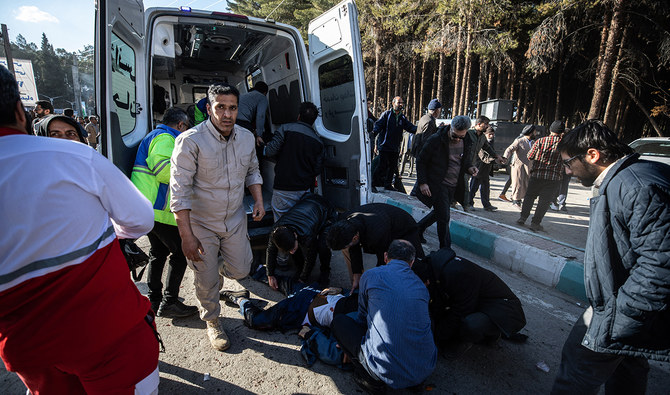
Iranian emergency services arrive at the site where two explosions in quick succession struck a crowd marking the anniversary of the 2020 killing of Guards general Qasem Soleimani, near the Saheb al-Zaman Mosque in the southern Iranian city of Kerman on January 3, 2024. (AFP)
Short Url
Updated 03 January 2024
Follow

Pakistan condemns ‘inhuman terrorist attacks’ in Iran as death toll surges past 100

  • Explosions rock Iran’s Kerman city in ceremony marking four years since assassination of military commander 
  •  Pakistan stands in solidarity with Iran at this hour of grief, says Foreign Minister Jalil Abbas Jilani 

ISLAMABAD: Pakistan’s Foreign Minister Jalil Abbas Jilani strongly condemned explosions in Iran that killed over 100 people and wounded scores of others on Wednesday, describing them as “inhuman terrorist attacks.”

Two explosions in Iran’s southeastern city of Kerman killed over 100 and injured dozens of others. The blasts took place near the tomb of former Islamic Revolutionary Guard Corps (IRGC) General Qassem Soleimani. A large crowd had gathered at a ceremony held to mark four years since his assassination.

“Pakistan strongly condemns the inhuman terrorist attacks in Kerman, that claimed several innocent lives,” Jilani wrote on social media platform X. 

“Our heart goes out to families of victims. Pakistan stands in solidarity with Iran at this hour of grief.”

As chief commander of the elite Quds force, the overseas arm of Iran’s Revolutionary Guard Corps (IRGC), Soleimani ran clandestine operations in foreign countries and was a key figure in Iran’s long-standing campaign to drive US forces out of the Middle East.

Tensions between Iran and Israel, along with its ally the United States, have reached a new high over Israel’s war on Iranian-backed Hamas militants in Gaza in retaliation for their Oct. 7 rampage through southern Israel.

Yemen’s Iran-backed Houthi militia have attacked ships they say have links to Israel at the entrance to the Red Sea, one of the world’s busiest shipping lanes.

US forces have come under attack by Iran-backed militants in Iraq and Syria over Washington’s backing of Israel and have carried out their retaliatory air strikes.

On Monday an Israeli air strike killed a senior commander of Iran’s Revolutionary Guards in Syria.

Iran has in the past blamed Israel for attacks on individual people or places within its borders — claims which Israel has neither confirmed nor denied — but there was no indication of any involvement of a foreign state in the explosions at Wednesday’s ceremony.


Pakistan, China to sign multiple MoUs at major agriculture investment conference today

Updated 18 January 2026
Follow

Pakistan, China to sign multiple MoUs at major agriculture investment conference today

  • Hundreds of Chinese and Pakistani firms to attend Islamabad event
  • Conference seen as part of expanding CPEC ties into agriculture, trade

KARACHI: Islamabad and Beijing are set to sign multiple memorandums of understanding (MoUs) to boost agricultural investment and cooperation at a major conference taking place in the capital today, Monday, with hundreds of Chinese and Pakistani companies expected to participate.

The conference is being billed by Pakistan’s Ministry of National Food Security and Research as a platform for deepening bilateral agricultural ties and supporting broader economic engagement between the two countries.

“Multiple memorandums of understanding will be signed at the Pakistan–China Agricultural Conference,” the Ministry of National Food Security said in a statement. “115 Chinese and 165 Pakistani companies will participate.”

The conference reflects a growing emphasis on expanding Pakistan-China economic cooperation beyond the transport and energy foundations of the flagship China-Pakistan Economic Corridor (CPEC) into agriculture, industry and technology.

Under its first phase launched in 2015, CPEC, a core component of China’s Belt and Road Initiative, focused primarily on transportation infrastructure, energy generation and connectivity projects linking western China to the Arabian Sea via Pakistan. That phase included motorways, power plants and the development of the Gwadar Port in the country's southwest, aimed at helping Pakistan address chronic power shortages and enhance transport connectivity.

In recent years, both governments have formally moved toward a “CPEC 2.0” phase aimed at diversifying the corridor’s impact into areas such as special economic zones, innovation, digital cooperation and agriculture. Second-phase discussions have highlighted Pakistan’s goal of modernizing its agricultural sector, attracting Chinese technology and investment, and boosting export potential, with high-level talks taking place between planning officials and investors in Beijing.

Agri-sector cooperation has also seen practical collaboration, with joint initiatives examining technology transfer, export protocols and value-chain development, including partnerships in livestock, mechanization and horticulture.

Organizers say the Islamabad conference will bring together government policymakers, private sector investors, industry associations and multinational agribusiness firms from both nations. Discussions will center on investment opportunities, technology adoption, export expansion and building linkages with global buyers within the framework of Pakistan-China economic cooperation.