

Pakistan says keen to enhance ties with UAE in IT sector 

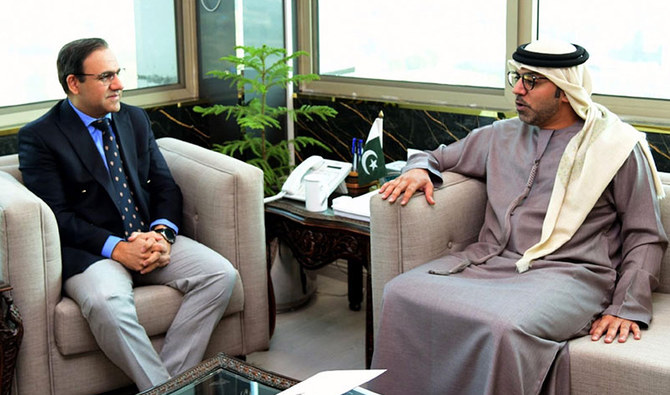
Pakistan Caretaker Minister for IT and Telecommunication Dr. Umar Saif holds meeting with UAE Ambassador to Pakistan, Mr. Hamad Obaid Ibrahim Al-Zaabi in Islamabad, Pakistan, on January 3, 2023. (Photo courtesy: Radio Pakistan)
Short Url
Updated 03 January 2024
Follow

Pakistan says keen to enhance ties with UAE in IT sector 

  • Pakistan’s IT minister meets UAE’s Ambassador to Pakistan Hamad Obaid Ibrahim Al-Zaabi in Islamabad 
  • Both discuss matters of mutual interest, including those related to IT and telecom, says state media 

ISLAMABAD: Pakistan is keen to enhance its ties with the United Arab Emirates (UAE), especially in the IT sector, Caretaker Information Technology Minister Dr. Umar Saif was quoted as saying by state-run Radio Pakistan on Wednesday. 

Pakistan and the UAE have enjoyed fraternal relations since decades and cooperate in various fields such as defense, trade, economy, IT and telecom. In October 2023, Pakistan’s caretaker IT minister paid a visit to the UAE where he participated in the 43rd GITEX edition (Gulf Information Technology Exhibition) GLOBAL tech and startup show. 

UAE’s Ambassador to Pakistan Hamad Obaid Ibrahim Al-Zaabi called on Saif in Islamabad to discuss matters related to IT and telecom, Radio Pakistan said. 

“Caretaker Minister for IT and Telecommunication Dr. Umar Saif has said that Pakistan is keen to enhance ties with the United Arab Emirates especially in IT sector,” the state-run media said. 

The UAE is also home to an estimated 1.8 million Pakistani expatriates and, after Saudi Arabia, is the second-largest source of remittances for the South Asian nation of more than 240 million. 

The Gulf nation is Pakistan’s third-largest trade partner after China and the United States. It is also viewed as an ideal export destination by policymakers in the South Asian country due to its geographical proximity to Pakistan. 

In another meeting with British High Commissioner to Pakistan Jane Marriott, Saif acknowledged the UK government’s support for governance reform in Pakistan in the fields of health, education and public finance sectors for decades. 

“He said Pakistan’s IT industry has great potential to expand their business in the UK, and our startups need to be able to attract bigger investments from UK-based venture,” Radio Pakistan said. 


Pakistan says Indonesia’s Pertamina exploring cooperation in ‘vast untapped potential’ in minerals 

Updated 6 sec ago
Follow

Pakistan says Indonesia’s Pertamina exploring cooperation in ‘vast untapped potential’ in minerals 

  • Islamabad is pitching its largely untapped mineral sector to foreign investors as a new pillar of economic recovery and industrial growth
  • Jakarta is eyeing overseas mining partnerships through Pertamina to leverage its exploration expertise and secure strategic raw materials

ISLAMABAD: Indonesia has expressed interest in engaging in Pakistan’s largely untapped mineral sector, with Jakarta’s state-owned energy company Pertamina seen as a potential partner for exploration and mining cooperation, a statement from Pakistan’s Information Ministry said this week.

The engagement comes as Pakistan positions mining as a potential engine of long-term growth, following years of underinvestment and stalled projects, and as resource-rich Asian economies increasingly look overseas to secure supplies of critical minerals and diversify investment portfolios.

Government and industry estimates suggest Pakistan’s untapped mineral resources could be worth trillions of dollars, anchored by major copper-gold deposits such as Reko Diq, as well as coal, iron ore and emerging critical minerals. Meanwhile, Indonesia, one of the world’s leading producers of minerals such as nickel, coal and copper, has in recent years expanded the role of its state-owned firms in overseas energy and extractive ventures, driven by rising domestic demand, industrial policy linked to downstream processing and global competition for strategic resources.

Against this backdrop, Federal Minister for Petroleum Ali Pervaiz Malik met Indonesia’s Ambassador to Pakistan, Chandra Warsenanto Sukotjo, on Thursday to discuss cooperation with a particular focus on minerals and exploration, the information ministry said.

“Indonesia’s state-owned company, Pertamina, possesses extensive experience in exploration, and avenues for cooperation in exploration activities between the two countries could be explored,” the Indonesian ambassador said, according to the statement.

Malik welcomed Indonesia’s interest and assured full government support, highlighting what the statement described as Pakistan’s “vast untapped potential” in minerals and exploration. He encouraged Indonesian companies to partner with Pakistani firms on mutually beneficial projects.

The petroleum minister also formally invited Indonesia to participate in the Pakistan Minerals Investment Forum (PMIF) 2026, telling the ambassador that the upcoming event would be significantly larger than the previous two editions and aimed at attracting a wider pool of international investors.

Both sides agreed to continue engagement and explore concrete opportunities to deepen cooperation across minerals, exploration and energy, the statement said, framing the talks as part of broader efforts to strengthen Pakistan–Indonesia economic ties beyond traditional diplomatic and cultural links.

Pakistan holds significant reserves of copper, gold, coal and other minerals across Balochistan, Khyber Pakhtunkhwa and Gilgit-Baltistan, but officials say much of this potential remains underdeveloped due to legal disputes, infrastructure gaps and lack of foreign investment. In recent years, Islamabad has sought to change that by resolving long-running disputes, hosting international mineral investment forums, and courting partners from North America, the Gulf and Asia.

The government has placed particular emphasis on large-scale projects such as the Reko Diq copper-gold mine in Balochistan, while also encouraging smaller exploration and mining ventures through joint partnerships with foreign companies and state-owned enterprises.