Police in Pakistan’s southeast apprehended 487 criminals using cellphone apps in 2023

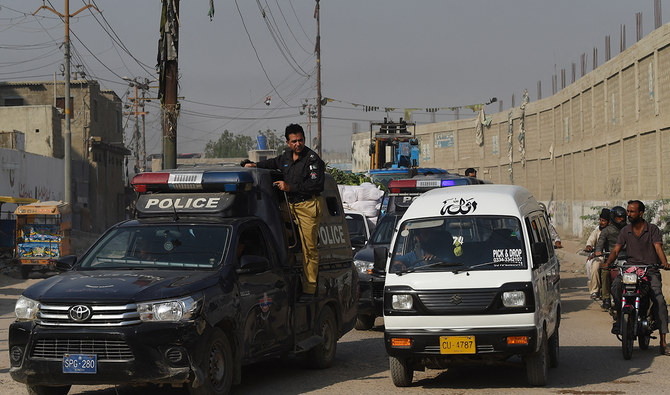
Policemen patrol along a street in Karachi, Pakistan on November 2, 2023. (AFP/File)
Short Url
Updated 03 January 2024
Follow

Police in Pakistan’s southeast apprehended 487 criminals using cellphone apps in 2023

  • The law enforcement agency launched Hotel Eye and Talash apps amid rising number of crimes in the province
  • Sindh’s provincial capital of Karachi recorded more than 87,000 street crimes last year that led to 134 fatalities

KARACHI: Police in Pakistan’s southeastern Sindh province announced on Wednesday they apprehended 487 wanted and absconding criminals by using cellphone applications like Hotel Eye and Talash in 2023, a particularly violent year marked by over 134 killings of people in Karachi who lost their lives while trying to resist street crimes.
Karachi, Pakistan’s largest city, has long grappled with transnational militant networks, sectarian groups and local gangs, leading to a comprehensive security operation launched by paramilitary rangers in September 2013.
To combat the persistent challenge of street crime, Sindh police launched Hotel Eye in 2017, enabling hotel owners to upload guest details for police monitoring.
In October 2022, the Talash or “Search” app was introduced, facilitating police in identifying criminals through thumbprints during snap checks.
Launched formally by Chief Minister Sindh Syed Murad Ali Shah in July, the apps have been instrumental in capturing hardened criminals, including many on the wanted lists.
“A total of 259 suspects were arrested across various districts of Sindh, including Karachi, involving 122 proclaimed offenders and 137 absconders with the help of the Hotel Eye Management System,” said a police handout.
“The Talash app not only helped arrest 228 absconders and proclaimed offenders during snap checking, raid operations and other measures but also enabled the identification of 146 dead bodies,” it added.
According to Karachi police, 87,250 street crimes incidents were also recorded in the city that led to 134 fatalities.
Additionally, citizens lost 27,381 cellphones, 7,083 motorbikes and 258 cars in the city.
This marks an increase in criminal activities compared to 2022, when nearly 80,000 incidents of street crimes took place, leading to 115 deaths.
“While apps like Hotel Eye and Talash have assisted the police in apprehending criminals, and the use of technology is commendable, Karachi’s crime problem remains significant,” Nazir Shah, who has reported on crimes in the city for nearly two decades, told Arab News. “When one examines the crime landscape of Karachi and observes the escalating numbers of incidents, the achievement of the police gets overshadowed.”


Pakistan partially rolls back solar policy, keeps old net-metering terms for pending applicants

Updated 13 sec ago
Follow

Pakistan partially rolls back solar policy, keeps old net-metering terms for pending applicants

  • Decision applies to applications submitted before Feb. 8, which will be processed under previous net-metering regulations
  • Move follows public backlash after Pakistan cut buyback rates for rooftop solar power under new billing framework

ISLAMABAD: Pakistan’s power minister has ordered electricity distribution companies to process all rooftop solar net-metering applications submitted before Feb. 8 under the previous, more favorable rules, according to a government statement released Thursday.

The decision comes after days of public criticism over new regulations that lowered the rate paid to solar users for surplus electricity, part of broader reforms aimed at easing financial pressure on loss-making power utilities.

The directive by Power Minister Sardar Awais Leghari applies nationwide, including the private utility K-Electric, and affects thousands of households and businesses awaiting approval to connect solar systems to the national grid.

“All electricity distribution companies, including K-Electric, will provide the net-metering facility for applications submitted up to February 8,” the ministry said in the statement, adding immediate implementation orders had been issued.

Authorities said 5,165 pending applications fall under the decision, adding about 250.822 megawatts of capacity to the national grid. The ministry said the move would remove uncertainty for consumers and directed companies to maintain transparency in processing requests.

Pakistan introduced grid-connected rooftop solar and net-metering in 2015 during a worsening power shortage, allowing consumers to sell excess electricity to the grid at the same tariff they paid utilities, a policy designed to encourage renewable adoption and reduce outages.

Over the past three years, soaring electricity prices and frequent blackouts triggered a rapid solar boom, with households and businesses installing panels to cut costs. Solar’s share of the energy mix rose sharply and tens of thousands of new connections were added annually.

Earlier this month, however, regulators replaced the net-metering regime with a net-billing framework separating purchase and sale prices, meaning consumers would receive a lower, market-linked rate for exported electricity while paying full tariffs for grid power.

Officials argued the change was necessary because widespread rooftop generation was reducing utility revenues and worsening the country’s circular debt crisis. Consumers and industry groups criticized the move, saying it undermined investment certainty.

The government has since moved to protect existing users and now pending applicants from the revised pricing mechanism, while new connections after the cutoff date will fall under the updated billing system.