

Police search royal mansion as investigation into King Charle’s brother Andrew goes on

1 / 2
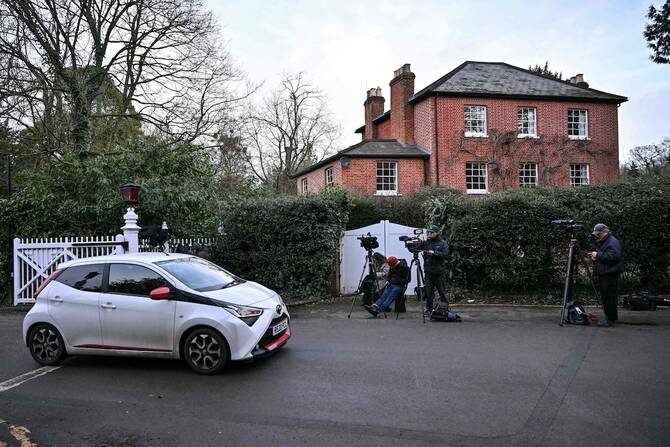
Members of the media stake out the entrance to Windsor Great Park, near the entrance to Royal Lodge, where police said they are still conducting a search on Feb. 20, 2026. (AFP)
2 / 2
UK police are ‘assessing’ reports that former prince Andrew Mountbatten-Windsor sent trade reports to convicted sex offender Jeffrey Epstein in 2010. (AFP file photo)
Short Url
Updated 20 February 2026
Follow

Police search royal mansion as investigation into King Charle’s brother Andrew goes on

  • King Charles: ‘Let me state clearly: the law must take its course”
  • UK police have a general practice of not publicly naming suspects

SANDRINGHAM, England: British police were searching the ​former mansion of King Charles’ younger brother Andrew Mountbatten-Windsor on Friday after a photograph of the royal emerging from a police station was splashed on newspapers around the world.

Mountbatten-Windsor was arrested on Thursday, his 66th birthday, on suspicion of misconduct in public office over allegations he sent confidential government documents to disgraced financier Jeffrey Epstein when he was a trade envoy.

The former prince was released under investigation after being held by police for more than 10 hours. He has not been charged with any offense but looked haunted in a Reuters photograph after his release, slumped in the back of ‌a Range Rover, eyes ‌red and with a look of disbelief on his face.

The ​photograph ‌of ⁠a man ​who ⁠was once a dashing naval officer and reputed favorite son of the late Queen Elizabeth was carried on the front page of newspapers in Britain and around the world, accompanied by headlines such as “Downfall.”

Mountbatten-Windsor has always denied any wrongdoing in relation to Epstein, a convicted sex offender who took his own life in 2019, and said he regrets their friendship. But the release of millions of documents by the US government showed he had remained friends with Epstein long after the financier was convicted of soliciting prostitution from ⁠a minor in 2008.

Those files suggested Mountbatten-Windsor had forwarded to Epstein British ‌government reports about investment opportunities in Afghanistan and assessments of Vietnam, Singapore ‌and other places he had visited as the government’s Special ​Representative for Trade and Investment.

King says the ‌law must take its course

The arrest of the senior royal, eighth in line to the throne, ‌is unprecedented in modern times. The last member of the royal family to be arrested in Britain was Charles I, who was beheaded in 1649 after being found guilty of treason.

King Charles, who stripped his brother of his title of prince and forced him out of his Windsor home last year, said on Thursday he ‌had learned about the arrest with “deepest concern.”

“Let me state clearly: the law must take its course,” the king said. “What now follows is the ⁠full, fair and proper process ⁠by which this issue is investigated in the appropriate manner and by the appropriate authorities.”

The news broke early on Thursday morning that six unmarked police cars and around eight plain-clothed officers had arrived at Wood Farm on the king’s Sandringham estate in Norfolk, eastern England, where Mountbatten-Windsor now resides.

Thames Valley Police officers also searched the mansion on the king’s Windsor estate west of London where Mountbatten-Windsor had lived before being forced out amid anger at the Epstein revelations.

Officers said late on Thursday that the royal had been released under investigation. They said the searches at Sandringham had concluded but the searches in Windsor were continuing.

While being arrested means that police have reasonable suspicion that a crime has been committed and that the royal is suspected of involvement in an offense, it does not imply ​guilt.

A conviction for misconduct in a public ​office carries a maximum sentence of life imprisonment, and cases must be dealt with in a Crown Court, which handle the most serious criminal offenses.


Trump pivots to new 10 percent global tariff, new probes after Supreme Court setback

Updated 28 min 46 sec ago
Follow

Trump pivots to new 10 percent global tariff, new probes after Supreme Court setback

WASHINGTON: US President Donald Trump moved swiftly on Friday to replace tariffs struck down by the Supreme Court with a temporary ​10 percent global import duty for 150 days while opening investigations under other laws that could allow him to re-impose the tariffs.
Trump told a briefing he was ordering new tariffs under Section 122 of the Trade Act of 1974, duties that would go on top of surviving tariffs. These would partly replace tariffs of 10 percent to 50 percent under the 1977 International Emergency Economic Powers Act that the top court declared illegal.
Trump said later on Truth Social that he had signed an order for the tariffs on all countries “which will be effective almost immediately.”
A spokesperson for the US Customs and Border Protection agency declined comment when asked when collections of the illegal IEEPA tariffs would halt at ports of entry.
Trump’s Treasury Secretary, Scott Bessent, said the new 10 percent duties and potentially enhanced tariffs under the Section 301 unfair practices statute and the Section 232 national security statute would result in virtually unchanged tariff revenue in 2026.
“We will get back to the same tariff level for the countries. ‌It will just be ‌in a less direct and slightly more convoluted manner,” Bessent told Fox News, adding that the Supreme ​Court ‌decision had ⁠reduced Trump’s ​negotiating ⁠leverage with trading partners.
The never-used Section 122 authority allows the president to impose duties of up to 15 percent for up to 150 days on any and all countries to address “large and serious” balance of payments issues. It does not require investigations or impose other procedural limits. After 150 days, Congress would need to approve their extension.
“We have alternatives, great alternatives,” Trump said. “Could be more money. We’ll take in more money and we’ll be a lot stronger for it,” Trump said of the alternative tools.
While the administration will likely face legal challenges, the Section 122 tariffs would lapse before any final ruling could be made, said Josh Lipsky, international economics chair at the Atlantic Council, a think tank in Washington.
Trump said his administration also was initiating several new country-specific investigations under Section 301 of the Trade Act of 1974 “to protect our country from unfair trading practices of ⁠other countries and companies.”
Trump’s shift to other statutes, including Section 122, while initiating new investigations under Section 301 ‌had been widely anticipated, but these have often taken a year to complete.
The 10 percent tariffs only last ‌five months, but Trump said that would allow his administration to complete investigations to enhance tariffs.
Asked if rates ​would ultimately end up being higher after more probes, Trump said: “Potentially higher. ‌It depends. Whatever we want them to be.”
He said some countries “that have treated us really badly for years” could see higher tariffs, whereas for others, “it’s going to ‌be very reasonable for them.”
The fate of dozens of trade deals to cut IEEPA-based duties and negotiations with major US trading partners remained unclear in the wake of the ruling, though Trump said he expected many of them to continue. He said deals that are abandoned “will be replaced with the other tariffs.”
“This is unlikely to affect reciprocal trade negotiations with our trading partners,” said Tim Brightbill, trade partner with the law firm Wiley Rein in Washington. “Most countries would prefer the certainty of a trade deal to the chaos of last year.”
US ‌Trade Representative Jamieson Greer said details on new Section 301 investigations would be revealed in coming days, adding these are “incredibly legally durable.” Trump relied on Section 301 to impose broad tariffs on Chinese imports during his first term.
The Supreme Court’s ruling puts about $175 ⁠billion in tariff revenue collected over the past year subject to potential refunds, according to estimates provided to Reuters by Penn-Wharton Budget Model economists.
Asked if he would refund the IEEPA duties, Trump said, “I guess it has to get litigated for the next two years,” a response indicating that a quick, automatic refund process was unlikely.
Speaking in Dallas, Bessent told business leaders that since the Supreme Court did not provide any instructions on refunds, those were “in dispute,” adding: “My sense is that could be dragged out for weeks, months, years.”
Part of the reason why Trump opted for IEEPA to impose tariffs last year was because the 1977 sanctions statute allowed fast and broad action with almost no constraints. Until Friday, he had also used it as a cudgel to swiftly punish countries over non-trade disputes, such as Brazil’s prosecution of former president and Trump ally Jair Bolsonaro.
While Trump’s new investigations will prolong tariff uncertainty, they could inject more order into his tariff policy by forcing him to rely on trade laws that have well-understood procedures, research and public comment requirements, and longer timelines, said Janet Whittaker, senior counsel with Clifford Chance in Washington.
“The administration will need to follow these set processes, conduct the investigations, and so for businesses, that means more visibility into the process,” Whittaker said.
Robert Lighthizer, Trump’s trade chief during his ​first term, said on Fox News that he hoped Congress would revise decades-old ​trade laws to give Trump new tariff tools.
“I think there’s consensus in this Congress that we have to change the old system, and I hope that they will take this as an opportunity to do that,” Lighthizer said.
