

Somalia vows to defend sovereignty after Ethiopia-Somaliland deal

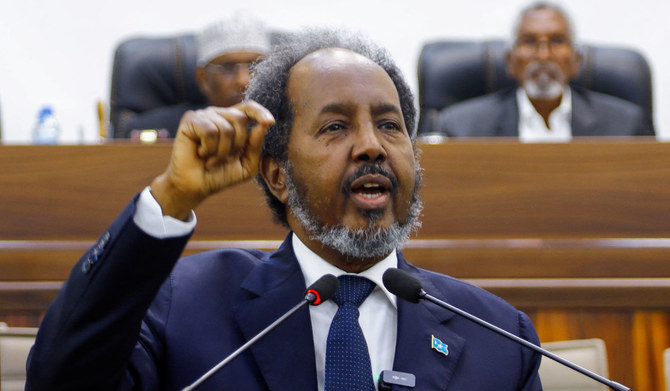
Somalia's President Hassan Sheikh Mohamud addresses the parliament regarding the Ethiopia-Somaliland port deal, in Mogadishu, Somalia January 2, 2024. (REUTERS)
Short Url
Updated 03 January 2024
Follow

Somalia vows to defend sovereignty after Ethiopia-Somaliland deal

  • Ethiopia was cut off from the coast after Eritrea seceded and declared independence in 1993 following a three-decade war

MOGADISHU: Somalia vowed on Tuesday to defend its territory by “any legal means” and recalled its ambassador to Ethiopia after Addis Ababa struck a controversial deal with the breakaway region of Somaliland.
Mogadishu branded Monday’s surprise pact that gives Ethiopia long-sought access to the Red Sea a “clear violation” of its sovereignty and appealed to the international community to stand by its side.
The Addis Ababa deal was announced only days after Somalia’s central government had agreed to resume dialogue with the separatist northern region after years of stalemate.
Somaliland has been seeking full statehood since claiming independence from Somalia in 1991, a move fiercely opposed by Mogadishu and not recognized internationally.
The “historic” memorandum of understanding signed by Ethiopian Prime Minister Abiy Ahmed and Somaliland leader Muse Bihi Abdi gives Ethiopia access to the Red Sea port of Berbera and a military base.

BACKGROUND

The Somali government said it was appealing to the United Nations, African Union, the Arab League and regional East African grouping IGAD among others ‘to stand with the right for Somalia to defend its sovereignty and force Ethiopia to adhere to international laws.’

“Somaliland is part of Somalia under the Somali constitution, so Somalia finds this step to be a clear violation against its sovereignty and unity,” the Somali Cabinet said in a statement.
It said the agreement was “null and void with no legal basis and Somalia will not accept it.”
“In response to this, the Somali government has recalled its ambassador in Ethiopia for consultation.”
The government also said it was appealing to the United Nations, African Union, the Arab League and regional East African grouping IGAD among others “to stand with the right for Somalia to defend its sovereignty and force Ethiopia to adhere to international laws.”
In an address to the nation, Prime Minister Barre called for the people of Somalia to stay calm.
“I want to assure you that we are committed to defending the country, we will not allow an inch of land, sea and skies to be violated,” he said.
“We will defend our land with any legal means possible ... We must unite and forget about our differences to defend our land, integrity and sovereignty.”
There was no immediate comment from the Ethiopian government to Somalia’s reaction.
The deal comes months after Abiy said his country, Africa’s second most populous, would assert its right to access the Red Sea, sparking concerns among its neighbors.
Ethiopia was cut off from the coast after Eritrea seceded and declared independence in 1993 following a three-decade war.
Addis Ababa had maintained access to a port in Eritrea until the two countries went to war in 1998-2000, and since then Ethiopia funnels most of its trade through Djibouti.
Ethiopia’s economy has been constrained by its lack of access to the Red Sea, a narrow strip of water between Africa and the Arabian Peninsula.
On the southern coast of the Gulf of Aden, the port of Berbera offers an African base at the gateway to the Red Sea and further north to the Suez canal.
Abiy’s national security adviser Redwan Hussein said Ethiopia would have access to a leased military base on the Red Sea as part of the agreement.
It was not clear when the pact would take effect.
In 2018, Ethiopia acquired a 19-percent stake in the Berbera port, according to Dubai-based DP World, which manages the port’s operations.
The company itself holds a 51-percent stake, while Somaliland has the remaining 30 percent.
On Friday, Somalia and Somaliland agreed to resume dialogue after two days of talks mediated by Djibouti President Ismail Omar Guelleh, the first of their kind since 2020 when similar negotiations stalled.
The deal was welcomed by IGAD, which Somalia joined only in November, and the British Embassy which described it as a “vital step toward reconciliation.”
Somaliland, a former British protectorate with 4.5 million people, prints its own currency, issues its own passports and elects its own government.
Although Somaliland has often been seen as a beacon of stability in the chaotic Horn of Africa region, its quest for statehood has gone unrecognized internationally, leaving it poor and isolated.
Political tensions also surfaced there last year, spilling over into deadly violence.


Although Somaliland has often been seen as a beacon of stability in the chaotic Horn of Africa region, its quest for statehood has gone unrecognized internationally, leaving it poor and isolated.
Political tensions also surfaced there last year, spilling over into deadly violence.


Ukraine drops NATO goal as Trump envoy sees progress in peace talks

Updated 57 min 18 sec ago
Follow

Ukraine drops NATO goal as Trump envoy sees progress in peace talks

  • The move marks a major shift for Ukraine, which has fought to join NATO as a safeguard against Russian attacks and has such an aspiration included in its constitution

BERLIN/KYIV: President Volodymyr Zelensky offered to drop Ukraine’s aspirations to join the NATO military alliance as he held five hours of talks with US envoys in Berlin on Sunday to end the war with Russia, with negotiations set to continue on Monday.
Trump’s envoy Steve Witkoff said “a lot of progress was made” as he and Trump’s son-in-law Jared Kushner met Zelensky in the latest push to end Europe’s bloodiest conflict since World War Two, though full details were not divulged.
Zelensky’s adviser Dmytro Lytvyn said the president would comment on the talks on Monday once they were completed. Officials, Lytvyn said, were considering the draft documents.
“They went on for more than five hours and ended for today with an agreement to resume tomorrow morning,” Lytvyn told reporters in a WhatsApp chat.
Ahead of the talks, Zelensky offered to drop Ukraine’s goal to join NATO in exchange for Western security guarantees.
The move marks a major shift for Ukraine, which has fought to join NATO as a safeguard against Russian attacks and has such an aspiration included in its constitution. It also meets one of Russia’s war aims, although Kyiv has so far held firm against ceding territory to Moscow.
“Representatives held in-depth discussions regarding the 20-point plan for peace, economic agendas, and more. A lot of progress was made, and they will meet again tomorrow morning,” Witkoff said in a post on X.
The talks were hosted by German Chancellor Friedrich Merz, who a source said had made brief remarks before leaving the two sides to negotiate. Other European leaders are also due in Germany for talks on Monday.
“From the very beginning, Ukraine’s desire was to join NATO, these are real security guarantees. Some partners from the US and Europe did not support this direction,” Zelensky said in answer to questions from reporters in a WhatsApp chat.
“Thus, today, bilateral security guarantees between Ukraine and the US, Article 5-like guarantees for us from the US, and security guarantees from European colleagues, as well as other countries — Canada, Japan — are an opportunity to prevent another Russian invasion,” Zelensky said.
“And it is already a compromise on our part,” he said, adding the security guarantees should be legally binding.
Russian President Vladimir Putin has repeatedly demanded Ukraine officially renounce its NATO ambitions and withdraw troops from the about 10 percent of Donbas which Kyiv still controls. Moscow has also said Ukraine must be a neutral country and no NATO troops can be stationed in Ukraine.
Russian sources said earlier this year that Putin wants a “written” pledge by major Western powers not to enlarge the US-led NATO alliance eastwards — shorthand for formally ruling out membership to Ukraine, Georgia, Moldova and other former Soviet republics.
Sending Witkoff, who has led negotiations with Ukraine and Russia on a US peace proposal, appeared to be a signal that Washington saw a chance of progress nearly four years after Russia’s 2022 invasion.
Under pressure from Trump to sign a peace deal that initially backed Moscow’s demands, Zelensky accused Russia of dragging out the war through deadly bombings of cities and Ukraine’s power and water supplies.
A ceasefire along the current front lines would be a fair option, he added.

‘CRITICAL MOMENT’
Germany’s Defense Minister Boris Pistorius said it was a “good sign” Trump had sent his envoys while fielding questions in an interview with the ZDF broadcaster on the suitability of Witkoff and Kushner, two businessmen, as negotiators.
“It’s certainly anything but an ideal setup for such negotiations. That much is clear. But as they say, you can only dance with the people on the dance floor,” Pistorius said.
On the issue of Ukraine’s offer to give up its NATO aspirations in exchange for security guarantees, Pistorius said Ukraine had bitter prior experience of relying on security assurances. Kyiv had in 1994 agreed to give up its Soviet-era nuclear arsenal in exchange for territorial guarantees from the US, Russia and Britain.
“Therefore, it remains to be seen to what extent this statement Zelensky has now made will actually hold true, and what preconditions must be met,” Pistorius said.
“This concerns territorial issues, commitments from Russia and others,” he said, adding mere security guarantees, especially without significant US involvement, “wouldn’t be worth much.”
Britain, France and Germany have been working to refine the US proposals, which in a draft disclosed last month called for Kyiv to cede more territory, abandon its NATO ambitions and accept limits on its armed forces.
European allies have described this as a “critical moment” that could shape Ukraine’s future, and sought to shore up Kyiv’s finances by leveraging frozen Russian central bank assets to fund Kyiv’s military and civilian budget.