GAZA: Israel pounded Gaza on Friday, nearly 12 weeks into the war started by the October 7 attacks, as Egypt hosted a Hamas delegation for talks aimed at ending the conflict that has devastated much of the besieged Palestinian territory.
With vast areas of northern Gaza in ruins and largely deserted, Israeli air strikes and ground combat have focussed on central and southern districts, driving ever more displaced families into crowded areas around Rafah near the Egyptian border.
Intense fighting around central Deir Al-Balah and the biggest southern city, Khan Yunis, has driven about 100,000 newly displaced people into already-overcrowded Rafah, said the UN humanitarian office, even as targets there were bombed too.
Rafah residents combed through rubble for survivors and bodies after a deadly air strike Thursday.
One local man, Tayseer Abu Al-Eish, said he was at home when “we heard a loud explosion and debris started falling on us. My daughters were screaming.”
The relentless bombardment has caused mass civilian casualties and sparked global calls for a cease-fire as alarm has mounted over the dire fate of Palestinians enduring hunger and sleeping in makeshift shelters in the cold winter months.
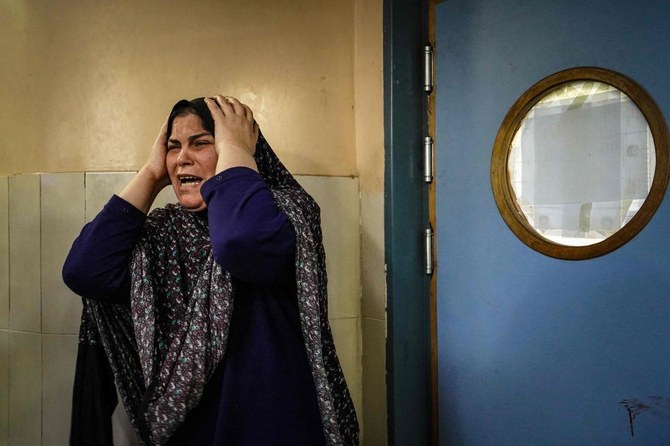
After another strike, in Deir Al-Balah, one bereaved mother, Suhair Nasser, wept as she cradled the bodies of her twin children, exclaiming that “the house was bombed and the debris fell on the kids on December 28, their birthday.”
The military said it had “eliminated dozens of terrorists” across Gaza over the past 24 hours and was “extending operations in Khan Yunis,” the hometown of Hamas’s Gaza chief Yahya Sinwar.
Gunmen of Hamas, considered a “terrorist” group by the United States and European Union, launched an attack on October 7 that left about 1,140 people dead, mostly civilians, according to an AFP tally based on Israeli figures.
The Palestinian militants also took about 250 people hostage, more than half of whom remain captive inside the war zone, some of them believed dead.
Israel’s relentless military campaign since then has killed at least 21,507 people, mostly women and children, according to the health ministry in Hamas-ruled Gaza.
Israel’s army says 168 soldiers have been killed inside Gaza.
Hamas’s military wing, the Ezzedine Al-Qassam Brigades, said Friday it had launched a fresh barrage of rockets at southern Israel.
An Israeli siege imposed after October 7, following years of crippling blockade, has deprived Gaza’s 2.4 million people of food, water, fuel and medicine.
The UN says more than 80 percent of Gaza’s population has been driven from their homes, with many now living in cramped shelters or tents around Rafah.
The UN agency for Palestinian refugees, UNRWA, said 308 people seeking shelter in their facilities have been killed.
UN humanitarian chief Martin Griffiths bemoaned “an impossible situation for the people of Gaza, and for those trying to help them.”
“You think getting aid into Gaza is easy? Think again,” he wrote Friday on X, formerly Twitter.
A UN aid convoy came under fire by the Israeli military without causing casualties, UNRWA said.
The severe shortages have been only sporadically eased by humanitarian aid convoys entering primarily via Egypt.
A truckload of fresh food, including meat, eggs and fruit, reached a Rafah market Friday, bringing some relief.
“This is the first time eggs and some types of fruit have entered Gaza from Egypt,” said vendor Muntasser Al-Shaer.
“All types of fruit are missing in the markets. There are some types of vegetables but they’re really expensive.”
While Israel has repeatedly vowed to destroy Hamas, Cairo has proposed a plan involving renewable cease-fires, a staggered release of hostages for Palestinian prisoners and ultimately an end to the war, say sources close to Hamas.
Speaking to AFP on condition of anonymity, a Hamas official said the delegation would “give the response of the Palestinian factions, including several observations” regarding the proposal Egypt recently submitted to Hamas and Islamic Jihad.
Hamas would seek “guarantees for a complete Israeli military withdrawal” from Gaza, the official said.
Looking at post-war Gaza, the proposal provides for a Palestinian government of technocrats after talks involving “all Palestinian factions,” which would be responsible for governing and rebuilding the territory.
Israel is yet to formal comment on the Cairo plan but Prime Minister Benjamin Netanyahu told families of hostages on Thursday that “we are in contact” with the Egyptian mediators and promised that “we are working to bring them all back.”
Egypt’s State Information Services chief Dia Rashwan said the plan was “intended to bring together the views of all parties concerned, with the aim of ending the shedding of Palestinian blood.”
In Tel Aviv, hundreds rallied on Thursday calling for a cease-fire.
“Israelis, Palestinians, Muslims, Jews, Christians — this is everybody’s home,” said one demonstrator, teacher Itay Eyal, 51, who stressed that all sides are entitled to “life, freedom, sovereignty and dignity.”
He said “the atrocities committed by Hamas on October 7 will never be pardoned and excused” but added that “if you don’t see the historical context, then you’re condemned to repeat the same tragedy over and over again.”
Tensions have also flared in the occupied West Bank, where Israeli forces shot dead a Palestinian motorist who had wounded four people in an alleged car ramming attack.
The Gaza war has also seen violence flare elsewhere across the Middle East, where Israel has long waged a shadow war with its arch foe Iran and armed groups allied with Tehran.
Israeli forces have traded heavy cross-border fire with Lebanon’s Iran-backed Hezbollah since the Gaza war erupted.
On Friday the army said it struck “Hezbollah infrastructure in southern Lebanon” after rocket fire from there.
A US warship shot down a drone and an anti-ship ballistic missile fired Thursday by Yemen’s Iran-backed Houthi militia, the US military said.
The Houthis have repeatedly targeted vessels in the vital Red Sea shipping lane with strikes they say are in support of Palestinians in Gaza.


![]()

Israel bombs Gaza as Egypt hosts Hamas to discuss truce proposal
Short Url
https://arab.news/27u2t
Israel bombs Gaza as Egypt hosts Hamas to discuss truce proposal
- Palestinians stream into southern Gaza town as Israel expands its offensive in center
- Military said it had “eliminated dozens of terrorists” across Gaza over past 24 hours


Latest updates


© 2026 SAUDI RESEARCH & PUBLISHING COMPANY, All Rights Reserved And subject to Terms of Use Agreement.