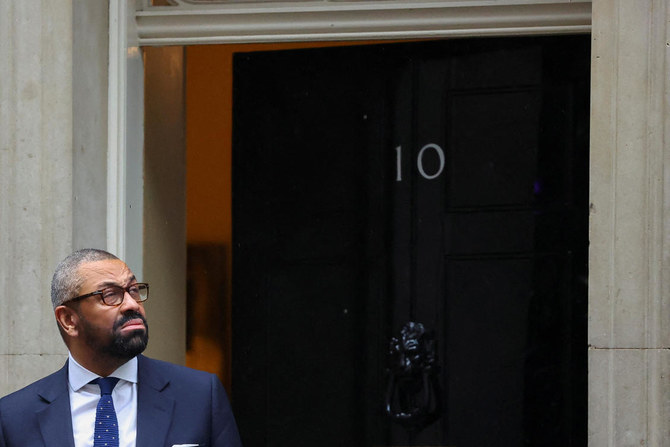
LONDON: British Home Secretary James Cleverly was under fire Sunday for joking about date rape just hours after announcing plans to crack down on what he had dubbed a “perverse” offense.
Cleverly, who oversees national security and law enforcement in England and Wales, faced a call to step down after he reportedly joked at an event at the prime minister’s home about drugging his wife.
He told women guests at a Dec. 18 reception that the secret to a long marriage was having a spouse who “is always mildly sedated so she can never realize there are better men out there,” the Sunday Mirror newspaper reported.
Cleverly said “a little bit of Rohypnol” — the so-called date rape drug — “in her drink every night” was “not really illegal if it’s only a little bit.”
The drug, colloquially known as a roofie when it is crushed and put into someone’s beverage without their knowledge, makes the subject drowsy and can lead to unconsciousness and memory loss.
Cleverly apologized through a spokesperson for what he called an “ironic joke” after he had announced the Conservative government planned to update legislation to make clear that such drink spiking is illegal. He described the practice as a “perverse” crime.
The comments were made during a drinks reception at 10 Downing Street where political journalists mingled with political aides, ministers and Prime Minister Rishi Sunak.
Conversations at such events are typically off the record, but the Sunday Mirror said it decided to report the news because of Cleverly’s position and the subject matter.
“In what was always understood as a private conversation, James, the home secretary tackling spiking, made what was clearly meant to be an ironic joke – for which he apologizes,” his spokesperson said.
Jemima Olchawski, chief executive of the women’s rights group the Fawcett Society said the remarks were “sickening,” and she called on Cleverly to resign.
“How can we trust him to seriously address violence against women and girls?” Olchawski said in a statement. “It’s sickening that the senior minister in charge of keeping women safe thinks that something as terrifying as drugging women is a laughing matter.”
Cleverly, 54, who met his wife in college and has two children, previously described tackling violence against women and girls as a personal priority.
Senior members of the opposition Labour Party condemned the “appalling” comments.
“It is truly unbelievable that the home secretary made such appalling jokes on the very same day the government announced new policy on spiking,” Yvette Cooper, a Labour member of Parliament, said. “Victims will understandably be questioning if they can trust him to take this vile crime seriously.”
The government has pledged to clarify that drink spiking is a crime while stopping short of making it a specific offense.
Police in England and Wales receive an average of 561 reports of spiking a month, mainly by women who report incidents at bars and nightclubs, according to a Home Office report.


British home secretary under fire for making joke about date rape drug
https://arab.news/284te
British home secretary under fire for making joke about date rape drug

- Cleverly said that the secret to a long marriage was having a sedated spouse who can never “realize there are better men out there"


Only 4% women on ballot as Bangladesh prepares for post-Hasina vote
- Women PMs have ruled Bangladesh for over half of its independent history
- For 2026 vote, only 20 out of 51 political parties nominated female candidates
DHAKA: As Bangladesh prepares for the first election since the ouster of its long-serving ex-prime minister Sheikh Hasina, only 4 percent of the registered candidates are women, as more than half of the political parties did not field female candidates.
The vote on Feb. 12 will bring in new leadership after an 18-month rule of the caretaker administration that took control following the student-led uprising that ended 15 years in power of Hasina’s Awami League party.
Nearly 128 million Bangladeshis will head to the polls, but while more than 62 million of them are women, the percentage of female candidates in the race is incomparably lower, despite last year’s consensus reached by political parties to have at least 5 percent women on their lists.
According to the Election Commission, among 1,981 candidates only 81 are women, in a country that in its 54 years of independence had for 32 years been led by women prime ministers — Hasina and her late rival Khaleda Zia.
According to Dr. Rasheda Rawnak Khan from the Department of Anthropology at Dhaka University, women’s political participation was neither reflected by the rule of Hasina nor Zia.
“Bangladesh has had women rulers, not women’s rule,” Khan told Arab News. “The structure of party politics in Bangladesh is deeply patriarchal.”
Only 20 out of 51 political parties nominated female candidates for the 2026 vote. Percentage-wise, the Bangladesh Socialist Party was leading with nine women, or 34 percent of its candidates.
The election’s main contender, the Bangladesh Nationalist Party, whose former leader Zia in 1991 became the second woman prime minister of a predominantly Muslim nation — after Pakistan’s Benazir Bhutto — was the party that last year put forward the 5 percent quota for women.
For the upcoming vote, however, it ended up nominating only 10 women, or 3.5 percent of its 288 candidates.
The second-largest party, Jamaat-e-Islami, has not nominated a single woman.
The 4 percent participation is lower than in the previous election in 2024, when it was slightly above 5 percent, but there was no decreasing trend. In 2019, the rate was 5.9 percent, and 4 percent in 2014.
“We have not seen any independent women’s political movement or institutional activities earlier, from where women could now participate in the election independently,” Khan said.
“Real political participation is different and difficult as well in this patriarchal society, where we need to establish internal party democracy, protection from political violence, ensure direct election, and cultural shifts around female leadership.”
While the 2024 student-led uprising featured a prominent presence of women activists, Election Commission data shows that this has not translated into their political participation, with very few women contesting the upcoming polls.
“In the student movement, women were recruited because they were useful, presentable for rallies and protests both on campus and in the field of political legitimacy. Women were kept at the forefront for exhibiting some sort of ‘inclusive’ images to the media and the people,” Khan said.
“To become a candidate in the general election, one needs to have a powerful mentor, money, muscle power, control over party people, activists, and locals. Within the male-dominated networks, it’s very difficult for women to get all these things.”