

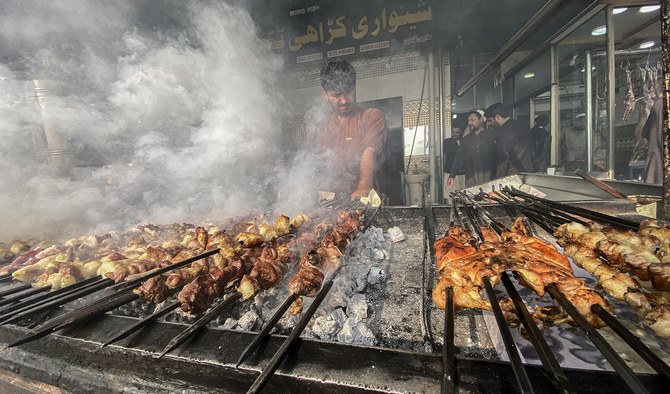
‘Patta Tikka’: In northwestern Pakistan, lamb liver with fat makes for a hearty meal

Noor Zada Shinwari, a chef, stands behind a grill as he prepares Patta Tikka in Peshawar, Pakistan on December 21, 2023. (AN photo)
Short Url
Updated 23 December 2023
Follow

‘Patta Tikka’: In northwestern Pakistan, lamb liver with fat makes for a hearty meal

  • Patta Tikka, lamb liver wrapped in fat with a dash of salt, is a traditional dish of the ethnic Pashtun tribe of Shinwari
  • A skewer of Patta Tikka costs $0.71 and is a popular food item during winter season in Khyber Pakhtunkhwa province

PESHAWAR: Noor Zada Shinwari has his hands full with over half a dozen skewers placed atop a barbecue grill. With squinting eyes, he brings one skewer with the uncooked meat directly above burning hot coal and waits for the lamb liver, wrapped in fat, to cook. 

The smell of fat and meat mixed with salt greets one’s nostrils as they travel on a road from Peshawar to the Pakistan-Afghanistan Torkham border in the northwestern Khyber district. There, one sees at least a dozen shops offering the sumptuous meat dish popularly known as ‘Patta Tikka.’ 

Patta Tikka is a traditional dish of the ethnic Pashtun Shinwari tribe that resides in the eastern and southeastern regions of Afghanistan and the northwestern Khyber Pakhtunkhwa province of Pakistan. 

“Patta” is a Pashto word that translates into “hidden,” and the dish is called Patta Tikka because of the way it is prepared: the liver of a lamb is buried with its fat before it is cooked on hot coal for around 30 minutes. 

And unlike other food items, it doesn’t require ingredients such as masala or chili powder. A dash of salt, and your palatable Patta Tikka is ready to be devoured. 

“This is the liver and fat of lambs, we make Patta Tikka from it,” Shinwari told Arab News as he busily cooked a batch of the lamb meat. “First, we cook the liver half and then wrap it in fat. Both the liver and the fat are of the lamb.” 

Shinwari has been preparing Patta Tikka in the Khyber district for the past 10 years. While the dish is a popular winter food item, it is also relished in summers. 

“People like it more in winter,” Shinwari said. “Otherwise, it is also sold in summer.”
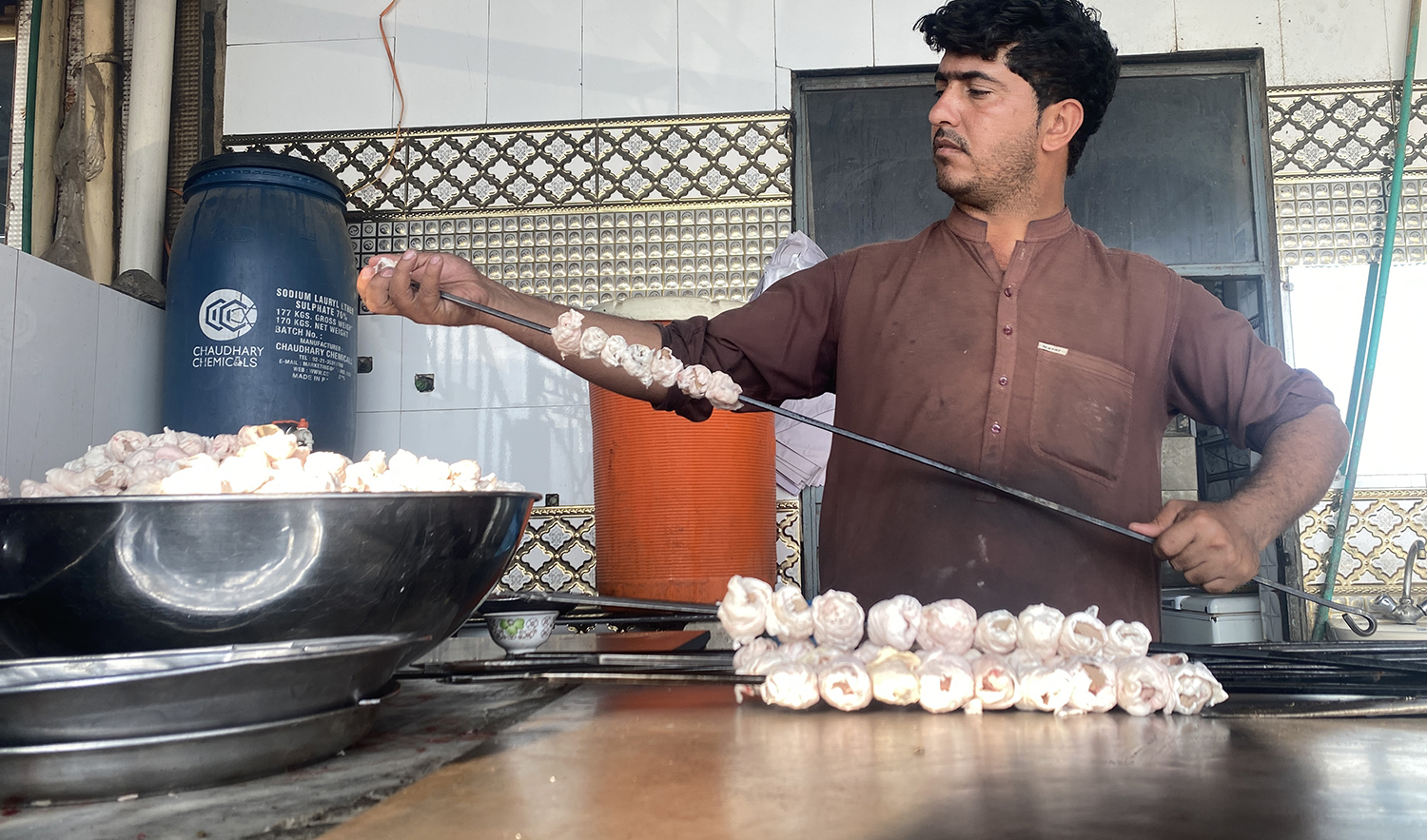


Noor Zada Shinwari, a chef, stands behind a grill as he prepares Patta Tikka in Peshawar, Pakistan on December 21, 2023. (AN Photo)

The fat, though, is hard to digest and the meat gives off a salty taste. The oily dish is a heavy one, and according to Shinwari, one person can’t have too much of it in one sitting. 

“A foodie can try to eat three skewers, otherwise, it is hard to eat more than two,” he said. 

The dish isn’t an expensive one, though. A skewer of Patta Tikka, which contains 9-10 small pieces of lamb liver, costs Rs200 ($0.71). 

The business of Patta Tikka got a boost during the 2000s, causing several shops selling the dish to crop up in the famous Karkhano Market on the Peshawar-Khyber road. 

Hajji Kameen Jan Shinwari used to work in restaurants. He established his restaurant in 2000 which initially employed only three people. 

Jan, who is one of the pioneers of Patta Tikka at Karkhano Market, has grown his restaurant to the extent that it now has around 21 employees. 

“Patta Tikka has been eaten since then [2000], however, people didn’t know about it at that time,” he told Arab News. 

Jan said only people from the northwestern town of Landi Kotal, the Afridis and the Shinwaris (tribes) would eat it at first while others did not like it. 

Now, customers come from far-flung areas to try Patta Tikka. He acknowledged the dish is popular due to its reasonable price. 

Muhammad Ammar Babar, 28, came from District Nowshera in northwestern Pakistan to try Patta Tikka with his friends at Karkhano Market. 

“This place is special for that [Patta Tikka],” Babar told Arab News. “Every place you might visit, they have some kind of specialty. Karkhano is famous for this kind of Patta Tikka.” 

Naveed Ahmad, a customer from Pakistan’s southern city of Hyderabad, couldn’t help but praise the dish. 

“I came here for the first time, and I took this Patta Dana [Tikka] dish for the first time and I enjoyed it very much,” Ahmad told Arab News. 

Patta Tikka is reasonably priced and doesn’t earn Jan big bucks. However, that isn’t why he serves the food item. 

“This [Patta Tikka] doesn’t earn us money but matches its expenses,” he said. “But when we place Patta Tikka, it attracts customers.” 


Pakistan seafood exports rise 22 percent in last six months on strong Gulf, Asia demand

Updated 5 sec ago
Follow

Pakistan seafood exports rise 22 percent in last six months on strong Gulf, Asia demand

  • Fisheries is a vital pillar of the national maritime economy that supports livelihoods of millions of Pakistanis, particularly in coastal communities
  • Maritime Affairs Minister Junaid Anwar Chaudhry stresses the need for strict regulatory compliance, sustainable fishing to protect marine biodiversity

KARACHI: Pakistan’s seafood exports climbed 22% over the past six months buoyed by strong demand from Gulf and Asian markets, the country’s Press Information Department said, citing official data.

KARACHI: Pakistan’s marine fisheries sector posted strong growth as its seafood exports rose to 122,629.11 metric tons, valued at $253.24 million, between July and December 2025, the Press Information Department said on Friday, citing Maritime Affairs Minister Junaid Anwar Chaudhry.

Pakistan’s exports stood at 102,942.05 metric tons worth $208.25 million during the corresponding period of the previous year, according to the Marine Fisheries Department data. The sector recorded a year-on-year increase of 19.1% in volume and 21.6% in value.

Fisheries is a vital pillar of the national maritime economy that supports livelihoods of millions of Pakistanis, particularly in coastal communities along the Arabian Sea in Sindh and Balochistan provinces, according to the maritime affairs minister.

Historically contributing around 1% to GDP, the sector has rebounded from pandemic-era disruptions through expanded processing capacity, improved cold-chain logistics, and stricter certification aligned with international standards.

“The performance reflects the growing competitiveness of Pakistan’s marine fisheries in global markets,” Chaudhry, who noted sustained export momentum from July till December, was quoted as saying by the PID.

According to the data, frozen fish remained the leading export category, accounting for 26,669.37 metric tons valued at $53.33 million. Shrimps and prawns followed with earnings of $40.46 million, while frozen cuttlefish generated $36.13 million. Other products, including shrimp meal, crabs, sardines, mackerel, flatfish species and fish meal, also contributed to higher export receipts, underscoring diversification and growth in value-added processing.

“China retained its position as Pakistan’s largest export destination, importing more than 83,602 metric tons worth $149.2 million — nearly 59% of total seafood exports— driven by steady demand for high-quality frozen products,” PID said.

“Thailand ranked second with imports valued at $31.3 million, mainly shrimps and prawns, supported by Pakistan’s HACCP-certified (Hazard Analysis and Critical Control Point-certified) processing standards.”

The United Arab Emirates, Malaysia, and Japan followed, with rising shipments of cuttlefish and fish meal.

Chaudhry said that market diversification efforts have also expanded exports to the European Union, Saudi Arabia, Vietnam, Kuwait, and the United States.

Monthly export figures showed consistent growth, peaking at $56.42 million in November and $55 million in December, aided by seasonal demand and logistical improvements. Non-tax revenue from the fisheries sectors also increased to Rs127.7 million (approximately $460,000), up from Rs118 million a year earlier.

Chaudhry attributed the gains to government initiatives such as collaboration with the International Maritime Organization (IMO) on sustainable fishing practices and investments in port infrastructure in Karachi and Gwadar.

“These developments signal the fisheries sector’s rising contribution to foreign exchange earnings and economic stability,” he said, stressing the need for strict regulatory compliance and sustainable fishing to protect marine biodiversity.