ICRC taps former UN Palestinian refugee agency director as new chief

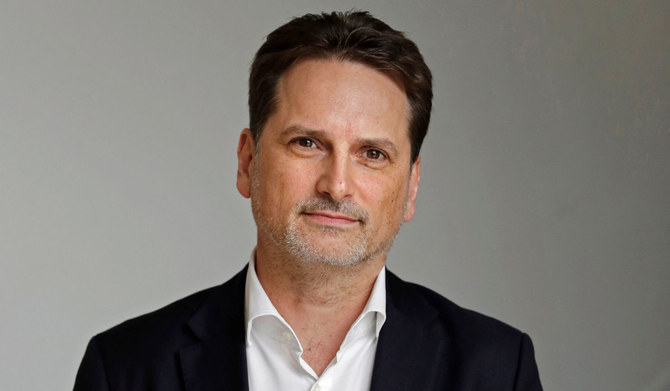
Pierre Krahenbuhl, Commissioner General for the United Nations Relief and Works Agency for Palestine Refugees (UNRWA), looks on during an interview in Jerusalem on January 19, 2018. (AFP file photo)
Short Url
Updated 23 December 2023
Follow

ICRC taps former UN Palestinian refugee agency director as new chief

  • Pierre Krahenbuhl ‘is recognized as a strategic and purpose-driven leader with deep organizational experience’

GENEVA: The Red Cross said on Friday that it had appointed Pierre Krahenbuhl, a controversial former head of the UN agency for Palestinian refugees, as its director-general.

The Swiss national, with more than 30 years of experience in the humanitarian sector, will take over in April when current chief Robert Mardini completes his four-year term.
“The Assembly of the International Committee of the Red Cross or ICRC has appointed Pierre Krahenbuhl as the organization’s next director-general,” it said in a statement.
Krahenbuhl, 57, has spent 25 years in prominent roles at the ICRC and serves as secretary-general to the ICRC assembly.

BACKGROUND

Pierre Krahenbuhl will be taking the helm of the ICRC as it grapples with its own funding shortage, which has forced it to make budget cuts and slash some 1,500 jobs.

“He is recognized as a strategic and purpose-driven leader with deep organizational experience and dedication to the ICRC,” the statement said.
In 2014, Krahenbuhl was appointed commissioner-general of the UN agency that supports Palestinian refugees or UNRWA.
He resigned from that position in 2019 amid an internal probe into alleged mismanagement and ethical abuses at the organization.
The findings were never made public, but Swiss media reported that it largely cleared him of the main allegations.
Krahenbuhl told the Le Temps daily that the probe “cleared me of the serious charges brought against me (fraud, corruption, mismanagement of funds, etc.) and retained only a few management failures.”
But others have contested that, and a Le Temps investigation maintained that the failures were not trivial and would have led to “inevitable disciplinary action” against Krahenbuhl if he had not left his post.
At the time of Krahenbuhl’s resignation, UNRWA was facing relentless attacks by the administration of former US president Donald Trump, which, along with Israel, accused it of perpetuating the Israeli-Palestinian conflict.
In 2018, Washington decided to suspend, then stop entirely, its contribution to the agency’s budget, robbing it of its most significant donor and sparking a funding crunch.
US President Joe Biden’s administration later fully restored the country’s support.
Krahenbuhl will be taking the helm of the ICRC as it grapples with its own funding shortage, forcing it to make budget cuts and slash some 1,500 jobs.
The ICRC is also facing pressure over the Israeli-Palestinian conflict and, in particular, its response to the war raging in Gaza.
The Swiss-based organization has been accused by both sides of not condemning the other and of insufficient help to those detained or being held hostage.
ICRC President Mirjana Spoljaric told journalists this week about maintaining neutrality in all conflicts and crises.

“Without neutrality, we wouldn’t be able to operate; without confidentiality... we wouldn’t be successful,” she said.


The UN says Al-Hol camp population has dropped sharply as Syria moves to relocate remaining families

Updated 15 February 2026
Follow

The UN says Al-Hol camp population has dropped sharply as Syria moves to relocate remaining families

  • Forces of Syria’s central government captured the Al-Hol camp on Jan. 21 during a weekslong offensive against the SDF, which had been running the camp near the border with Iraq for a decade

DAMASCUS: The UN refugee agency said Sunday that a large number of residents of a camp housing family members of suspected Daesh group militants have left and the Syrian government plans to relocate those who remain.
Gonzalo Vargas Llosa, UNHCR’s representative in Syria, said in a statement that the agency “has observed a significant decrease in the number of residents in Al-Hol camp in recent weeks.”
“Syrian authorities have informed UNHCR of their plan to relocate the remaining families to Akhtarin camp in Aleppo Governorate (province) and have requested UNHCR’s support to assist the population in the new camp, which we stand ready to provide,” he said.
He added that UNHCR “will continue to support the return and reintegration of Syrians who have departed Al-Hol, as well as those who remain.”
The statement did not say how residents had left the camp or how many remain. Many families are believed to have escaped either during the chaos when government forces captured the camp from the Kurdish-led Syrian Democratic Forces last month or afterward.
There was no immediate statement from the Syrian government and a government spokesperson did not respond to a request for comment.
At its peak after the defeat of IS in Syria in 2019, around 73,000 people were living at Al-Hol. Since then, the number has declined with some countries repatriating their citizens. The camp’s residents are mostly children and women, including many wives or widows of IS members.
The camp’s residents are not technically prisoners and most have not been accused of crimes, but they have been held in de facto detention at the heavily guarded facility.
Forces of Syria’s central government captured the Al-Hol camp on Jan. 21 during a weekslong offensive against the SDF, which had been running the camp near the border with Iraq for a decade. A ceasefire deal has since ended the fighting.
Separately, thousands of accused IS militants who were held in detention centers in northeastern Syria have been transferred to Iraq to stand trial under an agreement with the US
The US military said Friday that it had completed the transfer of more than 5,700 adult male IS suspects from detention facilities in Syria to Iraqi custody.
Iraq’s National Center for International Judicial Cooperation said a total of 5,704 suspects from 61 countries who were affiliated with IS — most of them Syrian and Iraqi — were transferred from prisons in Syria. They are now being interrogated in Iraq.