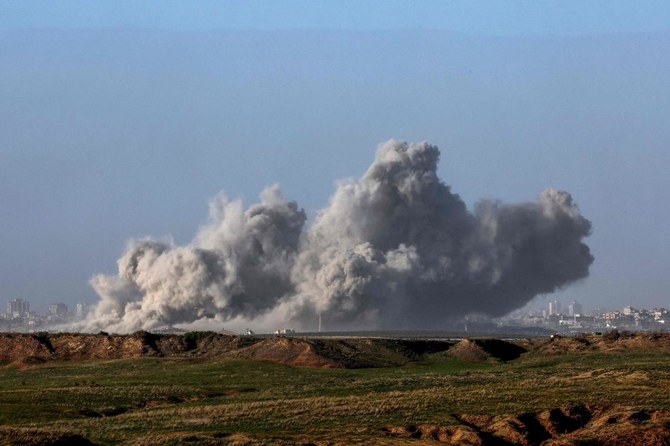
JERUSALEM: The Israeli military campaign in Gaza, experts say, now sits among the deadliest and most destructive in recent history.
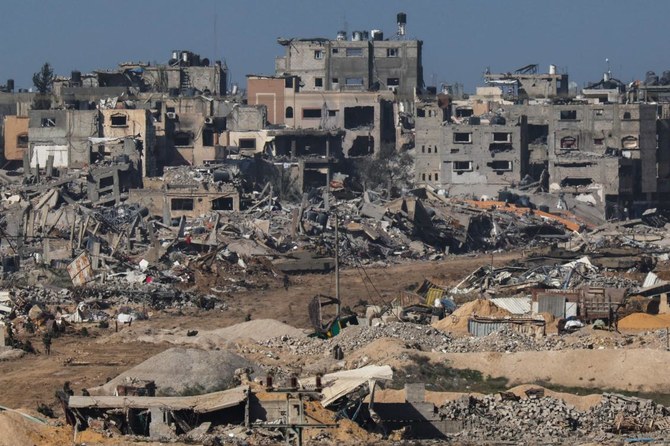
In just over two months, the offensive has wreaked more destruction than the razing of Syria’s Aleppo between 2012 and 2016, Ukraine’s Mariupol or, proportionally, the Allied bombing of Germany in World War II.
It has killed more civilians than the US-led coalition did in its three-year campaign against the Daesh group.
The Israeli military has said little about what kinds of bombs and artillery it is using in Gaza. But from blast fragments found on-site and analyzes of strike footage, experts are confident that the vast majority of bombs dropped on the besieged enclave are US-made. They say the weapons include 2,000-pound (900-kilogram) “bunker-busters” that have killed hundreds in densely populated areas.
With the Palestinian death toll in Gaza surpassing 20,000, the international community is calling for a ceasefire. Israel vows to press ahead, saying it wants to destroy Hamas’ military capabilities following the militant group’s Oct. 7 cross-border rampage that triggered the war, in which it killed 1,200 people and took 240 others hostage.
The Biden administration has quietly continued to supply arms to Israel. Last week, however, President Joe Biden publicly acknowledged that Israel was losing international legitimacy for what he called its “indiscriminate bombing.”
Here’s a look at what is known so far about Israel’s campaign on Gaza.
HOW MUCH DESTRUCTION IS THERE IN GAZA?
Israel’s offensive has destroyed over two-thirds of all structures in northern Gaza and a quarter of buildings in the southern area of Khan Younis, according to an analysis of Copernicus Sentinel-1 satellite data by Corey Scher of the CUNY Graduate Center and Jamon Van Den Hoek of Oregon State University, experts in mapping damage during wartime.
The percentage of damaged buildings in the Khan Younis area nearly doubled in just the first two weeks of Israel’s southern offensive, they said.
That includes tens of thousands of homes as well as schools, hospitals, mosques and stores. UN monitors have said that about 70 percent of school buildings across Gaza have been damaged. At least 56 damaged schools served as shelters for displaced civilians. Israeli strikes damaged 110 mosques and three churches, the monitors said.
Israel holds Hamas responsible for civilian deaths by embedding militants in civilian infrastructure. Those sites also shelter multitudes of Palestinians who have fled under Israeli evacuation orders.
“Gaza is now a different color from space. It’s a different texture,” said Scher, who has worked with Van Den Hoek to map destruction across several war zones, from Aleppo to Mariupol.
HOW DOES THE DESTRUCTION STACK UP HISTORICALLY?
By some measures, destruction in Gaza has outpaced Allied bombings of Germany during World War II.
Between 1942 and 1945, the allies attacked 51 major German cities and towns, destroying about 40-50 percent of their urban areas, said Robert Pape, a US military historian. Pape said this amounted to 10 percent of buildings across Germany, compared to over 33 percent across Gaza, a densely populated territory of just 140 square miles (360 square kilometers).
“Gaza is one of the most intense civilian punishment campaigns in history,” said Pape. “It now sits comfortably in the top quartile of the most devastating bombing campaigns ever.”
The US-led coalition’s 2017 assault to expel the Daesh group from the Iraqi city of Mosul was considered one of the most intense attacks on a city in generations. That nine-month battle killed around 10,000 civilians, a third of them from coalition bombardment, according an Associated Press investigation at the time.
During the 2014-2017 campaign to defeat Daesh in Iraq, the coalition carried out nearly 15,000 strikes across the country, according to Airwars, a London-based independent group that tracks recent conflicts. By comparison, the Israeli military said last week it has conducted 22,000 strikes in Gaza.
WHAT TYPES OF BOMBS ARE BEING USED?
The Israeli military has not specified what it is using. It says every strike is cleared by legal advisers to make sure it complies with international law.
“We choose the right munition for each target — so it doesn’t cause unnecessary damage,” said the army’s chief spokesman, Rear Adm. Daniel Hagari.
Weapons experts have been able to draw conclusions by analyzing blast fragments found on-site, satellite images and videos circulated on social media. They say the findings offer only a peek into the full scope of the air war.
So far, fragments of American-made Joint Direct Attack Munitions (JDAM) bombs and smaller diameter bombs have been found in Gaza, according to Brian Castner, a weapons investigator with Amnesty International.
The JDAM bombs include precision-guided 1,000- and 2,000-pound (450-kilogram and 900-kilogram) “bunker-busters.”
“It turns earth to liquid,” said Marc Garlasco, a former Pentagon defense official and a war crimes investigator for the UN “It pancakes entire buildings.”
He said the explosion of a 2,000-pound bomb in the open means “instant death” for anyone within about 30 meters (100 feet). Lethal fragmentation can extend for up to 365 meters (1,200 feet).
In an Oct. 31 strike on the urban refugee camp of Jabaliya, experts say a 2,000-pound bomb killed over 100 civilians.
Experts have also identified fragments of SPICE (Smart, Precize Impact, Cost-Effective) 2000-pound bombs, which are fitted with a GPS guidance system to make targeting more precise. Castner said the bombs are produced by the Israeli defense giant Rafael, but a recent State Department release first obtained by The New York Times showed some of the technology had been produced in the United States.
The Israeli military is also dropping unguided “dumb” bombs. Several experts pointed to two photos posted to social media by the Israeli Air Force at the start of the war showing fighter jets stocked with unguided bombs.
IS THE STRATEGY WORKING?
Israel says it has two goals: destroy Hamas and rescue the 129 hostages still held by militants.
Eleven weeks into the war, Israel says it has destroyed many Hamas sites and hundreds of tunnel shafts and has killed 7,000 Hamas fighters out of an estimated 30,000-40,000. Israeli leaders say intense military pressure is the only way to free more hostages.
But some families of hostages worry that the bombing endangers their loved ones. Hostages released during a weeklong ceasefire last month recounted that their captors moved them from place to place to avoid Israeli bombardment. Hamas has claimed that several hostages died from Israeli bombs, though the claims could not be verified.
The level of destruction is so high because “Hamas is very entrenched within the civilian population,” said Efraim Inbar, head of the Jerusalem Institute for Strategy and Security, a think tank. He also said intense bombardment of Hamas’ tunnels is needed to protect advancing Israeli ground forces from attacks.


![]()
![]()
![]()

Israel’s military campaign in Gaza seen as among the most destructive in recent history, experts say

Short Url
https://arab.news/c373n
Israel’s military campaign in Gaza seen as among the most destructive in recent history, experts say
- With the Palestinian death toll in Gaza surpassing 20,000, the international community is calling for a ceasefire
- The Biden administration has quietly continued to supply arms to Israel


Latest updates


© 2026 SAUDI RESEARCH & PUBLISHING COMPANY, All Rights Reserved And subject to Terms of Use Agreement.