

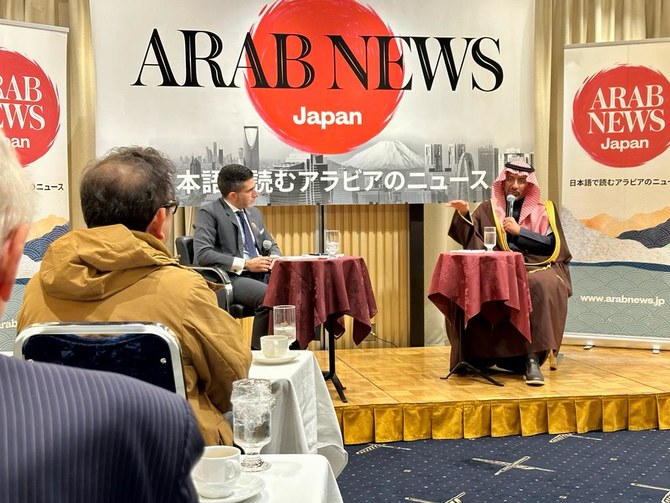
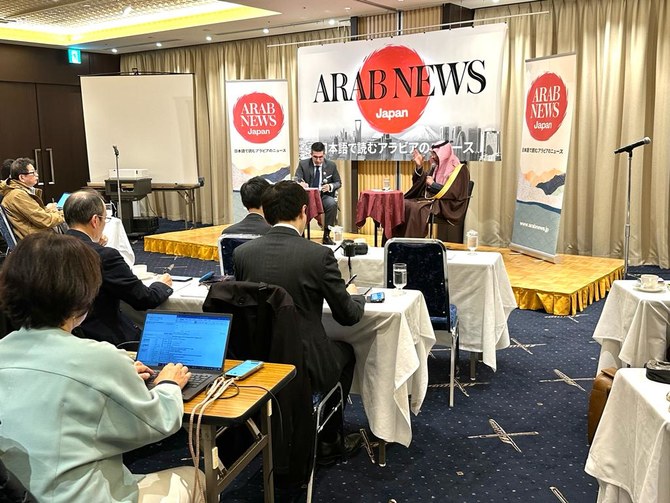


TOKYO: Bandar AlKhorayef, Saudi Minister of Industry and Mineral Resources, participated in an Arab News Japan Fireside chat event on Dec. 18 in Tokyo.
Speaking to Arab News’ Editor in Chief, Faisal J. Abbas, at the Foreign Correspondents’ Club of Japan (FCCJ), where Arab News Japan first launched four years ago, AlKhorayef began his talk by highlighting the transformation Saudi Arabia went through in recent years and giving an outline of what the Kingdom’s Vision 2030 is set to achieve, which he says is one of the main purposes of his Tokyo visit.
“The visit is really focusing on explaining what we are doing in Saudi (Arabia) and getting our partners in Japan interested, and also how to be a part of what is going on.”

Saudi Arabia's Minister of Industry and Mineral Resources Bandar AlKhorayef. (ANJ Photo)
“On the mining side, it has been very clear for us that the stress and the demand on minerals will be increasing. And for countries who are looking for ways to secure their supply of different minerals, we created what we called: The Future Minerals Forum, an annual forum that takes place in Saudi Arabia,” he added.
AlKhorayef explained that while Saudi Arabia is still “under explored,” the most recent estimates of existing mineral resources the Kingdom currently posses stand at $1.3 trillion. The figures are to be updated in January, but the minerals include phosphates, zinc, aluminum and fertilizers.
“The other part is manufacturing. Saudi Arabia has been a manufacturing country for more than 50 years. We are huge producer of chemicals, but we are trying to do is bring up manufacturing to be more be more complex to enter more value added products,” he added.
The minister elaborated on the 12 target sectors that the Kingdom aimed to target. He also had a message to Japanese car manufacturers in response to a question on the rising market share of Electric Vehicles (EVs) and Chinese brands in the Saudi market, which was historically a Japanese stronghold.
“The perception of Japanese manufacturing and Japanese companies and brands is very highly perceived. But we all know sometimes thing, and certain events happen and they change the dynamics of the market,” he explained.
“That is why I tell the large brands in Saudi Arabia, especially Toyota and Hyundai, if you don’t protect your market share, you will definitely lose it.”
Asked about security threats in the Middle East, and how it impacts plans to further develop industry and attract investors in Saudi Arabia, Minister AlKhorayef said “the region is definitely a big region, and it is important to understand it has different components.”
“Saudi Arabia has been in this region, and with conflicts going up or down, it still survives because there is a fundamental reason for that. The stability we have in Saudi Arabia is genuine, because it is based on a great relation between the people and the leaders,” he said.
“Secondly, Saudi Arabia I would argue is the number one country that has showed great progress in investing its oil returns into society,” he elaborated adding that this is “because our leadership is keen on creating a strong country, strong societies and strong people.”
The fire side chat was open to a Q&A by leading Japanese media outlets such as The Nikkei Shimbun, NHK, Jiji Press, Kyodo News and Mainichi Shimbun.


