

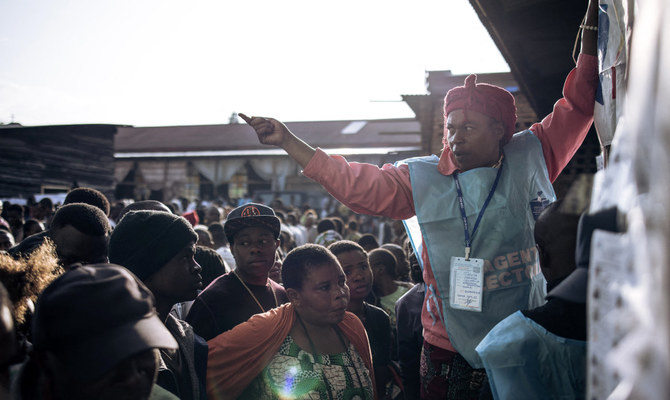

KINSHASA/GOMA, Democratic Republic of Congo: Democratic Republic of Congo has extended elections into Thursday for those whose polling stations did not open on Wednesday, prompting a group of opposition presidential candidates to call for a rerun of the chaotic vote.
At stake is not just the legitimacy of the next administration. Congolese election disputes often spark unrest with potentially far-reaching consequences. Congo is the world’s third-largest copper producer, and the top producer of cobalt, a battery component needed for the green transition.
The decision by the national election commission (CENI) caps a contentious campaign and an election day beset by delays, opposition allegations of fraud, and violence.
Speaking to reporters in the capital Kinshasa after polls were meant to have closed, CENI President Denis Kadima acknowledged many polling stations across the country had opened late and some not at all and said voting would be extended for those whose centers did not open.
This “cannot affect the credibility of the process. On the contrary, it is a demonstration that we want to grant the same right to (all) Congolese,” he said.
The opposition and independent observers had already sounded the alarm about a possible extension, saying it would enable fraud.
In a joint statement late on Wednesday, five opposition candidates, including top challengers Martin Fayulu and Denis Mukwege, said the commission had no constitutional or legal right to extend the vote.
They demanded “the reorganization of these failed elections by a differently structured CENI” and at a date agreed by all stakeholders.
“It is total chaos,” said Fayulu earlier after voting in Kinshasa. The former oil executive was runner-up in the disputed 2018 presidential election.
This time, President Felix Tshisekedi is competing against 18 opposition challengers in the hope of a second term running the mineral-rich yet poverty-stricken nation.
POLLING STATION CONCERNS
Throughout election day, observers flagged delays or failures opening polling stations and other issues, including malfunctioning electronic voting systems and violent attacks.
Towards the scheduled end of voting, presidential candidate and Nobel Peace Laureate Mukwege condemned what he called “the proliferation of serious dysfunction and irregularities ... which confirm our fears of evidently planned electoral fraud.”
We “fear that the results of such a chaotic vote will not reflect the will of the people,” he said.
The tumult of election day follows a campaign marred by political violence and repeated warnings from the opposition and observers about a lack of transparency. Their concerns include issues with the voter list and illegible ID cards.
For months, the electoral commission repeatedly rejected the opposition’s allegations of mismanagement and fraud. It insisted it could deliver a free and fair vote as promised across Africa’s second-largest country, even as critics flagged irregularities they said would jeopardize the legitimacy of the results.
In the eastern cities of Goma and Beni, some polling stations opened hours late and people struggled to find their names on voter lists, according to Reuters witnesses. At one center in Goma, voting machines’ batteries ran out, leaving large crowds of people unable to vote as darkness fell.
In Bunia, also in eastern Congo, security forces fired warning shots to disperse protesters after a voting center was vandalized and kits destroyed, a Reuters reporter said.
ELECTORAL TRANSPARENCY
About 44 million Congolese registered to take part in the election, which also includes regional ballots.
As voting day neared, the electoral commission sought extra helicopters, raising concerns about its ability to open polling stations in areas otherwise unreachable due to bad roads or a lack of security.
The observer mission of Congo’s powerful Catholic Church known as CENCO, on Wednesday warned such an extension would undermine the integrity of the results.
“It is important for the election to take place in one day to avoid fraud,” said CENCO Secretary-General Donatien Nshole before the commission announced the extension.
Full provisional results were expected by Dec. 31, but it is not clear how the latest developments will affect the schedule. Some vote-counting had started at polling stations where voting was completed, Reuters reporters said.
The presidential election is decided in a single round, requiring a simple majority of the vote to win.
In Beni, some voters were undeterred by the delays. “Even with night falling, I will wait,” said 28-year-old homemaker Rebecca Tommy, standing in line nearly two hours after polls were meant to close.
“I am still waiting here to vote because it is my right.”


