

A dozen still missing after China’s earthquake, 137 dead

1 / 5
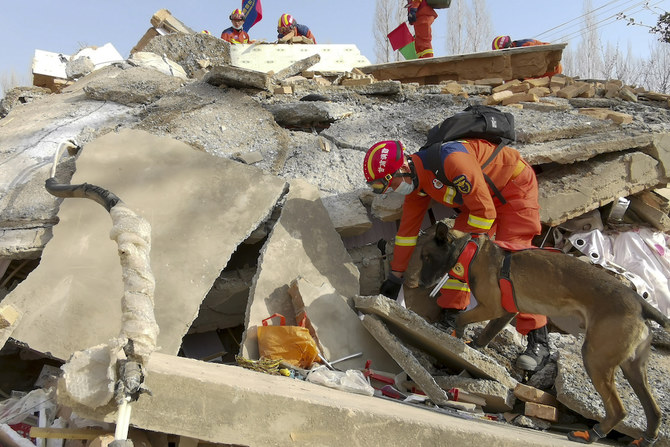
A rescuer uses a sniffer dog to search for survivors at a collapsed house in Linxia Hui Autonomous Prefecture, northwest China’s Gansu Province on Dec. 19, 2023. (Xinhua via AP)
2 / 5
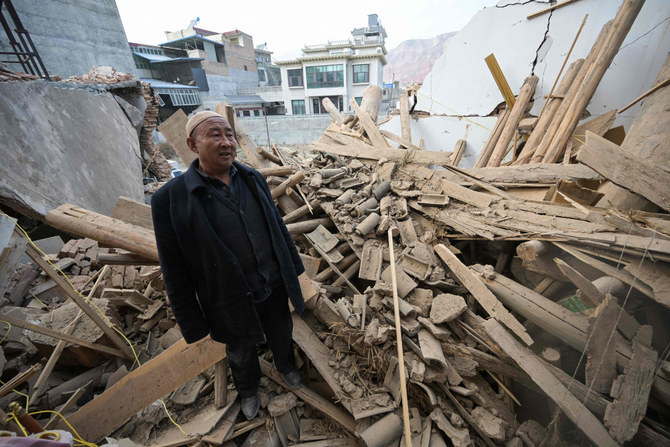
A man inspects a damaged building after an earthquake at Dahejia in Jishishan County in northwest China's Gansu province on December 20, 2023. (AFP)
3 / 5
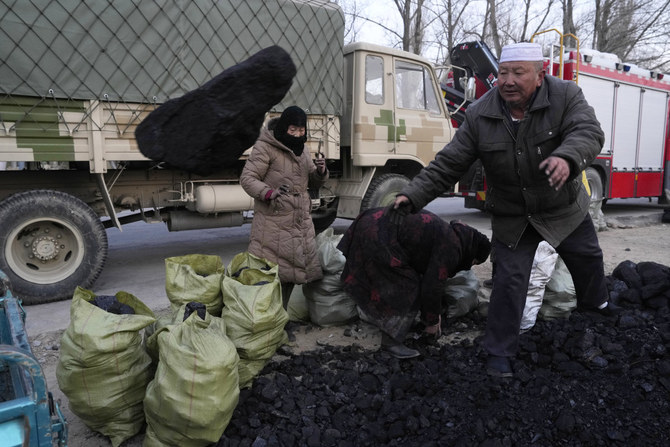
Residents collect coal for heating after an earthquake in Dahejia town in northwestern China's Gansu province on Dec. 20, 2023. (AP)
4 / 5
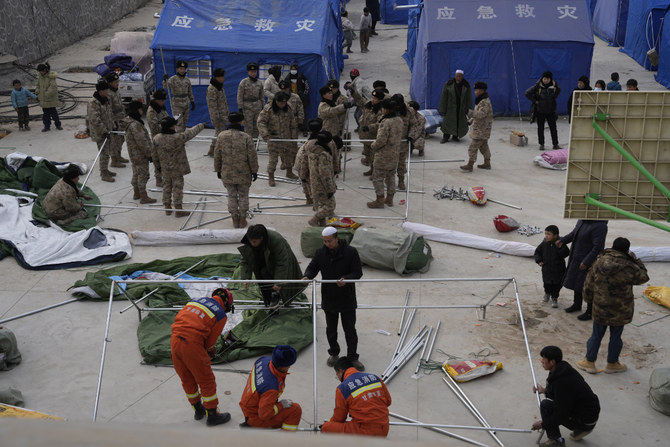
Soldiers and other volunteers help set up tents at a temporary shelter for residents on Dec. 20, 2023, following an earthquake in Dahejia town in northwestern China's Gansu province. (AP)
5 / 5
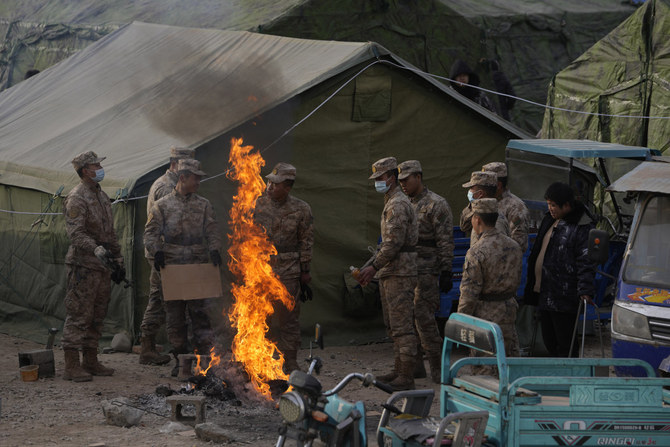
Chinese soldiers gather near a fire at a temporary shelter after an earthquake in Dahejia town in northwestern China's Gansu province on Dec. 20, 2023. (AP)
Short Url
Updated 21 December 2023
Follow

A dozen still missing after China’s earthquake, 137 dead

  • Monday night's earthquake killed at least 134 people and injured more than 900 others
  • Nearly 15,000 homes collapsed in Gansu province and more than 87,000 people have been resettled

DAHEJIA, China: A dozen people were still missing on Thursday after a 6.2-magnitude earthquake struck northwestern Gansu province late Monday, and netizens questioned the speed at which rescue operations had ended.

Chinese media reported that search-and-rescue work in Gansu ended at 3 p.m. (0700 GMT) on Tuesday, about 15 hours after the disaster hit a remote and mountainous area near the border straddling Gansu and Qinghai provinces. It was not immediately clear whether the search in Qinghai was continuing.

In Gansu, 115 people had been found dead as of 9 a.m. on Wednesday (0100 GMT) and 784 were injured, authorities said. Gansu has not reported any missing persons.

Neighboring Qinghai saw its death toll rose to 22 with 198 injured and 12 missing as of 8:56 p.m. on Wednesday.

More than 207,000 homes were wrecked and nearly 15,000 collapsed in Gansu, affecting more than 145,000 people.

Discussions online showed netizens curious about how quickly rescue efforts wrapped up in Gansu, with many suggesting that the sub-freezing temperatures were the main factor in shortening the “golden period” for finding survivors — typically 72 hours post-disaster.

People trapped under rubble exposed to prolonged temperatures of -10°Celsius (14°F) run the risk of rapid hypothermia and may only be able to live for five to 10 hours even if uninjured, local media reported, citing researchers.

“They would have been dead by the time they were found, even 24 hours is already too long. Outdoor temperatures are below minus 10°C,” a user on Chinese microblogging platform Weibo commented.

Some users on Weibo considered other factors such as that the search area was not especially wide, and that people have been all accounted for, leading to rescue efforts ending in less than a day.

SURVIVING THE COLD

Rescuers on Wednesday pulled to safety victims of the earthquake, which jolted Jishishan county in Gansu a minute before midnight on Monday, sending many residents in the area out of homes into the cold in the dead of the night.

Survivors face uncertainty in the wintry months ahead without permanent shelter amid freezing temperatures.

Many of the affected families are Hui people, an ethnic minority mostly found in western Chinese provinces and regions such as Gansu, Ningxia and Shaanxi.

In Gansu’s Sibuzi village, villagers worried about the freezing winter.

“Many people escaped from their homes, some without socks, just ran out barefoot. It’s extremely cold standing on the ground,” said Zhou Habai, an ethnic Hui woman.

The 24-year-old, now staying in a makeshift tent after her home was destroyed, said some villagers have been gathering and burning firewood to keep warm.

About 60 percent of the survivors have not received tents, 63-year-old Ye Zhiying, from the same village, told Reuters.

He said officials from the Communist Party had told them that the village would distribute tents by noon on Thursday, and would be set up in less than a week.

“Whether everyone can be accommodated or not, we don’t know,” said the Hui villager, who was given a tent on Wednesday.

Roads, power and water lines and agricultural production facilities have suffered damage, and the quake triggered land and mudslides that swept through villages in Qinghai’s Haidong where the missing were reported from.


India’s new budget bets on AI, data centers to sustain growth

Updated 42 min 32 sec ago
Follow

India’s new budget bets on AI, data centers to sustain growth

  • Budget features new Bharat‑VISTAAR AI‑powered platform for agriculture sector
  • It also includes tax holiday until 2047 for foreign companies using Indian data centers

NEW DELHI: India’s latest budget has emerged as one of its most technology-focused, with new measures to utilize artificial intelligence, semiconductor manufacturing, and expand digital infrastructure aimed at offsetting the impact of global tariff wars.

Finance Minister Nirmala Sitharaman presented the 2026-27 budget in parliament on Sunday, saying it would “accelerate and sustain economic growth by enhancing productivity and competitiveness” at a time when India was facing “an external environment in which trade and multilateralism are imperiled and access to resources and supply chains are disrupted.”

New Delhi has yet to secure a trade deal with its largest trading partner, the US, which last year hit it with punitive tariffs of up to 50 percent over India’s purchases of Russian oil. To mitigate their impact, India has been looking for alternative agreements, including last week’s agreement with the EU, cutting duty on 99.5 percent of Indian exports to the bloc.

The new budget prioritizes infrastructure and domestic manufacturing, with a total expenditure estimated at $583 billion.

It offers tariff concessions for products from the marine, leather, and textile industries — all of which have been affected by US tariffs — and provides duty exemptions on materials and goods used to process rare-earth minerals, make lithium ion batteries, solar glass, and components for electric vehicles.

The finance minister also announced doubled spending for semiconductor manufacturing to $4.8 billion and a tax holiday until 2047 for foreign companies providing cloud services using Indian data centers.

The budget also features Bharat‑VISTAAR (Virtually Integrated System to Access Agricultural Resources), a multilingual AI‑powered platform for the agriculture sector to give farmers customized, real‑time advisory on crop management, weather, soil conditions and government schemes in different Indian languages.

“There is a lot of focus on AI and technology. It is to achieve the ambitious target India has already declared — Viksit Bharat 2047. It is very clear that without technology, it would be difficult to achieve that target,” Prof. Pardeep S. Chauhan, Centre for Economic Studies and Planning, Jawaharlal Nehru University, told Arab News, referring to the government’s plan to transform the nation into a fully developed country by 2047 — the 100th anniversary of its independence.

“That was the need of the hour, and the government has taken care of it, focusing on semiconductors, AI, and rare-earth minerals.”

The technology focus also comes against the backdrop of China’s dominance in the global critical minerals supply chains, and last year’s restrictions imposed by Beijing in the wake of escalating trade tensions with the US.

“India lags far behind the US and China, particularly China,” Chauhan said. “India has taken this move to maybe after five, 10, 15 years ... compete up to some extent. Without technology, nobody can think of establishing (their) leadership — whether it’s in the economy, defense or financial infrastructure architecture. Everywhere you need technology.”