

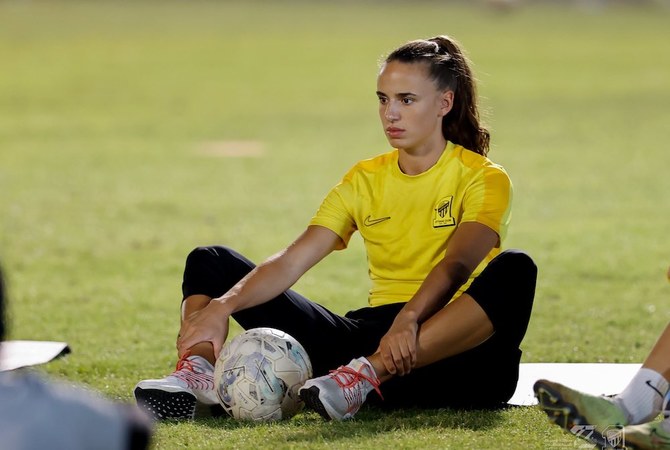

LONDON: Ashleigh Plumptre, the intrepid Al-Ittihad center-back, admits she is not easily starstruck, but there is one sportswoman, that if they were to meet, would make her quite “nervous.”
Since arriving in Saudi Arabia in September, she has not rushed to seek autographs or take selfies with icons such as Karim Benzema or N’Golo Kante, prominent figures in her club’s men’s team.
Her motivation for making the transition from her hometown club Leicester City to Jeddah transcends financial incentives and fame.
According to Plumptre, the move is about enriching her life.
However, the prospect of encountering one particular sports star, Tunisia’s tennis player Ons Jabeur, makes Plumptre giddy with excitement, akin to a child on Christmas morning.
“When I said I’m not easily starstruck, I think if I saw her I’d be very nervous,” Plumptre told Arab News over Zoom, a smile lighting up her face. “I can’t even fathom that.”
Plumptre is desperate to realize a childhood dream by competing at the Olympics.
Her choice of Jabeur as the person she would most like to meet at the Olympics is fitting. Both Plumptre and Jabeur are trailblazers in their own right. Plumptre became the highest-profile women’s player in the Saudi Women’s Premier League when she joined Al-Ittihad in September.
Jabeur is a three-time grand slam finalist, who is continually breaking barriers for Arab and African athletes by excelling in a sport dominated by Americans and Europeans.
“I just think she’s an incredibly inspirational human, never mind a tennis player,” Plumptre said.
A coveted meeting with Jabeur hinges on Nigeria’s success in the Confederation of African Football Women’s Olympic qualifying tournament.
Two “very difficult” home-and-away ties against Cameroon await the Super Falcons in the third round in February.
If they win those and fourth-round matches against either Tanzania or South Africa in April, they would seal one of two African berths in the Paris 2024 women’s football tournament.
“Would it be the pinnacle of my career? Yes,” Plumptre continued. “It makes me smile just thinking about the Olympics. I love helping people and the only thing I was really interested in at school was human biology.
“I was just fascinated with the human body. My dream when I was younger was to be a doctor on an Olympic team because I love the Olympics.”
Plumptre has already experienced footballing nirvana, having performed admirably at her maiden World Cup in Australia and New Zealand in the summer.
She was instrumental in Nigeria reaching the last 16, beating the co-hosts and eventual semifinalists Australia in the group stage.
“It was a crazy, crazy experience, but one that I will always cherish,” Plumptre said.
The magnitude of the tournament prompted her to start a diary, a departure from her normal habits, capturing her emotions and experiences during this extraordinary journey.
“I was like, ‘I want to remember this for the rest of my life,’” she said.
Her diary would surely be a compelling read, documenting triumph and adversity.
Plumptre battled tendinitis, affecting her ability to train properly during the tournament. Yet, she persevered, displaying mental strength that surpassed her expectations. In the last-16 tie against heavily fancied England, she hit the crossbar as the Super Falcons pushed for victory.
However, with the score locked at 0-0 after 120 pulsating minutes, the Lionesses would win the resultant penalty shootout 4-2.
Despite the agonizing defeat, Plumptre’s enduring emotion is one of immense pride.
“It’s made me realize I can mentally push through things that I just didn’t think I could,” she said.
Plumptre’s decision to represent Nigeria over the Lionesses epitomizes her unwavering pursuit of inner fulfillment, both in life and football. Despite winning 30 caps across England’s youth teams, she never received a call-up to the senior squad.
After Leicester City’s 2021 FA Women’s Championship triumph, Plumptre contemplated her future goals. At the dining table one day, she pondered, “Well, what else do I care about?”
Motivated partly by her half-sister Bayleigh’s experience with racism at school, Plumptre explored her Nigerian heritage. Identifying as mixed race while Bayleigh, 13, identifies as black, they share the same black father, Tim, and different white mothers. The decision to represent Nigeria provided an opportunity for Plumptre to teach both herself and Bayleigh about their ancestry.
With 15 caps for Nigeria since 2022, Plumptre harbors no regrets about turning her back on the European champions and World Cup runners-up.
“I just feel like if I were to have made that decision, everything from then on would have been different,” Plumptre said. “And would it have been what I was meant to do? I really don’t think so.”
She enjoyed playing alongside Lionesses including Keira Walsh, Alessia Russo, and Georgia Stanway in the England age-group ranks, though.
“I’m very much in support of them doing well as I know a lot of them and they’re good people.”


