

Greece approves new law granting undocumented migrants residence rights, provided they have a job

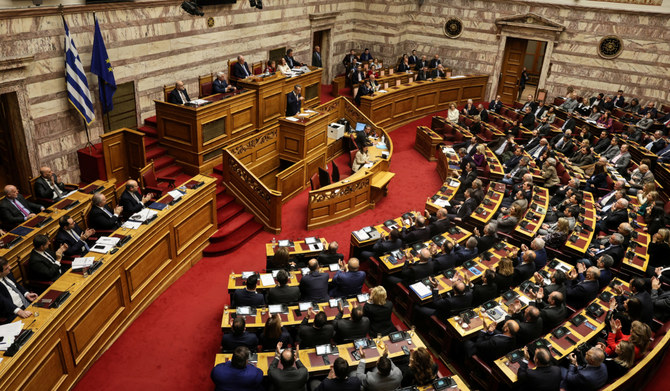
Greek Prime Minister Kyriakos Mitsotakis addresses lawmakers ahead of a parliament vote on the 2024 budget, in the Greek parliament in Athens, Greece December 17, 2023. (REUTERS)
Short Url
Updated 20 December 2023
Follow

Greece approves new law granting undocumented migrants residence rights, provided they have a job

  • In a joint statement, the International Organization for Migration and the UNHCR described the bill as “a positive example of political will to lift the barriers that render people invisible and marginalized”
  • The Mediterranean’s deadliest shipwreck in living memory occurred on April 18, 2015, when an overcrowded fishing boat collided off Libya with a freighter trying to come to its rescue

ATHENS, Greece: Greece’s parliament on Tuesday overwhelmingly approved new legislation that will grant tens of thousands of undocumented migrants residence and work permits amid a shortage of unskilled labor.
The law drafted by the center-right government links the right to residence with proof of employment. According to the labor ministry, it will affect some 30,000 people, many of them agricultural laborers.
The United Nations migration and refugee agencies praised the new law, which applies to migrants who have been living in Greece without residence permits for at least three years up to the end of November. It will not cover later arrivals.
Lawmakers in the 300-member parliament voted 262 in favor of the law — despite grumbling from the governing New Democracy’s right wing and with the backing of leftwing opposition parties.
New Democracy had threatened to expel any of its lawmakers who didn’t back the measures — making a single exception for a former prime minister who had strongly criticized the bill.
Speaking after the vote, Migration Minister Dimitris Kairidis praised the cross-party consensus, saying it would help address market demand for less skilled workers. He said the government seeks to blend “strict border controls and fighting (migrant trafficking) with facilitating legal migration” according to Greece’s needs.
He said the new law would not allow for illegal gain of Greek citizenship or family reunification rights, and the permits would be contingent on migrants’ continued employment.
In a joint statement, the International Organization for Migration and the UNHCR described the bill as “a positive example of political will to lift the barriers that render people invisible and marginalized.”
The statement said it would benefit Greece’s economy while protecting migrants from exploitation by legalizing their employment. The two agencies also hailed the provision that reduces the wait from six to two months for asylum-seekers who want to enter the Greek labor market.
Located in the European Union’s southeastern corner on the Mediterranean Sea, Greece remains a key entry point for people seeking a better life in the EU. Most cross in small boats from neighboring Turkiye to Greece’s eastern Aegean islands.
Despite a drastic drop in arrivals from the peak of nearly 1 million in 2015, some 45,000 people reached Greece so far this year, the highest number in four years. While many are granted legal residence as refugees, others remain illegally in the country for years, blending into the gray economy.
In June, hundreds of people are believed to have died after a battered trawler carrying up to 750 people from Libya to Italy foundered off southwestern Greece.
The Mediterranean’s deadliest shipwreck in living memory occurred on April 18, 2015, when an overcrowded fishing boat collided off Libya with a freighter trying to come to its rescue. Only 28 people survived. Forensic experts concluded that there were originally 1,100 people on board.


Thai border clashes hit tourism at Cambodia’s Angkor temples

Updated 3 sec ago
Follow

Thai border clashes hit tourism at Cambodia’s Angkor temples

SIEM REAP: Chasing visitors around Cambodia’s Angkor temple ruins to offer his services, tour guide Bun Ratana says he has had little work since deadly clashes with Thailand broke out, despite it being high season.
The UNESCO heritage site lies in Siem Reap city, just a two-hour drive from the Thai border, which for more than two weeks has been roiled by military combat that has killed dozens.
Travel cancelations due to the conflict have left the centuries-old stone structures — Cambodia’s top tourist attraction — unusually quiet and businesses desperate.
With more than 10 canceled tours in December alone, Bun Ratana said his income has plunged by around 80 percent, to just $150, compared to the same month last year.
He blamed the renewed fighting, rooted in a border dispute dating to the colonial era.
But he is hopeful tourists will return to the Angkor archaeological park — home to scores of temple ruins from the Khmer Empire, including the Bayon Temple and top attraction, Angkor Wat.
“Some tourists are scared, but here in Siem Reap it is safe,” Bun Ratana told AFP.
After the dispute flared with fresh fighting in May, the neighbors shuttered overland crossings.
Tour operators, vendors and drivers in Siem Reap and Bangkok say the closures and renewed clashes in July and this month have sharply hit business.
Founder of tour agency Journey Cambodia, Ream Boret, told AFP bookings were down.
Outside Angkor Wat, tuk-tuk driver Nov Mao said his income had halved since the clashes began.
- ‘They may be scared’ -
Tourism makes up around a tenth of Cambodia’s GDP, with a record-breaking 6.7 million arrivals last year.
But ticket sales to Angkor were down at least 17 percent year-on-year from June to November, according to Angkor Enterprise — spiralling after July’s five-day clashes killed dozens.
Unlike past Decembers, quietness has fallen over the park, as local and foreign tourists have “disappeared,” said T-shirt vendor Run Kea.
“I think they may be scared... I am scared too,” the 40-year-old said, adding she was only making a fraction of her usual earnings.
Around 420 kilometers (260 miles) away in the Thai capital, minivans that once plied the six-hour route shuttling tourists to Angkor Wat sit idle since border crossings were closed to tourists earlier this year.
Tour agencies told AFP that bus trips to the border had ceased, and uncertainty had hit tourism in Thailand too.
Thai owner of Lampoo Ocean Travel Prasit Chankliang said when customers ask if they could travel to Cambodia, “we can only tell them that they can’t go — and there’s nothing we can tell them about when they might be able to travel again.”

- ‘Very safe’ -

Arnaud Darc, hospitality industry expert and CEO of Cambodia-based Thalias Group, said the local tourism industry relied heavily on the Angkor temples and a few entry points to the country, especially overland routes via neighboring nations.
“Disruption is concentrated in overland regional travel, not in global demand for Cambodia,” he said, citing fewer Thai visitors but more Chinese arrivals.
Several foreign tourists at Cambodia’s most famous temple complex told AFP they had not been put off traveling by the conflict.
An American tourist called Dorothy said she wasn’t worried about visiting Angkor as she was clued in to travel logistics and border rules, saying she felt “very safe.”
“We are very happy that we came here and we feel safe at the moment,” said German visitor Kay Florek, who arrived in Siem Reap with her family despite hearing news of combat.
But experts say fear persists, which has been worsened by widespread media reports and a blockbuster movie about Internet scam networks run by criminal groups across the region.
At cyberscam compounds, mostly in Cambodia and Myanmar, thousands of willing and trafficked scammers con victims out of billions of dollars a year with romance and investment schemes, monitors say.
“Sadly, the reality on the ground is that Cambodia’s top tourism hotspots are safe — but the headlines have done damage already,” said Hannah Pearson, director of Southeast Asia tourism consultancy Pear Anderson.
Like Cambodia, she said Thailand had also recorded fewer visitors this year, “triggered initially by worries over scam centers” and worsened by the border clashes.
Director of Siem Reap’s provincial tourism department Thim Sereyvudh admitted that Cambodia’s reputation as a host of transnational scammers had hurt the industry.
But he was confident tourists would return to Angkor Wat after the fighting ceased.
“The sooner the war ends,” he said, “the sooner they will come back.”