Czechs extend Slovak border checks to curb migration

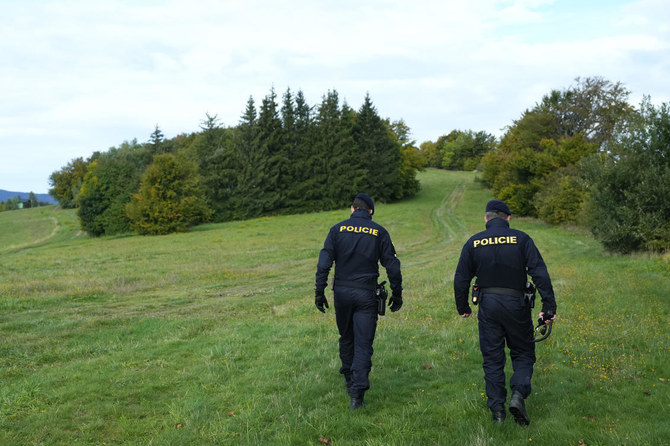
Czech policemen walk on patrol at the border with Slovakia near Stary Hrozenkov, Czech Republic, on Sept. 29, 2022. (AP/File)
Short Url
Updated 01 November 2023
Follow

Czechs extend Slovak border checks to curb migration

  • Slovakia has recently seen growth in the number of migrants and asylum seekers
  • Slovakia detected approximately 24,500 undocumented migrants from January to August

PRAGUE: The Czech government said Wednesday it would extend random checks on the country’s border with Slovakia by 20 days until November 22 as it seeks to curb illegal migration.
Austria, the Czech Republic and Poland introduced checks on their border with Slovakia in early October, then prolonged them to November 2.
Slovakia has recently seen growth in the number of migrants and asylum seekers coming largely from Serbia via Hungary and heading to wealthier Western European countries.
“Until a really efficient protection of the EU’s outer border is in place, we will have to tackle the impact of illegal migration on the inner borders of the Schengen area,” Czech Interior Minister Vit Rakusan said on X, formerly Twitter.
Slovakia detected approximately 24,500 undocumented migrants from January to August, compared with 10,900 for all of last year.
It launched checks on the Hungarian border on October 5 in response to the measure adopted by Prague, Vienna and Warsaw the day before.
Austrian and Polish authorities were not immediately available to comment on Prague’s latest move.
Germany, where many of the migrants and asylum seekers are heading, tightened checks on its eastern border with the Czech Republic and Poland at the end of September.
Austria also announced checks on its border with the Czech Republic on October 17.
The countries tightening controls are all members of the European Union and of Europe’s Schengen open-borders zone.
The reintroduction of border checks in the Schengen Area is permitted in exceptional circumstances, and Brussels must be notified before implementation.


Indonesia strips citizenship of ex-officers who joined Russian mercenary forces

Updated 10 sec ago
Follow

Indonesia strips citizenship of ex-officers who joined Russian mercenary forces

  • Muhammad Rio, Satria Kumbara went viral after claiming they were fighting in Ukraine
  • Both were dishonorably discharged, Indonesian police and navy have separately confirmed

JAKARTA: Indonesia has revoked the citizenship of former security forces personnel who joined Russian mercenary forces, the government said, addressing the cases of a former policeman and a navy officer who have reportedly joined the fighting in Ukraine.

Muhammad Rio, a former member of Indonesia’s paramilitary police force Brimob in Aceh province, said he was recruited by Russia’s Wagner Group in videos and photos that have widely circulated since last week. 

His case followed that of former Indonesian marine Satria Kumbara, who also went viral last year after uploading clips on TikTok, where he claimed to be fighting alongside Russian forces in Ukraine. 

Their Indonesian citizenships have been revoked, said Law Minister Supratman Andi Atgas. 

“Anyone, be it a Brimob officer or a civilian, who joins a foreign military without the president’s permission will automatically lose his citizenship … That is clearly stipulated in the law,” he told reporters. 

According to Atgas, the Indonesians who joined Russian mercenary forces did so discreetly, had their own contacts and never reported to the local Indonesian Embassy following their arrival, which makes them “difficult to track down.” 

After the latest case of Rio made headlines across Indonesia, Aceh police spokesperson Joko Krisdiyanto issued a statement over the weekend, saying that the ex-policeman had deserted his post since Dec. 8 and left Indonesia on Dec. 18.  

On Jan. 7, he sent photos and videos to a group chat comprising fellow police officers, “showing that the concerned person has joined the Russian mercenary division, while also describing the registration process and the salary received in Russian ruble converted to Indonesian rupiah.” 

He was slapped with a dishonorable discharge on Jan. 9 over a series of misconduct, including his alleged involvement with the Russian military, Krisdiyanto said. 

The Indonesian Navy has also confirmed that ex-marine Kumbara was dishonorably discharged in 2023.