


Authorities warn that more could die as forecasts suggest a scarcity of rains and rising heat
“El Nino is making an already dire situation worse,” said Tinashe Farawo, spokesman for the Zimbabwe National Parks and Wildlife Management Authority
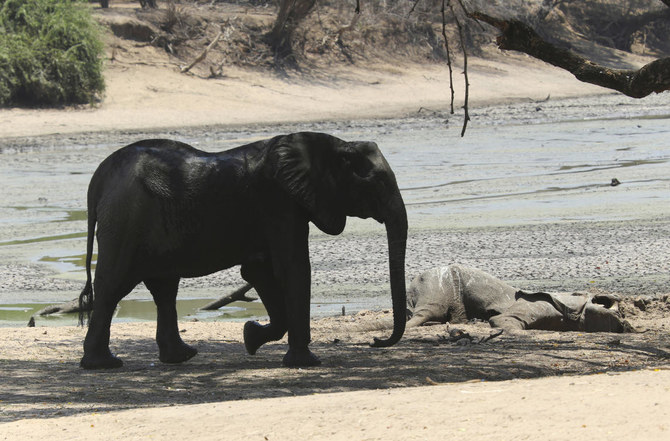
HARARE, Zimbabwe: At least 100 elephants have died in Zimbabwe’s largest national park in recent weeks because of drought, their carcasses a grisly sign of what wildlife authorities and conservation groups say is the impact of climate change and the El Nino weather phenomenon.
Authorities warn that more could die as forecasts suggest a scarcity of rains and rising heat in parts of the southern African nation including Hwange National Park. The International Fund for Animal Welfare has described it as a crisis for elephants and other animals.
“El Nino is making an already dire situation worse,” said Tinashe Farawo, spokesman for the Zimbabwe National Parks and Wildlife Management Authority.
El Nino is a natural and recurring weather phenomenon that warms parts of the Pacific, affecting weather patterns around the world. While this year’s El Nino brought deadly floods to East Africa recently, it is expected to cause below-average rainfall across southern Africa.
That has already been felt in Zimbabwe, where the rainy season began weeks later than usual. While some rain has now fallen, the forecasts are generally for a dry, hot summer ahead.
Studies indicate that climate change may be making El Ninos stronger, leading to more extreme consequences.
Authorities fear a repeat of 2019, when more than 200 elephants in Hwange died in a severe drought.
“This phenomenon is recurring,” said Phillip Kuvawoga, a landscape program director at the International Fund for Animal Welfare, which raised the alarm for Hwange’s elephants in a report this month.
Parks agency spokesperson Farawo posted a video on social media site X, formerly Twitter, showing a young elephant struggling for its life after becoming stuck in mud in a water hole that had partly dried up in Hwange.
“The most affected elephants are the young, elderly and sick that can’t travel long distances to find water,” Farawo said. He said an average-sized elephant needs a daily water intake of about 200 liters (52 gallons).
Park rangers remove the tusks from dead elephants where they can for safekeeping and so the carcasses don’t attract poachers.
Hwange is home to around 45,000 elephants along with more than 100 other mammal species and 400 bird species.
Zimbabwe’s rainy season once started reliably in October and ran through to March. It has become erratic in recent years and conservationists have noticed longer, more severe dry spells.
“Our region will have significantly less rainfall, so the dry spell could return soon because of El Nino,” said Trevor Lane, director of The Bhejane Trust, a conservation group which assists Zimbabwe’s parks agency.
He said his organization has been pumping 1.5 million liters of water into Hwange’s waterholes daily from over 50 boreholes it manages in partnership with the parks agency. The 14,500-square-kilometer (5,600-square-mile) park, which doesn’t have a major river flowing through it, has just over 100 solar-powered boreholes that pump water for the animals.
Saving elephants is not just for the animals’ sake, conservationists say. They are a key ally in fighting climate change through the ecosystem by dispersing vegetation over long distances through dung that contains plant seeds, enabling forests to spread, regenerate and flourish. Trees suck planet-warming carbon dioxide out of the atmosphere.
“They perform a far bigger role than humans in reforestation,” Lane said. “That is one of the reasons we fight to keep elephants alive.”
At least 100 elephants have died in Zimbabwe’s largest national park in recent weeks because of drought, their carcasses a grisly sign of what wildlife authorities and conservation groups say is the impact of climate change and the El Nino weather phenomenon. (AP/File)


