

Pakistan polls regulator releases updated voter numbers ahead of general elections

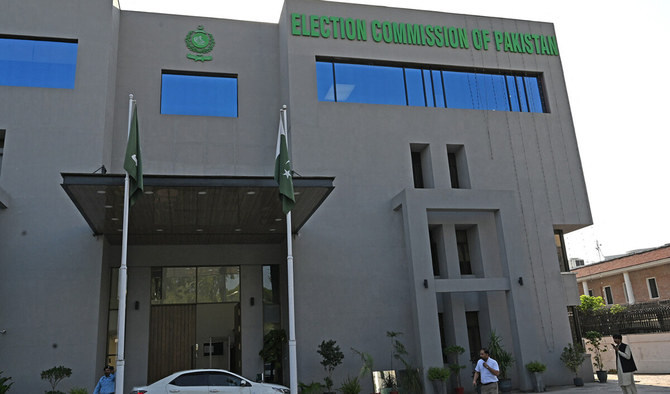
A security personnel, left, stands guard at the headquarters of Election Commission of Pakistan in Islamabad on September 21, 2023. (AFP/File)
Short Url
Updated 18 December 2023
Follow

Pakistan polls regulator releases updated voter numbers ahead of general elections

  • Total registered voters stand at 128.59 million, with 69.26 million men, 59.32 million women
  • For a Pakistani election to be valid, at least 10% voters in a constituency need to be women

ISLAMABAD: The Election Commission of Pakistan (ECP) has released new figures for registered voters across the nation ahead of general elections scheduled for Feb. 8, state-run Radio Pakistan reported on Monday.

The ECP on Friday issued the schedule for general elections on Feb. 8 after instructions from the Supreme Court following weeks of widespread speculation that polls could be delayed.

Elections in the politically and economically troubled South Asian nation were due to be held in November but were delayed due to fresh demarcation of constituencies under a new census.

“As per the latest voters' data unveiled by the ECP, the total number of registered voters stands at 128,585,760 [128.59 million],” Radio Pakistan said.

“Within this demographic, 69,263,704 [69.26 million] individuals identify as male, constituting a significant portion of the electorate. Simultaneously, the female voter count is recorded at 59,322,056 [59.32 million], showcasing a strong and active participation of women in the electoral process.”

The total number of registered voters in the country in 2018, when the last general elections were held, was nearly 106 million.

Last month, Human Rights Watch said there was a “large gender gap” in voters in Pakistan, a country in which women make up 49 percent of the population but are far behind men in voter registration.

“10 million more men than women have registered to vote in the general election scheduled for February 8, 2024,” HRW said in its report in November. “This is a large gender gap in a country in which women make up 49 percent of the population.”

The Human Rights World report said though voting was a constitutional right for all adults in Pakistan, in past elections millions of women had been effectively barred from voting.

“Particularly in Pakistan’s most conservative constituencies, political party officials, local elders, and other powerful figures have colluded in broadcasting messages telling women not to vote and sometimes physically preventing them from polling stations,” the report added.

“Courts have been slow to uphold legal challenges to these practices”

In Pakistan, voters need to have a Computerized National Identification Card (CNIC) to be eligible to vote but despite public awareness campaigns and mobile registration centers meant to make it easier for women to obtain ID cards, many still cannot do so because of restrictions on movement and barriers to education. Not having a CNIC also deprives women of access to other essential services and benefits such as government loans and a monthly social security stipend under the Benazir Income Support Program.

In 2017, Pakistan enacted the Elections Act to address some of the reasons for women’s disenfranchisement. The law stipulates that for an election to be valid, at least 10 percent of the voters in any constituency had to be women. But this low percentage has done little to address the disparity, according to experts.

Pakistan’s constitution permits the government to achieve equality of citizens by adopting special provisions for the protection of women. The United Nations Convention on the Elimination of All Forms of Discrimination against Women (CEDAW) obligates governments to “take all appropriate measures to eliminate discrimination against women in political and public life,” including in elections.

The CEDAW Committee, in a General Recommendation, calls for “full and equal participation of women” in democratic political systems.

“Governments and parliaments should reflect the makeup of society as a whole; millions of missing women voters means their concerns are poorly represented in Pakistan,” HRW said.

“As the country approaches another general election, the Pakistan government should take urgent steps to ensure women can participate on an equal basis in the electoral process.”


US freezes visa processing for 75 countries, media reports Pakistan included

Updated 14 January 2026
Follow

US freezes visa processing for 75 countries, media reports Pakistan included

  • State Department announces indefinite pause on immigrant visas starting Jan 21
  • Move underscores Trump’s hard-line immigration push despite close Pakistan-US ties

ISLAMABAD: The United States will pause immigrant visa processing for applicants from 75 countries starting Jan. 21, the State Department said on Wednesday, with Fox News and other media outlets reporting that Pakistan is among the countries affected by the indefinite suspension.

The move comes as the Trump administration presses ahead with a broad immigration crackdown, with Pakistan included among the affected countries despite strong ongoing diplomatic engagement between Islamabad and Washington on economic cooperation, regional diplomacy and security matters.

Fox News, citing an internal State Department memo, said US embassies had been instructed to refuse immigrant visas under existing law while Washington reassesses screening and vetting procedures. The report said the pause would apply indefinitely and covers countries across Asia, Africa, the Middle East, Europe and Latin America.

“The State Department will pause immigrant visa processing from 75 countries whose migrants take welfare from the American people at unacceptable rates. The freeze will remain active until the US can ensure that new immigrants will not extract wealth from the American people,” the Department of State said in a post on X.

According to Fox News and Pakistan news outlets like Dawn, the list of affected countries includes Pakistan, Afghanistan, Bangladesh, Iran, Iraq, Egypt, Nigeria, Russia, Somalia, Brazil and Thailand, among others. 

“The suspension could delay travel, study, and work plans for thousands of Pakistanis who annually seek US visas. Pakistani consulates in the US are expected to provide guidance to affected applicants in the coming days,” Dawn reported.

A State Department spokesman declined comment when Arab News reached out via email to confirm if Pakistan was on the list. 

The Department has not publicly released the full list of countries or clarified which visa categories would be affected, nor has it provided a timeline for when processing could resume.

Trump has made immigration enforcement a central pillar of his agenda since returning to office last year, reviving and expanding the use of the “public charge” provision of US immigration law to restrict entry by migrants deemed likely to rely on public benefits.

During his previous term as president, Trump imposed sweeping travel restrictions on several Muslim-majority countries, a policy widely referred to as a “Muslim ban,” which was challenged in US courts before a revised version was upheld by the Supreme Court. That policy was later rescinded under the President Joe Biden administration.

The latest visa freeze marks a renewed hardening of US immigration policy, raising uncertainty for migrants from affected countries as Washington reassesses its screening and vetting procedures. 

The freeze on visas comes amid an intensifying crackdown on immigration enforcement by the Trump administration. In Minneapolis last week, a US Immigration and Customs Enforcement (ICE) agent shot and killed 37-year-old Renee Good, a US citizen, during a federal operation, an incident that has drawn nationwide protests and scrutiny of ICE tactics. Family members and local officials have challenged the federal account of the shooting, even as Department of Homeland Security officials defended the agent’s actions. The case has prompted resignations by federal prosecutors and heightened debate over the conduct of immigration enforcement under the current administration.