

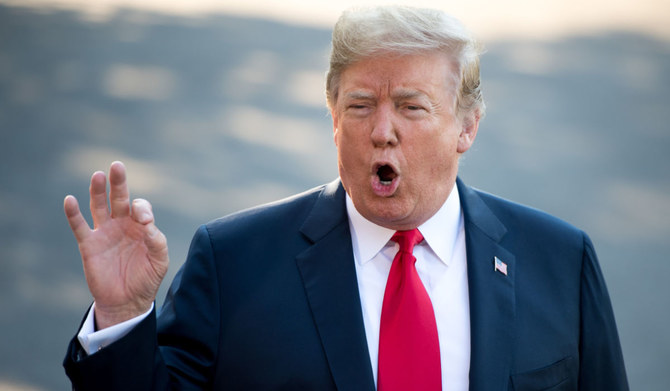
Trump repeats ‘poisoning the blood’ anti-immigrant remark

Donald Trump. (AFP file photo)
Short Url
Updated 17 December 2023
Follow

Trump repeats ‘poisoning the blood’ anti-immigrant remark

  • “They’re poisoning the blood of our country,” Trump told a rally in the city of Durham, adding that immigrants were coming to the US from Asia and Africa in addition to South America. “All over the world they are pouring into our country”

DURHAM, New Hampshire: Donald Trump, the Republican presidential frontrunner, said on Saturday that undocumented immigrants were “poisoning the blood of our country,” repeating language that has previously drawn criticism as xenophobic and echoing of Nazi rhetoric.
Trump made the comments during a campaign event in New Hampshire where he railed against migrant crossings at the US-Mexico border, which hit new highs in September. Trump has promised to crack down on illegal immigration and restrict legal immigration if elected to a second four-year term in office.
“They’re poisoning the blood of our country,” Trump told a rally in the city of Durham, adding that immigrants were coming to the US from Asia and Africa in addition to South America. “All over the world they are pouring into our country.”
Trump used the same “poisoning the blood” language during an interview with The National Pulse, a right-leaning website, that was published in late September. It prompted a rebuke from the Anti-Defamation League, whose leader, Jonathan Greenblatt, called the language “racist, xenophobic and despicable.”
Jonathan Stanley, a Yale professor and author of a book on fascism, said Trump’s repeated use of that language was dangerous. He said Trump’s words echoed the rhetoric of Nazi leader Adolf Hitler, who warned against German blood being poisoned by Jews in his political treatise “Mein Kampf.”
“He is now employing this vocabulary in repetition in rallies. Repeating dangerous speech increases its normalization and the practices it recommends,” Staley said. “This is very concerning talk for the safety of immigrants in the US“
In October Trump campaign spokesperson Steven Cheung had dismissed criticism of the former president’s language as “nonsensical,” arguing that similar language was prevalent in books, news article and on TV. Cheung did not immediately respond to a request for comment about Trump’s remarks on Saturday.


Modi ally proposes social media ban for India’s teens as global debate grows

Updated 54 min 18 sec ago
Follow

Modi ally proposes social media ban for India’s teens as global debate grows

  • India is the world’s second-biggest smartphone market with 750 million devices and a billion Internet users
  • South Asian nation is a key growth market for social media apps and does not set a minimum age for access

NEW DELHI: An ally of Indian Prime Minister Narendra Modi has proposed a bill to ban social media for children, as the world’s biggest market for Meta and YouTube joins a global debate on the impact of social media on young people’s health and safety.
“Not only are our children becoming addicted to social media, but India is also one of the world’s largest producers of data for foreign platforms,” lawmaker L.S.K. Devarayalu said on Friday.
“Based on this data, these companies are creating advanced AI systems, effectively turning Indian users into unpaid data providers, while the ‌strategic and economic ‌benefits are reaped elsewhere,” he said.
Australia last ‌month ⁠became the ‌first country to ban social media for children under 16, blocking access in a move welcomed by many parents and child advocates but criticized by major technology companies and free-speech advocates. France’s National Assembly this week backed legislation to ban children under 15 from social media, while Britain, Denmark and Greece are studying the issue.
Facebook operator Meta, YouTube-parent Alphabet and X did ⁠not respond on Saturday to emails seeking comment on the Indian legislation. Meta has ‌said it backs laws for parental oversight but ‍that “governments considering bans should be careful ‍not to push teens toward less safe, unregulated sites.”
India’s IT ministry ‍did not respond to a request for comment.
India, the world’s second-biggest smartphone market with 750 million devices and a billion Internet users, is a key growth market for social media apps and does not set a minimum age for access.
Devarayalu’s 15-page Social Media (Age Restrictions and Online Safety) Bill, which is not public but was seen by Reuters, says ⁠no one under 16 “shall be permitted to create, maintain, or hold” a social media account and those found to have one should have them disabled.
“We are asking that the entire onus of ensuring users’ age be placed on the social media platforms,” Devarayalu said.
The government’s chief economic adviser attracted attention on Thursday by saying India should draft policies on age-based access limits to tackle “digital addiction.”
Devarayalu’s legislation is a private member’s bill — not proposed to parliament by a federal minister — but such bills often trigger debates in parliament and influence lawmaking.
He is from the ‌Telugu Desam Party, which governs the southern state Andhra Pradesh and is vital to Modi’s coalition government.