

Vast tunnel network in Gaza remains a challenge, say military experts

1 / 2
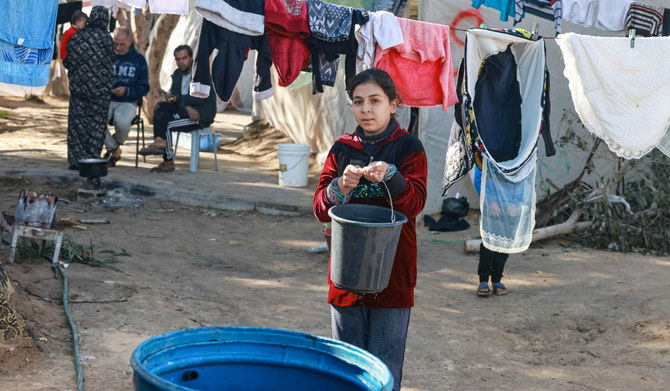
A girl carries a bucket of water at a camp for displaced Palestinians in Rafah in the southern Gaza Strip on Saturday amid continuing battles between Israel and Hamas. (AFP)
2 / 2
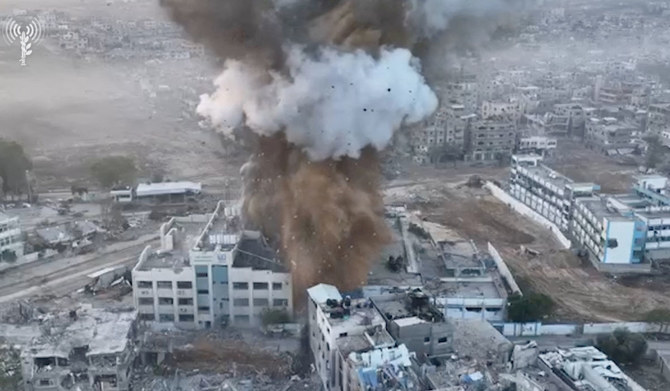
An explosion takes place in what Israel military said was a tunnel at AI Shifa Hospital complex before a temporary truce between Israel and Hamas came into effect, in Gaza, in this still image obtained from a handout video obtained by Reuters on November 24, 2023. (REUTERS)
Short Url
Updated 16 December 2023
Follow

Vast tunnel network in Gaza remains a challenge, say military experts

  • Since the war began, close to 19,000 people have been killed in Gaza, sparking international demands for a ceasefire and even calls from Israel’s staunch ally, the US, for a shift in strategy and more precise strikes

CAIRO: The Israeli army’s death toll in Gaza is already almost twice as high as during a ground offensive in 2014, a reflection of how far it has pushed into the enclave and of Hamas’ effective use of guerrilla tactics and an expanded arsenal.
Israeli military experts, an Israeli commander, and a Hamas source described how the Palestinian group has used a big weapons stockpile, its knowledge of the terrain, and a vast tunnel network to turn Gaza’s streets into a deadly maze.
At their disposal, they have arms ranging from drones rigged with grenades to anti-tank weapons with powerful twin charges.
Since Israel’s ground campaign began in late October, about 110 Israeli soldiers have been killed as tanks and infantry thrust into the cities and refugee camps, based on official Israeli figures. About a quarter were tank crew.
That compares with 66 in the 2014 conflict, when Israel launched a more limited three-week ground incursion but the goal then was not to eliminate Hamas.
“There is no comparing the scope of this war to 2014 when our forces mostly operated no deeper than a kilometer inside Gaza,” said Yaacov Amidror, a retired Israeli major-general and former national security adviser who is now at the Jewish Institute for National Security of America or JINSA.
He said the army “has yet to find a good solution for the tunnels,” a network hugely expanded in the past decade.
Israel’s offensive was launched after the Oct. 7 rampage by Hamas gunmen.
Since the war began, close to 19,000 people have been killed in Gaza, sparking international demands for a ceasefire and even calls from Israel’s staunch ally, the US, for a shift in strategy and more precise strikes.
Prime Minister Benjamin Netanyahu said on Thursday Israel would wage war “until absolute victory.”
Israeli officials have said it could take months before it is complete.
“It has been a challenge from day one,” Ophir Falk, foreign policy adviser to Netanyahu, told Reuters, saying the offensive had come with a “huge price” in Israeli soldiers.
“We know that we wi’ll probably have to pay an additional price to complete the mission.”
Hamas has posted videos on its Telegram channel this month showing fighters with bodycams weaving through buildings to launch shoulder-held rockets at armored vehicles. One of them, posted on Dec. 7, was from Shejaiya, east of Gaza City, an area where both sides reported heavy fighting.
In another post on Dec. 5, a camera emerges from a tunnel, like a periscope, to scan an Israeli camp where soldiers rested. The post said an underground blast later hit it.
Reuters could not verify the videos.
A Hamas source, who spoke to Reuters from inside Gaza on condition of anonymity, said fighters moved as close as possible to launch ambushes, “taking advantage of the land we know like no others do,” often moving around or emerging from tunnels.
“There is a huge discrepancy between our power and their power; we don’t fool ourselves,” he said.
Hamas has not said how many of its fighters have been killed. Israel’s military has said it has killed at least 7,000. The group has previously dismissed the Israeli figure, saying it includes civilians.
Hamas spokespeople outside Gaza did not immediately respond to Reuters requests for comment on this article.
An Israeli commander who fought in 2014 said the expanded scope of this operation meant more troops were on the ground, giving Hamas the “defender’s advantages,” so higher troop casualties were to be expected.
Israel’s military does not release troop numbers or other operational details.
Israel’s Channel 12 television showed one army reservist unit, wary of booby-trapped doors, smashing through the wall of a building to enter a room to discover a munitions cache.
Mirroring tactics used in 2014, Israel’s military has posted images on social media showing routes smashed through built-up areas by bulldozers so troops can avoid existing roads that might have land mines.
Even in some districts in north Gaza where many buildings have been pounded into rubble, bouts of fierce fighting have persisted.
“Hamas made some huge steps to build up its force since 2014,” said Eyal Pinko, a former senior official with Israel’s intelligence services who is now at Bar Ilan University’s Begin-Sadat Center for Strategic Studies.
He said some advanced arms, such as Russian-designed Kornet anti-tank missiles, were smuggled in with the help Iran.
But he said Hamas had mastered building other weapons in Gaza, such as RPG-7 rocket-propelled grenades, and the militants now had a bigger munitions reserve.
Hamas posts have said the group’s weaponry includes “tandem” anti-tank weapons with two charges to pierce armor, which Pinko also said was in the militants’ arsenal.
Hamas videos often show big blasts when vehicles are hit.
Israeli military experts said a blast did not mean a vehicle was destroyed as they said it could also be caused by defensive systems that exploded to halt incoming projectiles.
Ashraf Abouelhoul, the managing editor of Egypt’s Al-Ahram daily who previously worked in Gaza and is a specialist on Palestinian affairs, said militants moved as close as possible to launch missiles and “locally-made projectiles.”
But he said Israeli drones and other tactics were eroding their ability to surprise, even in urban areas.
“City fighting has become more difficult” for the militants, he said.
Israel’s military posted a video this month that it said showed militants emerging from a tunnel under a bombed building before missiles struck both.
“Hamas may post their new weapons and tactics, but in principle, it remains a guerrilla resistance movement,” said Alexander Grinberg, a former Israeli military intelligence officer with the Jerusalem Institute for Strategy and Security.


Aoun reassures Lebanon that risk of war is ‘fading’ in year-end message

Lebanese President Joseph Aoun. (File/AFP)
Updated 31 December 2025
Follow

Aoun reassures Lebanon that risk of war is ‘fading’ in year-end message

  • Israeli military spokesperson said it targeted 380 armed operatives, 950 military sites in Lebanon in past year
  • Beirut’s southern suburb residents pledge to avoid celebratory gunfire on New Year’s Eve

BEIRUT: Lebanese President Joseph Aoun on Wednesday sought to reassure citizens in his year-end address, saying “the overall atmosphere remains positive and the risk of war is fading,” amid widespread concern over a possible Israeli escalation against Hezbollah.

Fear of renewed attacks followed Israeli criticism of a Lebanese Army weapons-confiscation operation that is set to enter its second phase at the start of the 2026. The plan include the expansion from areas north of the Litani River to the Awali River, after the first phase was completed south of the Litani.

President Aoun cautioned that this does not mean “completely eliminating the risk of war,” stressing that “work is underway with various friendly and brotherly countries to completely neutralize the threat of war.”

Addressing Internal Security officials, Aoun said that the “situation is among the best,” noting that this assessment has been echoed by foreign visitors to Lebanon, despite the strain caused by large numbers of Syrian and Palestinian refugees.

He added that security forces were fully carrying out their duties and solving crimes with notable speed, pointing to the successful visit of Pope Leo XIV earlier this year as further evidence of progress.

On Monday, Egyptian Ambassador to Lebanon Alaa Moussa stressed during a Beirut press conference that implementing “international agreements and resolutions, foremost among them the Nov. 27, 2014 agreement and Resolution 1701, constitutes the fundamental approach to sparing Lebanon further security tensions,” speaking of “dire consequences that could result from continued escalation.”

The Egyptian diplomat indicated that “there are no hidden warnings or threats directed at Lebanon, but rather a clear commitment to the agreements signed by the concerned parties, which must be fully implemented by everyone.”

The ambassador stated that his country, under the directives of President Abdel Fattah El-Sisi, is “exerting intensive efforts to reduce tensions in southern Lebanon and the region in general, through active diplomatic contacts led by the Minister of Foreign Affairs Badr Abdelatty with relevant regional and international parties.”

Israeli military spokesman Avichai Adraee published on Wednesday a summary of Israeli attacks on Hezbollah in Lebanon in 2025.

“The Army targeted approximately 380 armed operatives, including Ali Tabatabai (chief of staff), Hassan Kamal (responsible for anti-tank missiles on the southern front), Abbas Hassan Karky (logistics officer in the southern command), and Khodr Saeed Hashem (commander of the naval force in the Radwan Unit),” he said.

“It also attacked approximately 950 military targets, including 210 launch sites and weapons depots, 140 military buildings, and about 60 tunnel entrances,” Adraee added.

In the statement, he accused Hezbollah of committing about 1,920 ceasefire violations and said the military would continue its raids and targeting operations in the new year.

UNIFIL Com. Gen. Diodato Abagnara said in his end-of-the-year message that “UNIFIL will continue to support Lebanon and Israel in implementing their obligations under Resolution 1701, building on the stability achieved in 2025 and strengthening efforts toward a lasting peace.”

As part of the weapons restriction plan, on Tuesday, the Fatah movement — the Palestinian National Security Forces in Lebanon — handed over a new batch of heavy and medium weapons from the Ain Al-Hilweh Palestinian refugee camp to the Lebanese Army in four trucks, away from the media.

This is the second batch of weapons to be handed over from the camp, which is the largest Palestinian refugee camp in Lebanon. It represents the fifth phase of the Palestinian weapons handover process in the camps, four of which were completed between Aug. 21 and Sept. 13, 2025, encompassing nine camps, including Ain Al-Hilweh.

The handover follows and implements an agreement reached between Aoun and Palestinian President Mahmoud Abbas after the latter’s visit to Lebanon in May.

Abbas had announced “the Palestinian Authority’s support for the Lebanese state’s plan to extend its authority over all Lebanese territory, including the Palestinian camps.”

Hamas continues to refuse to hand over its weapons to the Lebanese Army, while Hezbollah maintains its weapons north of the Litani River.

The Lebanese Army implemented “exceptional security measures in various Lebanese regions on New Year’s Eve, with the aim of maintaining security.”

It called on citizens to “cooperate with the security measures taken to maintain public safety and prevent incidents,” warning of the consequences of firing weapons, which will be prosecuted as it poses a threat to public safety.

In another measure, authorities announced that gun licenses and traffic permits will be suspended until Jan. 2, 2026.

In Beirut’s southern suburbs, residents signed a pledge as part of an Internal Security Forces campaign against celebratory gunfire on New Year’s Eve, committing not to fire weapons in public and to report violations with photos or videos.