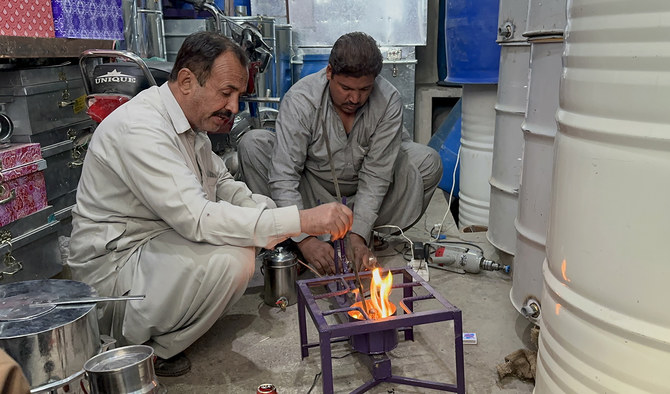

QUETTA: To survive sub-zero temperatures amid regular gas outages and the rising price of firewood in southwestern Pakistan, locals have invented a new gadget born of necessity: mobil oil powered stoves.
To light the device, a one-liter cylindrical container is filled with cheap, used mobil oil and a piece of paper or cloth drenched in mobil oil is placed inside the burner of the stove. Once lit, the used mobil oil continues to drip from the container into the stove burner to provide fuel to the fire, while a small, portable fan, commonly used to cool down microprocessors in personal computers, blows wind into the burner to keep the flame alive.
Since the onset of the winter season in the Balochistan province, of which Quetta is the capital, the new stoves have brought hundreds of customers to the city’s ‘Tak Tak Gali,’ a street famed for locally made water drums, gas and mobil oil stoves and other items forged out of aluminum, iron and steel.
One of the shops at the bazaar is run by 53-year-old Imdad Ali, who earlier this week altered a small stove as the sound of hammers hitting metal reverberated around him.
Ali not only makes the special stoves at the market himself, but also sources them from Gujranwala, an industrial city in the Punjab province that is known for steel and aluminum works.
“Regularly, more than 300 stoves are being sold out in the entire market per day, while local craftsmen are now making 15 to 20 mobil oil stoves with steel on a daily basis,” he told Arab News.
“The Punjab-made stoves are not very reliable due to their thin aluminum sheet, but the local mobil oil stoves we are making here with iron are long lasting and can be used for a large gathering or cooking purposes.”
Meanwhile, customers kept arriving at the market to buy the stoves, complaining of the biting cold weather, gas outages and high prices of firewood.
A stove locally made with iron sells for around Rs6,000 ($21.38), while the version made with aluminum in Gujranwala and other Punjab cities is priced at around Rs5,000 ($17.82).
“In December and January, temperature in Quetta drops below 0°C and people need a source of heating. Thus many people in Quetta and other colder districts of Balochistan are inclining toward these stoves which are very much effective,” Muhammad Imran, 35, who lives on the outskirts of Quetta, told Arab News as he paid for a stove.
“For common people, these stoves are very economical and suitable to use for cooking and other purposes.”
Pakistan discovered natural gas reserves in the Sui area of Balochistan’s Dera Bugti district in 1952, but residents of the impoverished province only started receiving gas in 1970.
The South Asian country has an average per day gas consumption of 4,100 million standard cubic feet per day (mmcfd), while its production increased from 2,923mmcfd to 31,27mmcfd following a recent gas discovery, according to data released by the Petroleum Club of Pakistan this month. The discovery has taken the country’s gas self-sufficiency to 76.26 percent.
But Balochistan, which borders Iran and Afghanistan, sees protests every winter when temperatures drop below 0°C and gas outages become common. Separatist insurgents have for decades been fighting the state over what they say is the unfair exploitation of the province’s vast gas and mineral resources. Common citizens blame the Sui Southern Gas Company (SSGC), a state-owned entity that supplies gas to Sindh and Balochistan provinces, for inadequate gas pressure for consumers of the poor region.
But the mobil oil stoves have provided an alternative to Balochistan’s residents and can keep burning for over four hours with just a liter of used oil, according to manufacturers.
“People in the remote, cold areas of Balochistan, from the Iran border to the Afghan border, are buying these stoves in large numbers, because in rural areas, they have a proper ventilation system in their homes,” Ali said.
“We guide the customers, who are from Quetta and buy these stoves, to connect an outer pipe with these stoves before lighting them inside their homes.”
Environment experts have, however, raised concerns about safety and health hazards associated with using mobil oil for heating rooms and cooking.
Muhammad Ali Kakar, a deputy director at the Balochistan Environmental Protection Authority, said the mobil oil stoves emitted carbon fumes that may cause cancer.
“Our department has started a survey of the markets selling these stoves,” he told Arab News. “We will start action against people selling these anti-health stoves.”
“Though the citizens are pestered with low-gas pressure and are therefore switching to alternative heating resources, there should be an awareness for them that health is more important than using hazardous heating resources.”