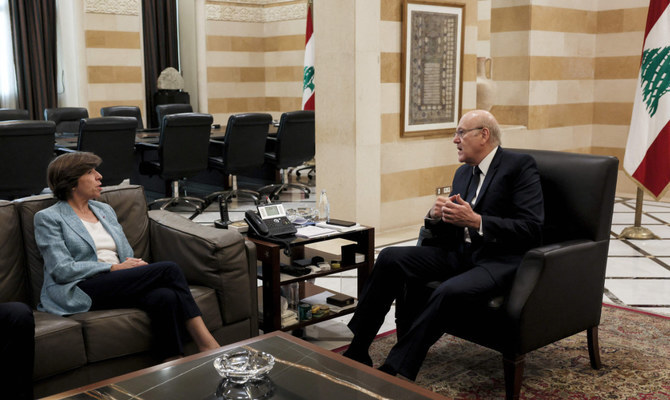
PARIS: France’s foreign minister travels to Lebanon on Saturday as part of diplomatic efforts by President Emmanuel Macron’s government to help contain the Middle East conflict.
Fears of a widening war have been growing, with Iran-backed groups targeting US and allied forces in Iraq and Syria, and daily exchanges of fire along Israel’s border with Lebanon.
“We must avoid a regional eruption,” foreign ministry spokesman Christophe Lemoine said ahead of Foreign Minister Catherine Colonna’s trip.
Colonna will call for “restraint” and “responsibility” to avoid a new front line on the Israeli-Lebanese border, he said.
There have been near-daily cross-border exchanges between Hezbollah, an Iran-backed Hamas ally in Lebanon, and Israel since the Palestinian group’s unprecedented October 7 attacks on Israel that Israeli officials say killed about 1,200 people, mostly civilians.
In response, Israel vowed to destroy Hamas and launched an unrelenting military offensive on Gaza that has left swathes of the besieged Palestinian territory in ruins. The health ministry in the Hamas-run strip says more than 18,700 people have been killed.
Along the Israel-Lebanon border violence has remained relatively limited, with 128 killed in total, including 90 Hezbollah combatants and at least 11 Israelis.
French officials are also seeking the release of the French hostages among the around 240 seized by Hamas militants, as the Israeli army announced Friday that it had recovered the body of French-Israeli hostage Elya Toledano, a 28-year-old seized at a desert rave party when the attack occurred.
Hamas released dozens of hostages in exchange for Palestinian prisoners held by Israel during a week-long truce last month, but several are still being held and others have been found dead.
Colonna said her country was “deeply saddened to hear the Israeli armed forces announce the death of our compatriot Elya Toledano, a Hamas hostage whose body was found in Gaza.”
“We share the grief of his family and loved ones. The release of all hostages is our priority,” she wrote on X.
But Israel has stepped up its shelling while issuing warnings to the Hezbollah leadership.
“If Hezbollah chooses to wage a full-fledged war on us, then it will transform, with its own hands, Beirut and South Lebanon into Gaza and Khan Yunis (a city in southern Gaza),” Prime Minister Benjamin Netanyahu said last week during a visit to troops along the Lebanese border.
Western governments, notably the United States and France, are stepping up behind-the-scenes diplomatic efforts to stop the situation from worsening.
The risk of full-out war is “very real” if the Lebanese side underestimates Israel’s determination to protect its borders in the aftermath of the traumatic October attack, a French diplomatic source said.
But French diplomats and security officials also believe that Israel needs to be reminded that any wider conflict would not guarantee regional security, the source said.
Colonna will therefore “reiterate French appeals for responsibility and restraint,” Lemoine said.
The head of the French external intelligence service, Bernard Emie, gave a similar message when he met Lebanese officials in Beirut last week.
Israel’s current objective is that Hezbollah forces move back from the border by 40 kilometers (25 miles), a Western diplomatic source in Beirut said.
In particular, they want Hezbollah’s elite Al-Radwan unit, equipped with heavy artillery, to back off, said the source, requesting anonymity.
Hezbollah meanwhile says it has no visible presence in the border region.
France maintains that the United Nations Security Council’s resolution 1701, which states that only the official Lebanese army and the UN’s UNIFIL force can be deployed in southern Lebanon, is a promising basis for discussions.
This stance is shared by Israel, but Hezbollah’s second-in-command Naim Qassem said this week that “we won’t discuss any deployment in southern Lebanon with anybody while the attack on Gaza continues.”
The Western diplomatic source said mediation efforts are focusing on settling an ongoing border dispute between both countries, by which Israel would withdraw from farms in the town of Chebaa and from the Lebanese part of the village of GHajjar.
France is the biggest contributor to UNIFIL with 700 soldiers, to whom Colonna could pay a visit on Saturday.
The UN force has been targeted by Israeli fire since the start of the violence, with France condemning “any violation of the safety” of the UN soldiers.
Colonna is scheduled to travel to Israel and the occupied West Bank on Sunday.


![]()

France steps up Mideast effort with FM’s Lebanon trip
Short Url
https://arab.news/4sms6
France steps up Mideast effort with FM’s Lebanon trip
- “We must avoid a regional eruption,” foreign ministry spokesman Christophe Lemoine said ahead of Foreign Minister Catherine Colonna’s trip
- Colonna will call for “restraint” and “responsibility” to avoid a new front line on the Israeli-Lebanese border


Latest updates




© 2026 SAUDI RESEARCH & PUBLISHING COMPANY, All Rights Reserved And subject to Terms of Use Agreement.